

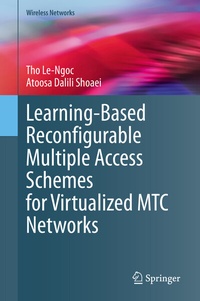
Learning-Based Reconfigurable Multiple Access Schemes for Virtualized MTC Networks
Description

Machine-type communications are expected to account for the dominant share of the traffic in future wireless networks. While in traditional wireless networks, designed for human-type communications, the focus is on support of large packet sizes in downlink, machine-type communication systems deal with heavy uplink traffic. This is due to the nature of the tasks performed by machine-type communication devices, which is mainly reporting measured data or a detected event. Furthermore, in these networks, using the virtualization framework, the network infrastructure can be shared between different applications for which providing isolation is of high importance. To support these unique characteristics of machine-type communications, proper access schemes need to be developed, which is the focus of this book.
This book benefits advanced-level students studying computer science and electrical engineering as a secondary textbook and researchers working in this field. Engineers and practitioners interested in the challenges and practical solutions of integrating MTC in the cloud radio access network of 5G-and-beyond cellular systems will want to purchase this book as well.
More details
Other editions
Additional editions
Persons
Tho Le-Ngoc obtained his B.Eng. (with Distinction) in Electrical Engineering in 1976, his M.Eng. in 1978 from McGill University, Montreal, and his Ph.D. in Digital Communications in 1983 from the University of Ottawa, Canada. During 1977-1982, he was with Spar Aerospace Limited and involved in the development and design of satellite communications systems. During 1982-1985, he was an Engineering Manager of the Radio Group in the Department of Development Engineering of SRTelecom Inc., where he developed the new point-to-multipoint DA-TDMA/TDM Subscriber Radio System SR500. During 1985-2000, he was a Professor at the Department of Electrical and Computer Engineering of Concordia University. Since 2000, he has been with the Department of Electrical and Computer Engineering of McGill University. His research interest is in the area of broadband digital communications. He is a fellow of the Institute of Electrical and Electronics Engineers (IEEE), the Engineering Institute of Canada (EIC), the Canadian Academy of Engineering (CAE) and the Royal Society of Canada (RSC). He is the recipient of the 2004 Canadian Award in Telecommunications Research, and recipient of the IEEE Canada Fessenden Award 2005. He holds a Canada Research Chair (Tier I) on Broadband Access Communications.
Atoosa Dalili Shoaei received the B.Sc. degree in information technology engineering from the Isfahan University of Technology, Isfahan, Iran, in 2009, the M.Sc. degree in information technology engineering from the Amirkabir University of Technology, Tehran, Iran, in 2012, and the Ph.D. degree in communications engineering from McGill University, Montreal, Canada, in 2019. Her main areas of research interests include media access control techniques, Internet of Things, and wireless virtualization. She was a recipient of the McGill Engineering Doctoral Awards (MEDA).
