

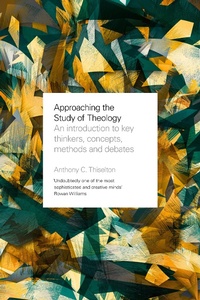
Approaching the Study of Theology
An Introduction to Key Thinkers, Concepts, Methods and Debates
Published on 21. September 2017
256 pages
978-0-281-07760-1 (ISBN)
Description

This introductory guide to philosophy of religion opens with an engaging history of the discipline, mapping the important landmarks and introducing the main areas of debate.
The rest of the book falls into three parts:
Part 1 describes the major approaches that have been developed by scholars over the centuries, which are still relevant today;
Part 2 explains the main concepts and issues, highlighting their significance in the work of major thinkers;
Part 3 provides a helpful glossary of all the key terms that readers need to understand in order to find their way around the subject.
The rest of the book falls into three parts:
Part 1 describes the major approaches that have been developed by scholars over the centuries, which are still relevant today;
Part 2 explains the main concepts and issues, highlighting their significance in the work of major thinkers;
Part 3 provides a helpful glossary of all the key terms that readers need to understand in order to find their way around the subject.
More details
Language
English
Place of publication
London
United Kingdom
Target group
College/higher education
Product notice
Reflowable
ISBN-13
978-0-281-07760-1 (9780281077601)
Copyright in bibliographic data and cover images is held by Nielsen Book Services Limited or by the publishers or by their respective licensors: all rights reserved.
Schweitzer Classification
Other editions
Additional editions
Anthony Thiselton
Approaching the Study of Theology
An Introduction to Key Thinkers, Concepts, Methods and Debates
Book
09/2017
SPCK Publishing
€21.10
Shipment within 10-15 days
Person
Anthony Thiselton is Professor of Christian Theology at the University of Nottingham. He has previously taught at the Universities of Sheffield, Bristol and Durham and is known internationally for his work on hermeneutics and the theory of interpretation.
Content
- Intro
- Introduction: Landmarks in the study of theology
- 1 Biblical roots
- (a) Doctrine of God
- (b) Humankind
- (c) Human alienation from God
- (d) Jesus Christ: Redeemer, Saviour and Lord
- (e) The Holy Spirit
- (f) The Church, the sacraments and other theological themes
- 2 The era of the church fathers (c. ad 100 - c. 500)
- (a) From the apostolic fathers to the Council of Nicaea
- (b) From the Council of Nicaea to ad 500
- 3 The medieval era
- 4 The Reformation and afterwards
- 5 The modern period
- (a) From Schleiermacher to Harnack
- (b) From Barth to Niebuhr
- (c) Four recent Roman Catholic theologians
- (d) Recent Protestant thinkers
- Part 1: Approaches
- 1 Biblical theology
- 2 Hermeneutical theology
- 3 Historical theology
- 4 Moral theology
- 5 Philosophical theology
- 6 Political theology
- 7 Practical theology
- 8 Systematic theology
- 9 Theology of religions
- Part 2: Concepts and issues
- Atonement
- Authority of the Bible
- Catholicism
- Christology
- Ecclesiology
- Eschatology
- Feminist theology
- God, theology of
- Humankind
- Justification
- Liturgy, liturgical theology
- Natural theology
- Orthodoxy, Eastern
- Pentecostalism
- Protestantism
- Resurrection of the dead
- Revelation
- Sin and alienation
- Theodicy
- Trinity, Holy
- Part 3: Key terms
- Agnosticism
- Allegory, allegorical interpretation
- Analogy
- Angels
- Anglicanism
- Antinomianism
- Apocalyptic
- Apologetics
- Apostle
- Apostolic fathers
- Ascension of Christ
- Asceticism
- Assurance
- Athanasian Creed
- Atheism
- Baptism
- Baptists
- Calvinism
- Cappadocian Fathers
- Cataphatic
- Celtic Christianity
- Chalcedon, Council of
- Charismatic
- Communion of saints
- Covenant
- Creation, Creatio ex nihilo
- Creationism
- Creed
- Cross
- Death and mortality
- Death of God theology
- Deification
- Deism
- Demons
- Desert fathers
- Devil
- Dialectical theology
- Dispensationalism
- Dogmatics
- Dualism
- Ecumenical theology
- Election
- Enthusiasm
- Epiphany
- Erastianism
- Eucharist
- Evangelicalism
- Faith, faithfulness
- Fall
- Fideism
- Filioque
- Forgiveness
- Foundationalism
- Fundamental theology
- Fundamentalism
- Gnosticism
- Gospel
- Grace
- Hamartology
- Healing
- Heart
- Heaven
- Heilsgeschichte
- Hell
- Heresy and orthodoxy
- Historical Jesus
- Holiness
- Holy Communion
- Homiletics
- Homoousios
- Hope
- Hypostasis
- Icons
- Image of God
- Immaculate conception
- Immanence
- Immortality
- Incarnation
- Incommensurability
- Intermediate state
- Irresistible grace
- Kairos
- Kenotic theology
- Kingdom of God
- Last Judgment
- Law
- Liberal Protestantism
- Liberation theology
- Logos
- Love
- Lutheranism
- Mediation, Mediator
- Mennonites
- Mercy, divine
- Messiah
- Methodism
- Millennium, millenarianism
- Missiology
- Modernism
- Monism
- Monotheism
- Mysticism
- Narrative theology
- Neo-orthodoxy
- Nicaea, Council of
- Numinous
- Ontological argument
- Open theism
- Original righteousness
- Orthopraxis
- Panentheism
- Pantheism
- Paraclete
- Parousia
- Pietism
- Pluralism, religious
- Pneumatology
- Polytheism
- Postcolonial theology
- Post-liberal theology
- Postmodern theology
- Prayer
- Predestination
- Pre-existence
- Prevenient grace
- Promise, promissory language
- Providence
- Purgatory
- Puritanism
- Queer theology
- Rapture
- Recapitulation
- Reception theory
- Reconciliation
- Redemption
- Reformation
- Repentance
- Sacrament
- Sacrifice
- Sanctification
- Sinless perfection
- Sobernost
- Soteriology
- Soul
- Spirit
- Spirituality
- Subordinationism
- Syncretism
- Teleological argument
- Temptation
- Theism
- Thomism
- Time
- Transcendence
- Transubstantiation
- Unitarianism
- Universalism
- Vatican II
- Wrath of God
- Bibliography
- Search terms for Scripture and patristic references
- Search terms for authors
- Search terms for subjects
