

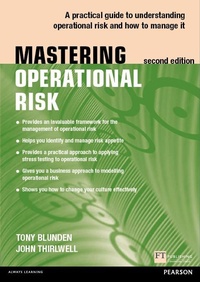
Mastering Operational Risk PDF eBook
A practical guide to understanding operational risk and how to manage it
2nd Edition
Published on 6. September 2013
376 pages
978-0-273-77883-7 (ISBN)
Description

A practical guide, from the basic techniques, through to advanced applications, showing you what operational risk is, and how you can manage it.
Mastering Operational Risk provides a step-by-step guide from the basic elements of operational risk through to advanced applications of operational risk management. Focusing on practical applications, it givesyou the knowledgeneeded to understand what operational risk is and puts in place a workable way of managing it.
More details
Other editions
Additional editions
Tony Blunden | John Thirlwell
Mastering Operational Risk
A practical guide to understanding operational risk and how to manage it
Book
09/2013
2nd Edition
FT Publishing International
€77.49
Shipment within 10-20 days
Content
- Cover
- Contents
- Preface to the first edition
- Preface to the second edition
- Acknowledgements
- The authors
- Part 1: Setting the scene
- Chapter 1: What is operational risk?
- The road to operational risk
- What do we mean by operational risk?
- The boundary issue
- Why operational risk is different from other risks
- Cause and effect
- Measurement and management of operational risk
- Challenges of operational risk management
- Introducing the framework
- Chapter 2: The business case for operational risk management
- Getting management's attention
- Operational risk management as a marketing tool
- Benefits of getting operational risk management right
- Benefits beyond the framework
- Business optimisation
- Conclusion
- Part 2: The framework
- Chapter 3: Governance
- Getting it right at the outset
- The three lines of defence
- Operational risk management framework
- Operational risk policy
- Roles and responsibilities statements
- Glossary
- Timeline
- Chapter 4: Operational risk appetite
- Risk appetite and control appetite
- Risk appetite
- Control appetite
- Chapter 5: Risk and control assessment
- Aims of risk and control assessment
- Prerequisites
- Basic components
- Avoiding common risk identification traps
- Assessing risks
- Owners
- Identifying controls
- What a risk and control assessment looks like
- Action plans
- How to go about a risk and control assessment
- Using risk and control assessments in the business
- Why do risk and control assessments go wrong?
- Summary
- Chapter 6: Events and losses
- Introduction
- What is meant by an event
- Data attributes
- Who reports the data?
- Reporting threshold
- Use of events
- External loss databases
- Using major events
- Timeliness of data
- Summary
- Chapter 7: Indicators
- What do we mean by key?
- Key performance indicators and key risk indicators
- Establishing KRIs and KCIs
- Targets and thresholds
- Periodicity
- Identifying the leading and lagging indicators
- Action plans
- Dashboards
- Summary
- Part 3: Advancing the framework
- Chapter 8: Reporting
- Why reporting matters
- Common issues
- Basic principles
- Report definition
- Reporting styles and techniques
- Dashboard reporting
- Summary
- Chapter 9: Modelling
- About operational risk modelling
- Previous approaches to operational risk modelling
- Towards an inclusive approach
- Distributions and correlations
- Practical problems in combining internal and external data
- Confidence levels and ratings
- Obtaining business benefits from capital modelling
- Modelling qualitative data
- Obtaining business benefits from qualitative modelling
- Summary
- Chapter 10: Stress tests and scenarios
- Introduction
- What are they and what's the difference between them?
- Why use scenarios?
- Problems with scenarios . . .
- . . . and how to do them better
- Governance
- Points to consider before developing scenarios
- Developing a set of practical scenarios
- Preparing for the extreme event
- Typical problems following scenario development
- The near death experience
- Applying scenarios to operational risk management data
- Summary
- Part 4: Mitigation and assurance
- Chapter 11: Business continuity
- Ensuring survival
- Business continuity and risk management
- Policy and governance
- Business impact analysis
- Threat and risk assessment
- The business continuity strategy and plan
- Testing the plan
- Maintenance and continuous improvement
- Chapter 12: Insurance
- Operational risk and insurance
- Insurance speaks to cause
- Buying insurance
- The insurance carrier
- Alternative risk transfer mechanisms
- Conclusion
- Chapter 13: Internal audit - the third line of defence
- Audit and the three lines of defence
- Independent assurance
- Internal and external audit
- Internal audit and risk management oversight
- The role of internal audit
- Audit committees
- Effective internal audit
- Part 5: Practical operational risk management
- Chapter 14: Outsourcing
- What is outsourcing?
- Outsourcing - transforming operational risk
- Deciding to outsource
- The outsourcing project - getting it right at the start
- Risk assessment
- Some tips on the request for proposal
- Selecting the provider
- Some tips on service level agreements
- Managing the project
- Exit strategy
- Chapter 15: Culture and people risk
- Why it's all about people
- How to embed a healthy operational risk culture
- Mitigating people risks
- Succession planning
- The human resources department
- Key people risk indicators
- Chapter 16: Reputation risk
- What is reputation?
- Stakeholders
- Reputation and brand
- What is reputation risk?
- Valuing reputation and reputation risk
- How can reputation be damaged?
- A framework for reputation risk management
- Reputation risk controls
- Tracking reputation risk
- Managing intermediary risk
- It won't happen to me: what to do when it does
- Resources and further reading
- Index
