

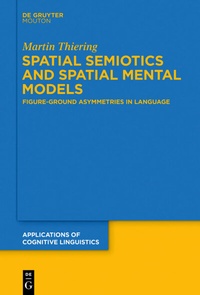
Spatial Semiotics and Spatial Mental Models
Figure-Ground Asymmetries in Language
1st Edition
Published on 12. December 2014
XVII, 291 pages
978-3-11-035687-8 (ISBN)
Description

This book presents novel data from endangered languages and cultures that are ever so often still not focused on. It combines different disciplines to capture the intricacies of spatial orientation and navigation. Also, the interplay between culture through language and practices presents new insights in the importance of combining cognitive semantics with cognitive anthropology.
More details
Other editions
Additional editions
E-Book
12/2014
1st Edition
De Gruyter Mouton
€139.95
Available for download
Book
11/2014
1st Edition
De Gruyter Mouton
€149.95
Shipment within 7-9 days
Person
Martin Thiering, Max Planck Institute for the History of Science, Berlin & Humboldt-Universität zu Berlin, Germany.
Content
- Intro
- Acknowledgements
- Abbreviations
- Index of tables
- Table of content
- Part I: Theoretical preambel
- Chapter 1: Setting the stage
- 1.1 Introduction
- 1.2 Behind the stage I: theoretical preliminaries
- 1.3 Behind the stage II: theoretical preliminaries in cognitive linguistics
- 1.4 Spatial cognitive semantics and spatial practices
- 1.5 Spatial semiotics and cognitive anthropology
- 1.6 Gestalt theoretical foundations
- 1.7 Figure-ground asymmetries in action: the case of Micronesian navigation
- 1.8 Lexical-semantic encoding patterns of spatial cognition: geometrical idealizations
- 1.9 The languages of mountainous and prairie regions
- 1.9 A sketch of the grammars
- 1.9.1 Dene Chipewyan
- 1.9.2 Upper Necaxa Totonac
- 1.9.3 Eipomek
- 1.10 Structure of the book
- Chapter 2: Cognitive representation of knowledge: spatial mental models
- 2.1 Introduction
- 2.2 Theoretical basics
- 2.3 Cognitive representation of knowledge: spatial mental models
- 2.4 A simple cognitive network
- 2.5 Cognition, perception, and language
- 2.6 Frames of reference
- 2.7 Figure-ground constructions
- 2.8 Degree of specificity
- 2.9 Mental models as cognitive maps: orientation as implicit spatial reasoning
- 2.10 Landmarks as coordinates of orientation
- 2.11 Intermediate conclusion
- Part II: Linguistic encodings of spatial mental models: the case studies
- Chapter 3: Figure-ground reversals in language
- 3.1 Introduction
- 3.2 Elicitation tools
- 3.2.1 The Topological Relational Markers Picture Series
- 3.2.2 The Caused Position Test
- 3.2.3 The Spatial Categorization Elicitation Test
- 3.3 Figure-ground asymmetries
- 3.3.1 Canonical figure-ground relationships
- 3.4 Figure-ground reversals
- 3.5 Concluding remarks
- Chapter 4: Degrees of specificity in spatial semantics
- 4.1 Introduction
- 4.2 Spatial semantics: topological spatial relations
- 4.2.2 Subjects, equipment, and materials
- 4.3 Degrees of specificity in spatial semantics: Dene and Totonac
- 4.3.1 Figure located on horizontal ground
- 4.3.2 Superior and interior spatial relations
- 4.4 Projective figure-ground spatial relations
- 4.5 Dynamic figure-ground spatial relations
- 4.6 Concluding remarks
- Chapter 5: Language loss in spatial semantics: Dene
- 5.1 Introduction
- 5.2 Topological relations in Dene
- 5.2.1 General summary of methods and results
- 5.2.2 Subjects, equipment, and materials
- 5.2.3 Overall results
- 5.3 Results of specific spatial topological relations in Dene
- 5.3.1 Similar expressions of topological relations
- 5.4 Differences in spatial marking
- 5.4.1 Superior and interior spatial relations
- 5.4.2 Projective figure-ground spatial relations
- 5.5 Miscellaneous figure-ground spatial relations
- 5.6 Concluding remarks
- Part III: Spatial concepts as landmarks: cognitive semantics meets cognitive anthropology
- Chapter 6: Spatial concepts, language and practice in Eipo and Dene
- 6.1 Introduction
- 6.2 Spatial mental models as cognitive maps
- 6.3 Cognitive maps of landmarks for orientation and navigation
- 6.4 Anthropological and linguistic background: Dene
- 6.4.1 Contact history and recent acculturation
- 6.4.2 Material culture and subsistence techniques
- 6.4.3 Social structures
- 6.4.4 Traditional religion
- 6.4.5 Physical environment
- 6.4.6 Relationships to neighboring groups
- 6.5 Anthropological and linguistic background: Eipo
- 6.5.1 Contact history and recent acculturation
- 6.5.2 Material culture and subsistence techniques
- 6.5.3 Social structures
- 6.5.4 Traditional religion
- 6.5.5 Physical environment
- 6.5.6 Relationship to neighboring groups
- 6.6 Excursus: center and periphery in Eipo
- 6.6.1 Building an Eipo house
- 6.7 Natural limitations in Eipo
- 6.8 Distance in Eipo
- 6.9 Representations of spaces in Eipo and Dene
- 6.9.1 Orientation in Eipomek
- 6.9.2 Orientation in Dene
- 6.10 Conclusion
- Chapter 7: Closing the stage
- 7.1 Final comments and outlook
- Bibliography
- Index
