

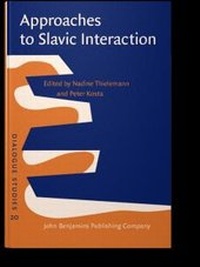
Approaches to Slavic Interaction
1st Edition
Published in September 2013
XI, 318 pages
978-90-272-7146-4 (ISBN)
Description

This volume provides an overview of current research priorities in the analysis of face-to-face-interaction in Slavic speaking language communities. The core of this volume ranges from discourse analysis in the tradition of interactional linguistics and conversation analysis to newer methods of politeness research. A further field includes empirical and interpretive methods of modern sociolinguistics and statistical analysis of spoken language in casual and institutional talks. Several papers focus on a semantic or syntactic analysis of talk-in-interaction by trying to show how interlocutors use certain lexical, grammatical, syntactic and multimodal or prosodic means for the management of interaction in performing specific actions, genres and displaying negotiations of epistemic, evidential or evaluative stances. The volume is rounded out by contributions to the theory of politeness where strategies of face-work in casual as well as institutional discourse are analyzed, or in which social tasks entertained by code-switching and language alternation within the interaction of bilinguals are discussed.
More details
Other editions
Additional editions
Nadine Thielemann | Peter Kosta
Approaches to Slavic Interaction
Book
08/2013
John Benjamins Publishing Co
€104.94
Shipment within 10-15 days
Persons
Content
- Approaches to Slavic Interaction
- Editorial page
- Title page
- LCC data
- Table of contents
- Contributors
- Introduction and overview
- 1. Introduction
- 2. Overview of the volume
- Acknowledgments
- References
- Part I. Multimodal, grammatical and paralinguistic resources in talk-in-interaction
- Talking out of turn: (Co)-constructing Russian conversation
- 1. Introduction
- 2. The mechanics of co-constructions
- 3. The interactional nature of co-constructions
- 4. Conclusion
- Acknowledgements
- References
- Appendix
- Reanimating responsibility: The wez- V2 (take-V2) double imperative in Polish interaction
- 1. Introduction
- 2. Data and method
- 3. Requesting here-and-now actions with the take-V2 format
- 4. Animating responsibility: Socialising children into an orientation towards communal tasks
- 5. Conclusion
- Acknowledgements
- References
- Eye behavior in Russian spoken interaction and its correlation with affirmation and negation
- 1. Synopsis
- 2. Introduction
- 3. Gaze grammar
- 4. Eye closing (EC)
- 5. EC as empty gesture: Blinking
- 6. Conclusions
- Acknowledgments
- References
- Hesitation markers in transitions within (story)telling sequences of Russian television shows
- 1. Introduction
- 2. Hesitation as a cognitive-pragmatic category
- 3. Stories and storytelling
- 4. Data and methods
- 5. Hesitation markers in the transitions within storytelling and more general telling sequences in t
- 6. The distribution of hesitation markers in the transitions within telling
- 7. Conclusion
- References
- Part II. Statistical analysis of Russian talk-in-interaction
- Russian everyday utterances: The top lists and some statistics
- 1. Introduction
- 2. Frequency distribution of utterance length in words
- 3. The top lists of Russian everyday utterances
- 4. Frequency distribution of utterance length in syllables
- 5. Average duration of utterances depending on their length in syllables
- 6. Dependence of average syllable duration on utterance length in syllables
- 7. Conclusion
- Acknowledgments
- References
- Speech rate as reflection of speaker's social characteristics
- 1. Introduction
- 2. Research material
- 3. Results
- 4. Conclusion
- Acknowledgments
- References
- Part III. Displaying and negotiating epistemic and evidential status and evaluation in interaction
- How evaluation is transferred in oral discourse in Russian
- 1. Introduction
- 2. Evaluation in phonetics and linguistics
- 3. Oral discourse
- 4. Realization of evaluation
- 5. Experimental vs. natural data
- 6. Experimental setup
- 7. Analysis of prosodic and rhetorical features
- 8. Summary and outlook
- References
- 'This is how I see it.' No prefacing in Polish
- 1. Introduction
- 2. What is no anyway?
- 3. Knowledge in interaction
- 4. Analysis
- 5. [No + more talk] - "my side" collaboration
- 6. Conclusion
- Acknowledgements
- References
- How can I lie if I am telling the truth? - The unbearable lightness of being of strong and weak moda
- 1. Introduction and prerequisites
- 2. Basic notions
- 3. Modal strength and conversational backgrounds
- References
- Part IV. Facework and contextualization in interaction - from (im)politeness to humor
- Irony in the face(s) of politeness: Strategic use of verbal irony in Czech political TV debates
- 1. Introduction
- 2. On forming and decoding irony
- 3. Televised debates and their language
- 4. Factors influencing the use of irony in political discussions
- 5. Irony in use: Case studies
- 6. Conclusions
- References
- Appendix
- Parliamentary communication: The case of the Russian Gosduma
- 1. Introduction
- 2. Political background
- 3. The data
- 4. Turn-taking system: The role of the Chair
- 5. Forms of address
- 6. Multi-addressed and multi-layered communication
- 7. Communicating with the broader public: Internet and TV coverage
- 8. Conclusions
- References
- Impoliteness and mock-impoliteness: A descriptive analysis
- 1. Introduction
- 2. Previous research
- 3. Methodology
- 4. Analysis
- 5. Conclusions
- Acknowledgements
- References
- Appendix
- Humor as staging an utterance
- 1. Introduction
- 2. What is animated speech?
- 3. Forms of conversational humor drawing on animated speech
- 4. Is animated speech a 'natural' contextualization cue?
- 5. Conclusion
- Data
- References
- Appendix
- Part V. Language alternation in face-to-face interaction of bilingual families
- Bilingual language use in the family environment: Evidence from a telephone conversation between mem
- 1. Introduction
- 2. Theoretical background
- 3. Data and method
- 4. Data analysis
- 5. Conclusion
- References
- Appendix
- Russian language maintenance through bedtime story reading? Linguistic strategies and language negot
- 1. Introduction
- 2. Research background
- 3. Theoretical background
- 4. Data and methodology
- 5. Analysis: When bedtime story reading becomes a language lesson
- 6. Conclusion
- References
- Appendix
- Index
