

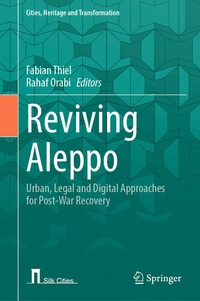
Reviving Aleppo
Description

This book provides indispensable and interdisciplinary insights into the revitalization and redevelopment of urban centers in war-stricken conflict regions, such as Aleppo in northern Syria. This contribution explores innovative, cutting-edge toolkits for academicians, digital building technologists, engineers, architects, archeologists, (urban) planners, land policy advisors and legal scholars. The compendium not only analyzes strategies and shortcomings of implementation guidelines drawn by donor organizations, development agencies and political actors, but also explores possibilities for initiating functioning and sustainably resilient networks that can establish capacity-building platforms for recovery and reconstruction. Although the work focuses on a city in Syria, it holds lessons, toolkits and instruments for other areas in the region and beyond.
More details
Other editions
Additional editions
Persons
Fabian Thiel studied Law at the University of Regensburg and Geography at the University of Hamburg, Ph.D. 2001 at the University of Hamburg, Habilitation 2017 at Justus-Liebig-University Giessen on the topic of Legal Geography. Professional stations among others: Environmental Research Center Leipzig-Halle and Integrated Expert for land management in Phnom Penh/Cambodia. Since 2018, he has acted as a full professor for Property Valuation and Land Law at Frankfurt University of Applied Sciences. Professor Thiel researches and teaches national and international property law, real estate valuation, land readjustment, planning law, land policy and legal geography.
Rahaf Orabi obtained her degree in Architecture from Damascus University in 2012. Following her graduation, she began working at the directorate general of Antiquities and Museums (DGAM) in Syria. Her specialization involved 3D documentation of endangered archeological sites, historical urban centers, and artifacts. In 2016, she obtained a master's degree in Architectural Design from Damascus University and later pursued a master's degree in Digital Cultural Heritage at the Cyprus Institute in 2021. She joined the Cyprus Institute as a research technical specialist in 2022. During her career, Rahaf was a member of Project Anqa, a collaborative effort between ICOMOS, CyArk, and the Carleton Immersive Media Studio (CIMS), aimed to digitally document monuments in Damascus. Additionally, she initiated a large-scale laser scanning project in the Old City of Aleppo as part of her Ph.D. dissertation, where she focused on the digital reconstruction of the Old City's historic urban fabric.
Content
Chapter 1 - Introduction: The Challenge of Recovery, 3D Digitisation as a Tool.- Chapter 2 - Urban Recovery Framework for Aleppo City.- Chapter 3 - Aleppo and Mosul - Reconstruction with Legal and Urban Development Tools.- Chapter 4 - Integrating Tenure Rights with a Balanced Socio-Spatial Approach Towards Sustainable Community in Aleppo.- Chapter 5 - Perception of Tenure Security, A Helpful Tool in the Recovery and Rebuilding of Post Conflict Aleppo.- Chapter 6 - Developing a Paperless Land Administration Strategy for Sustainable Peacebuilding and Reconstruction in Post-Conflict Syria.- Chapter 7 - Old Aleppo Between Reconstruction and Redevelopment Strategies: Balancing Preservation and Modernisation.- Chapter 8 - Landscape Strategies for a Sustainable and Inclusive Urban Recovery.- Chapter 9 - Physical Isolation and Spatial Injustice: Analytical Study of the Neirab Refugees Camp in Aleppo.- Chapter 10 - Maaloula: Analysis of Restoration Approach, Urban Conservation Research and Action Plan.- Part III. Digitisation and Geodata Management.- Chapter 11 - The Construction of an Informative 3D Model for the Monitoring of City Heritage Risk.- Chapter 12 - A Digital Photo Archive and Its Potential for the Preservation of Cultural Memory and Built Heritage The Syrian Heritage Archive Project (SHAP) at the Museum for Islamic Art, Berlin.- Chapter 13 - Digital Documentation of Mediaeval Castles in Syria and Lebanon.- Chapter 14 - From Mapping to Capacity Building, Activities of BTU Towards Post-War Recovery in Syria.
