

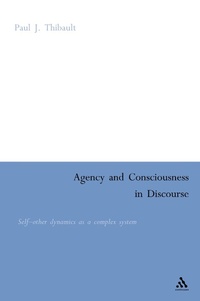
Agency and Consciousness in Discourse
Self-Other Dynamics as a Complex System
1st Edition
Published on 1. December 2004
352 pages
978-1-84714-266-5 (ISBN)
Description

In the past two decades there has been considerable interest in the ways in which subjects are positioned in discursive practice. This interest has entailed a focus on the role of language and discourse in the processes in and through which subjects are constituted in discourse. However, questions of agency and how it relates to consciousness have received less attention.
This book explores the ways in which agency and consciousness are created through transactions between self and other. The book argues that it is necessary to regard body-brain interactions in the context of the social and discursive practices which act upon human bodies. These issues of agency and individuation are explored in relation to infant semiosis, as well as in relation to children's symbolic play. Thibault looks at the importance of the self-referential moral conscience in relation to the interpersonal dimension of all acts of meaning-making. This conscience is also connected to the development of a self-referential viewpoint which the book argues is connected to the ecosocial semiotic systems of thinking about consciousness as a complex system operating on many different levels.
The author discusses and evaluates the work of linguists, psychologists, biologists, semioticians, and sociologists such as Basil Bernstein, Mikhail Bakhtin, J. J. Gibson, M. A. K. Halliday, Walter Kauffman, Lakoff & Johnson, Jay Lemke, Jean Piaget and Stanley Salthe, to develop a new theory of agency and consciousness.
This book explores the ways in which agency and consciousness are created through transactions between self and other. The book argues that it is necessary to regard body-brain interactions in the context of the social and discursive practices which act upon human bodies. These issues of agency and individuation are explored in relation to infant semiosis, as well as in relation to children's symbolic play. Thibault looks at the importance of the self-referential moral conscience in relation to the interpersonal dimension of all acts of meaning-making. This conscience is also connected to the development of a self-referential viewpoint which the book argues is connected to the ecosocial semiotic systems of thinking about consciousness as a complex system operating on many different levels.
The author discusses and evaluates the work of linguists, psychologists, biologists, semioticians, and sociologists such as Basil Bernstein, Mikhail Bakhtin, J. J. Gibson, M. A. K. Halliday, Walter Kauffman, Lakoff & Johnson, Jay Lemke, Jean Piaget and Stanley Salthe, to develop a new theory of agency and consciousness.
More details
Edition
1. Auflage
Language
English
Place of publication
London
United Kingdom
Publishing group
Bloomsbury Publishing PLC
Target group
Professional and scholarly
ISBN-13
978-1-84714-266-5 (9781847142665)
Copyright in bibliographic data and cover images is held by Nielsen Book Services Limited or by the publishers or by their respective licensors: all rights reserved.
Schweitzer Classification
Other editions
Additional editions
Book
12/2004
Continuum International Publishing Group Ltd.
€273.20
Shipment within 15-20 days
Person
Paul J. Thibault is Professor in Linguistics and Media Communication, Agder University, Kristiansand, Norway.
Content
Preface
1. Introduction
2. The Semiotic Mediation of Consciousness in Social Meaning-Making
3. Agency, Intentionality and Individuation in Infant Semiosis
4. Reflexive (Self) Consciousness, Conscience, and the Dialogical Basis of Intrapersonal Moral Consciousness
5. Dialogic Closure and the Semiotic Mediation of Consciousness in Ecosocial Networks
6. Metaphor as Semiotic Re-Organization Across Levels
References
1. Introduction
2. The Semiotic Mediation of Consciousness in Social Meaning-Making
3. Agency, Intentionality and Individuation in Infant Semiosis
4. Reflexive (Self) Consciousness, Conscience, and the Dialogical Basis of Intrapersonal Moral Consciousness
5. Dialogic Closure and the Semiotic Mediation of Consciousness in Ecosocial Networks
6. Metaphor as Semiotic Re-Organization Across Levels
References
