

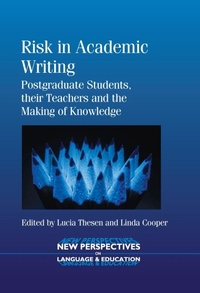
Risk in Academic Writing
Postgraduate Students, their Teachers and the Making of Knowledge
Published on 11. December 2013
248 pages
978-1-78309-107-2 (ISBN)
Description

This book brings together a variety of voices - students and teachers, journal editors and authors, writers from the global north and south - to interrogate the notion of risk as it applies to the production of academic writing. Risk-taking is viewed as a productive force in teaching, learning and writing, and one that can be used to challenge the silences and erasures inherent in academic tradition and convention. Widening participation and the internationalisation of higher education make questions of language, register, agency and identity in postgraduate writing all the more pressing, and this book offers a powerful argument against the further reinforcement of a 'northern' Anglophone understanding of knowledge and its production and dissemination. This volume will provide food-for-thought for postgraduate students and their supervisors everywhere.
Reviews / Votes
The volume is useful in exploring issues of voice, power, knowledge and gatekeeping. It is worth reading partly because of the self-reflexive manner in which these issues are explored from the point of view of the student, the journal editor, the supervisor or writing-circle facilitator. It contains some interesting approaches which could be used by others working in the domain of academic literacy, for example the writing circle and an ethnopoetic approach to analyse student 'error.' One of the strengths of the volume for those who enjoy reading about academic work is its immersion in practice, and the resultant sensitively conveyed detail.* Brenda Leibowitz, University of Johannesburg, in Critical Studies in Teaching and Learning, Vol 2, I * Risk in Academic Writing is a powerful, challenging, engaging, and moving collection of papers from writers in different geo-political settings both south and north, writing in diverse voices as postgraduates and teachers, and drawing on monolingual and multilingual backgrounds - in short writings from the contact zone. The book brilliantly claims the concept of risk and reworks it as a productive metaphor in relation to writing. It brings off that most difficult of tasks combining theoretical sophistication with the experiential and practical. If I were to read only one book on academic writing this year this would have to be it. -- Professor Sue Clegg, Emeritus Professor of Higher Education Research, Leeds Metropolitan University, UK This collection is both moving and intellectually engaging. It is fitting that it was conceived and birthed in South Africa with its themes of risk, writing and research pedagogy. A must-read for teachers of writing and scholars interested in the difficult and multifaceted challenges of North-South knowledge construction and representation. * Claire Aitchison, University of Western Sydney, Australia * This collection of essays provides deeply important insights into the ways in which emerging and also established scholars in the English-speaking world are negotiating their way through the regulatory conventions of what they may and may not say. The stories, and the theorisations accompanying them, work up to constitute a powerful new ethnography of risk. * Crain Soudien, University of Cape Town, South Africa *
More details
Series
Language
English
Place of publication
Bristol
United Kingdom
Publishing group
Channel View Publications Ltd
Target group
Professional and scholarly
ISBN-13
978-1-78309-107-2 (9781783091072)
Copyright in bibliographic data and cover images is held by Nielsen Book Services Limited or by the publishers or by their respective licensors: all rights reserved.
Schweitzer Classification
Other editions
Additional editions
Lucia Thesen | Linda Cooper
Risk in Academic Writing
Postgraduate Students, their Teachers and the Making of Knowledge
Book
12/2013
Multilingual Matters
€48.10
Shipment within 10-20 days
Persons
Lucia Thesen is a Senior Lecturer in the Centre for Higher Education Development at the University of Cape Town, South Africa. Her research focuses on postgraduate writing pedagogies and alternative forms and functions of academic literacy practices.
Linda Cooper is an Associate Professor in the Centre for Higher Education Development at the University of Cape Town, South Africa. Her research focuses on worker education, the recognition of prior learning and the theorization of different forms of knowledge.
Linda Cooper is an Associate Professor in the Centre for Higher Education Development at the University of Cape Town, South Africa. Her research focuses on worker education, the recognition of prior learning and the theorization of different forms of knowledge.
Content
Acknowledgments List of Frequently Used Acronyms and Abbreviations Lucia Thesen: Introduction: Risk as Productive: Working with Dilemmas in the Writing of Research Part I: Deletion and Agency 1. Linda Cooper: 'Does my Experience Count?' The Role of Experiential Knowledge in the Research Writing of Postgraduate Adult Learners 2. Somikazi Deyi: A Lovely Imposition: The Complexity of Writing a Thesis in isiXhosa Part II: Strategies for Hybridity: Writing Together 3. Suresh Canagarajah and Ena Lee: Negotiating Alternative Discourses in Academic Writing and Publishing: Risks with Hybridity 4. Aditi Hunma and Emmanuel Sibomana: Academic Writing and Research at an Afropolitan University: An International Student Perspective Part III: Pedagogies that Invite the Edge 5. Clement Mapfumo Chihota and Lucia Thesen: Rehearsing 'The Postgraduate Condition' in Writers' Circles 6. Moragh Paxton: Genre: a Pigeonhole or a Pigeon? Case Studies of the Dilemmas Posed by the Writing of Academic Research Proposals 7. Kate Cadman: Of House and Home: Reflections on Knowing and Writing for a 'Southern' Postgraduate Pedagogy Part IV: Reading the World in Students' Writing 8. Mary Scott: 'Error' or Ghost Text? Reading, Ethnopoetics, and Knowledge Making 9. Moeain Arend: 'It was Hardly about Writing': Translations of Experience on Entering Postgraduate Studies Part V: Peripheral Vision: Reflections from North and South 10. Theresa Lillis: Resonances, Resistances and Relations: Reflecting on the Politics of Risk in Academic Knowledge-Making 11. Brenda Cooper: Both Dead and Alive: Schroedinger's Cat in the Contact Zone Index
