

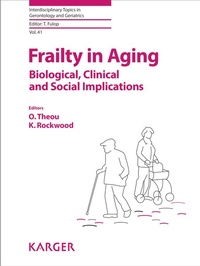
Frailty in Aging
Biological, Clinical and Social Implications
1st Edition
Published on 20. July 2015
212 pages
978-3-318-05457-6 (ISBN)
Available for download
Description

Frailty represents an important challenge for aging populations. As a concept it is full of 'known unknowns' such as which mechanisms lead to frailty and how it is best managed. In order to examine these circumstances, the new science of understanding and managing frailty requires an appropriate framing of the problem. This publication investigates the biology and management of frailty and its social aspects. It considers these and related questions: How can we recognize frailty? How does an understanding of frailty increase our comprehension of the aging process? What are its implications for health care systems, including primary care, hospitals and rehabilitation? How will a growing number of frail older adults affect society more generally? The book focuses on frailty as a state of vulnerability, which is related to aging, but which can occur across the life course, and aims to improve the life of frail people and those around them. The book is highly recommended to researchers in aging, health science researchers, health care professionals and anyone interested in the understanding of the aging process.
More details
Other editions
Additional editions
Book
07/2015
1st Edition
Karger, S
€195.03
Shipment within 7-9 days
Persons
Content
- Cover
- Front Matter
- Contents
- Introduction
- References
- The Biology of Frailty
- Frailty: Scaling from Cellular Deficit Accumulation?
- Abstract
- Frailty and Age-Related Deficit Accumulation
- Cellular Events in Aging
- The Origin of Deficit Accumulation
- Frailty at the Organ Level: Variable Organ Dysfunction
- Evidence for Scaling in Humans
- Mechanisms by Which Frailty Might Emerge from Subcellular Deficits
- Conclusions
- Sources of Funding
- References
- Assessment of Frailty in Animal Models
- Abstract
- Frailty and Its Measurement
- The Evaluation of Frailty in Invertebrates
- The Assessment of Frailty in Mammals
- Summary
- References
- Frailty, Inflammation and Immunosenescence
- Abstract
- How Can We Define Aging and Frailty?
- What Is the Cause of Frailty?
- How Can We Conceptualize Immune/Inflammation in the Pathogenesis of Frailty? Unique or Integrative Approach
- Conclusions
- Acknowledgments
- References
- Sex Differences in Frailty
- Abstract
- Sex Differences in Life Expectancy
- Evolutionary Theories
- Biological Factors
- Social and Behavioral Factors
- Sex Differences in Health Status
- Co-Morbidities
- Pathophysiological Factors
- Frailty as a Product of the Recovery Rate and the Environment
- Why Can Women Better Tolerate Their Health Deficits?
- Safety Factors and Quantitative Evolutionary Design
- Conclusions
- Acknowledgments
- References
- Frailty and the Microbiome
- Abstract
- Our Resident Microbes: Numerous, Diverse and Differentiated
- Key Functions of the Human Microbiome
- From Healthy Communities to Dysbiosis
- What Role Do Microbes Play in Aging and Frailty?
- Exploring the Potential Connection between Microbes and Frailty
- Conclusions
- References
- Evaluation and Management of Frailty
- Operationalizing Frailty Using the Frailty Phenotype and Deficit Accumulation Approaches
- Abstract
- The Deficit Accumulation, or Frailty Index, Approach
- The Frailty Phenotype, or Syndromic, Approach
- Other Operational Definitions of Frailty
- References
- Comparison and Clinical Applications of the Frailty Phenotype and Frailty Index Approaches
- Abstract
- Comparison of the Nature of the Items Included in the Frailty Index and the Frailty Phenotype
- Comparison of the Properties of the Frailty Index and the Frailty Phenotype
- Frailty Assessment in Clinical Settings
- Frailty Screening
- Future Studies
- References
- Frailty in Primary Care
- Abstract
- Frailty: An Age-Independent Marker of Risk that Fits the Biopsychosocial Model of Primary Care
- The Frailty Index in Primary Care
- The Frailty Phenotype in Primary Care
- Frailty Tools in Primary Care: Recommendations from Systematic Reviews
- Frailty Screening and Intervention in Primary Care: Randomized Controlled Trials
- New Commissioning Models in Primary Care: Examples from the United Kingdom
- Summary and Conclusions
- Appendix
- References
- Hospital Care for Frail Elderly Adults: From Specialized Geriatric Units to Hospital-Wide Interventions
- Abstract
- Hospital Care for Elders
- Prevalence of Frailty
- Adverse Events
- Hospital-Associated Disability
- Organization of Care
- Specialized Geriatric Interventions
- Geriatric and Frailty Evaluation
- Patient Targeting, Screening, Risk Assessment, Case Finding, Triage, and Referral
- Geriatric and Frailty Management
- Research Dilemmas
- Concluding Remarks
- References
- Frailty and Mobility
- Abstract
- How Frailty and Mobility Relate
- Specific Mobility Disorders and Frailty
- The Consequences of Impaired Mobility and Frailty
- Frailty and Mobility within Acute Care
- Frailty and Mobility in Dementia
- Why Mobility Must Be Disturbed in Delirium
- Frailty, Mobility and Age-Related Impairments
- Frailty, Mobility and Age-Related Impairments: The Frailty Phenotype
- Immobility and Reinforcement of the Frailty Stereotype
- Frailty, Mobility and the Dignity of Risk
- Scope for Intervention in Disorders of Mobility and Frailty
- Conclusion
- Acknowledgments
- References
- Frailty and Interprofessional Collaboration
- Abstract
- Introduction to the Clinical Teaching Unit at the University Health Center
- The Case for Interprofessionalism
- Key Principles of Interprofessional Collaborative Practice
- Interprofessional Collaboration Reconsidered
- Three Interdependent Processes of Practice
- Processes of Representation
- Processes of Sense-Making
- Processes of Improvisation
- Summary
- Acknowledgments
- References
- Frailty and Rehabilitation
- Abstract
- Defining Rehabilitation
- Frailty in the Context of Rehabilitation
- Frailty and Potential Rehabilitation Approaches
- Frailty as a 'Risk Factor' in Rehabilitation Programs
- Rehabilitating Frailty: Broader Empirical Research
- Intervention in Pre-Frailty
- The Frailty Intervention Trial Program
- Principles for Rehabilitation in Frailty
- Components of the Frailty Intervention Trial Program
- The Frailty Intervention Trial Program: The Intervention
- The Frailty Intervention Trial Program: Information Processing
- The Frailty Intervention Trial Program: Adherence
- Usual Care (Control) Group
- Implementation of the Frailty Intervention Trial Program: Observations
- Results of the Frailty Intervention Trial Program
- Interpreting the Results of the Frailty Intervention Trial Program
- Conclusion
- References
- End of Life Care in Frailty
- Abstract
- Challenges to Optimal End-of-Life Care Delivery in Frailty
- Symptom Management in Frailty
- What Is Needed to Move Health Care Providers and Systems Forward in the Provision of End-of-Life Care in Frailty?
- Conclusion
- References
- Social Aspects of Frailty
- Frailty and Organization of Health and Social Care
- Abstract
- Integrated Care
- Frailty Identification as a Guide for Integrated Care
- Potential Benefits of Routine Frailty Identification in Different Settings
- Improving the Organization of Health and Social Care for Older People with Frailty
- References
- Frailty's Place in Ethics and Law: Some Thoughts on Equality and Autonomy and on Limits and Possibilities for Aging Citizens
- Abstract
- Equality
- Autonomy and Informed Choice
- Concluding Thoughts
- Unanswered Questions
- Acknowledgments
- References
- Frailty and Social Vulnerability
- Abstract
- Social Vulnerability and Its Measurement
- Outcomes of Social Vulnerability
- Context Matters
- Clinical Relevance of Social Vulnerability
- The Scaling Problem
- Questions That Remain
- References
- Author Index
- Subject Index
- Cover

