

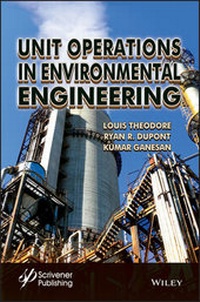
Unit Operations in Environmental Engineering
Description

More details
Other editions
Additional editions
Persons
Louis Theodore, MChE and EngScD, is a retired professor of chemical engineering (50 years). He is the author of several publications, including Fluid Flow for the Practicing Chemical Engineer, Thermodynamics for the Practicing Engineer, Mass Transfer Operations for the Practicing Engineer, and Air Pollution Control Equipment Calculations. Dr. Theodore is also a contributor to Perry's Chemical Engineers' Handbook.
R. Ryan Dupont has more than 35 years of experience teaching and conducting applied and basic research in environmental engineering at the Utah Water Research Laboratory at Utah State University. He received his PhD degrees in Environmental Health Engineering from the University of Kansas, Lawrence and has been a Professor of Civil and Environmental Engineering at USU since 1995, serving as the Head of the Environmental Engineering Division for 10 years. He was a 2015 National Air and Waste Management Association Richard I. Stessel Waste Management Award winner for excellence in Waste Management Education.
Kumar Ganesan is currently a professor and department head of the Department of Environmental Engineering at Montana Tech where he has been for the past 35 years. He received his PhD from Washington State University at Pullman, Washington in Engineering Science. His current research includes developing bio-fiber based metallic nanoparticle filters to remove toxic metals from air and water.
Content
Preface
Unit operations are several of the basic tenets of not only chemical engineering but also several other engineering disciplines, and contains many practical concepts that are utilized in countless industrial applications. One engineering curriculum that has embraced the unit operations approach is environmental engineering, and interestingly, a comprehensive "overview text" in the subject area is not presently available in the literature. Therefore, the authors considered writing a practical introductory text involving unit operations for environmental engineers. The text will hopefully serve as a training tool for those individuals pursuing degrees that include courses on unit operations. Although the literature is inundated with texts in this area emphasizing theory and theoretical derivations, the goal of this text is to present the subject from a strictly pragmatic introductory point-of-view, particularly for those individuals involved with environmental engineering.
As noted in the opening paragraph and in the title of this book - Unit Operations in Environmental Engineering - this work has been written primarily for environmental engineering students. But, who are environmental engineers and what is the environmental engineering profession? The answer, to some degree, depends on who one talks to since this profession has undergone dramatic changes over the last half century. The term environmental engineering came into existence in the mid-1960s when it displaced the perhaps politically incorrect term, sanitary engineering.
The reader should keep in mind that during the late 1900s, it was no secret that industry preferred to hire chemical engineers to address real-world environmental engineering problems. This was no doubt brought about because of the chemical engineer's understanding, and the environmental engineer's lack of knowledge, of unit operations, particularly those related to mass transfer operations.
Interestingly, the early sanitary engineering curriculum was almost exclusively based on primarily "water" topics, e.g., sewage, water supply and usage, sanitation, etc. The expansion of environmental engineering to include air, solid waste, noise, health risk, hazard risk, etc., evolved over time, all of which can today be viewed as a legitimate part of an environmental engineering curriculum. This book's subject matter of unit operations is therefore only one, but perhaps the most important subject in any interdisciplinary discipline that includes environmental engineering.
This is a book on unit operations . well, sort of. The principles of unit operations were originally set forth soon after the birth of the chemical engineering profession at the turn of the 20th century and it remains the keystone course in the chemical engineering curriculum. A new kid on the block entered the engineering field around 1950, perhaps spearheaded by the adoption of a sanitary engineering program at Manhattan College, Bronx, NY. The program was later renamed "Environmental Engineering" around 1970. The College also later served as the host of several NSF-funded environmental engineering course development seminars that were directed by the one of the authors, Lou Theodore; and the college also served as home for Lou Theodore (as Professor of Chemical Engineering) for 50 years.
Converting the aforementioned chemical engineering principles/approaches/applications embodied in unit operations to environmental engineering in an optimum manner was not as difficult as the authors originally anticipated. This was, no doubt, due to the clear overlap between the two disciplines.
As noted above, this book is concerned with unit operations, fluid flow, heat transfer, and mass transfer. Unit operations, by definition, are physical processes although there are some that include chemical and biological reactions. The unit operations approach allows both the student and practicing engineer to compartmentalize the various operations that constitute a process. As such, it has enabled the engineer of yesterday and today (and tomorrow) to perform more efficiently. This approach has also allowed the environmental engineer to achieve considerable success in the environmental management field.
The authors' approach in presenting unit operations material to environmental engineering students is to primarily key on introductory engineering principles so that the reader could then later satisfactorily predict the performance of the various unit operation equipment. In effect, the reader or instructor is provided the opportunity to expand chapter presentations. Although a chapter on Process and Plant Design is included in the introductory part (Part I) of the book, details on equipment design are treated superficially and the subject of plant design is rarely broached.
A comment on chemical reactions is also warranted. Chemical reactions have been defined by some as chemical unit processes. They serve as the backbone of the chemical process industries employing the batch, continuously stirred tank reactors (CSTRs), and tubular flow reactors. However, these chemical unit processes also find application in the wastewater treatment industry. Some of these chemical processes include oxidation, precipitation, neutralization, pH control, disinfection operations, certain coagulation operations, etc. Many of the chemical reactions involve chemicals such as calcium and sodium hydroxide, ferric and aluminum chloride, alum, ferric sulfide, etc. And, as one might suppose, these chemical unit processes are often operated in conjunction with physical unit processes (or unit operations).
Biological unit processes represent another class of chemical reactions that are important to the practicing environmental engineer. The major applications of these biochemical reaction pathways are in wastewater treatment and hazardous waste remediation. The principal biological processes used for wastewater treatment can be divided into two main categories: suspended growth and attached growth (or biofilm) processes. Their successful design and operation requires an understanding of the types of microorganisms involved, the specific reactions that occur, and the environmental factors that affect their performance, their nutritional needs, and their biochemical reaction kinetics.
The decision as to what units and notations to use was difficult. After much deliberation, the authors chose to use engineering - as opposed to metric/SI units, and chemical engineering notation - as opposed to those of other disciplines. This decision was based, to some extent, on the reality that a good part of the book's content was drawn from the chemical engineering literature, some of which was written by the primary author, Lou Theodore.
The book is divided into five parts.
Part I - Introduction to the Principles of Unit Operations
Part II - Fluid Flow
Part III - Heat Transfer
Part IV - Mass Transfer
Part V - Case Studies
In addition to providing materials on the history of unit operations and a discussion of the relationship among the transport phenomenon/unit operations/unit processes approaches, Part I contains material on traditional introductory engineering principles. These include: thermodynamics, chemical reaction principles, equilibrium versus rate consideration, rate principles, and process and plant design. Part II - Fluid Flow - addresses such subject areas as: fluid classifications, flow mechanisms, flow in conduits, prime movers plus various valve and fittings, sedimentation and centrifugation, porous media and packed beds, filtration, fluidization, ventilation and mixing. Part III - Heat Transfer - contains material concerned with: heat exchangers, waste heat boilers and evaporators, quenchers, psychrometry, humidification, drying, and cooling towers. (Note that the subject of heat transfer was rarely (if ever) included in the environmental engineering curriculum in the early days. For example, in Rich's classic "Unit Operations in Sanitary Engineering" text, only one of the 15 chapters in the text dealt with heat transfer. That has changed today because of the environmental engineer's interest in energy, energy conservation, combustion, hazardous waste incineration, global climate change, radiation effects of the sun, etc. In effect, heat transfer has become the new kid on the block in the unit operations arena, and is a topic that every environmental engineer should be proficient in). Part IV of the book - Mass Transfer - covers such topics as: absorption and stripping, adsorption, distillation, liquid-liquid and liquid-solid extraction, and other mass transfer operations. The last part of the book, Part V - Case Studies - provides three applications in each of the three unit operations. An Appendix is also included. An outline of the topics can be found in the Table of Contents.
The reader will note that there is no separate section, part or chapter devoted to biological processes. Rather, they have been integrated into relevant material presented in Parts II and IV. Biological treatment processes (in alphabetical order) that receive treatment include:
Activated Sludge
Aerated Lagoons
Anaerobic Digestion
Composting
Enzyme Treatment
Trickling Filters
Waste Stabilization Ponds
Details on the above seven biological methods were provided earlier by Theodore and McGuinn in "Pollution Prevention," Van Nostrand Reinhold, New York City, NY, 1992. An extensive analysis of these processes (plus many more) is also available in the work of Metcalf and Eddy, "Wastewater Engineering: Treatment and...
