

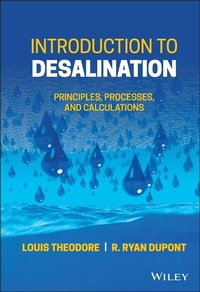
Introduction to Desalination
Description

Explore the principles, methods, and applications of modern desalination processes
Introduction to Desalination: Principles, Processes, and Calculations delivers a comprehensive and robust exploration of desalination highlighted with numerous illustrative examples and calculations.
The book is divided into three sections, the first of which offers an introduction to the topic that includes chapters covering global water scarcity and the need for "new water." The second section discusses the desalination process, including evaporation, reverse osmosis, crystallization, hybrid systems, and other potable water processes. The final part covers topics that include water conservation, environmental considerations of desalination, economic impacts of desalination, optimization, ethics, and the future of desalination.
The book also includes:
* A comprehensive introduction to desalination, including discussions of engineering principles, the physical, chemical, and biological properties of water, and water chemistry
* An extensive engineering analysis of the various desalination processes
* Practical discussions of miscellaneous desalination topics, including the environmental and economic effects of the technology
Perfect for process, chemical, mechanical, environmental, and civil engineers, Introduction to Desalination: Principles, Processes, and Calculations is also a valuable resource for materials scientists, operators, and technicians working in the field.
More details
Other editions
Additional editions
Persons
Louis Theodore, Eng.Sc.D, (retired) was a Professor of Chemical Engineering for 50 years. He is the author of several publications, including Fluid Flow for the Practicing Chemical Engineer, Thermodynamics for the Practicing Engineer, Mass Transfer Operations for the Practicing Engineer, and Air Pollution Control Equipment Calculations and Pollution Prevention.
R. Ryan Dupont, PhD, is Cazier Professor of Civil and Environmental Engineering, and a Research Associate at the Utah Water Research Laboratory. He is the author of many research publications and books including Groundwater and Soil Remediation: Process Design and Cost Estimating of Proven Technologies, Water Resource Management Issues: Basic Principles and Applications, and Unit Operations in Environmental Engineering.
Content
Preface vii
Dedication xi
Part I Introduction 1
1 Global Water Scarcity and the Need for "New Water" 3
2 Technical Glossary 21
3 Engineering Principles 47
4 Physical, Chemical, and Biological Properties of Materials 75
5 Water Properties 101
6 Water Chemistry 127
7 The Conservation Laws, Stoichiometry, and Thermodynamics 143
8 Unit Operations 171
Part II Desalination and Water Treatment Processes 199
9 The Desalination Process 201
10 Evaporation 223
11 Reverse Osmosis 247
12 Crystallization 271
13 Traditional Desalination Processes 295
14 New Desalination Processes 315
15 Non-Desalination Processes 335
Part III Select Related Topics 351
16 Water Conservation 353
17 Economic Considerations 381
18 Optimization Considerations 401
19 Ethical Considerations 433
20 The Future of Desalination 459
Index 475
1
Global Water Scarcity and the Need for "New Water"
1.1 Introduction
The title of this book includes the word desalination. Dictionary.com (2012) defines desalination as "the process of removing salt, esp from seawater so that it can be used for drinking or irrigation." Thus, desalination is a process that produces potable water. The reader should keep in mind, and this will be discussed later in the book, that there are other processes available for producing potable water, many of which are currently uneconomical. For this reason, the book primarily deals with desalination. The general topic of potable water is also considered and is addressed in several of the paragraphs to follow.
The world's total water is enormous compared with the presently conceivable needs of man, yet there is a growing water problem. Of the 1.39 billion km3 (332 million mi3) of water in the Earth's crust 99% is salty and useful neither for irrigation by present techniques nor for the majority of man's other needs.
Rain provides many times the world's annual water needs, but fresh water supplies vary widely over the Earth and from time to time in a given region. This accounts for the "water problem" that exists as the Earth's population continues to grow. In the United States, the actual "consumptive use" is approximately 12%-18% of the potential supply. Water prices are low, and on a statistical basis there should be no water shortages for many years. These average figures are of little comfort to the people of arid regions, however, and the United States, though relatively well supplied with water, is now beginning to turn to sources other than rainfall and runoff to meet growing water demands. The Southwest has too little water to support rapid population expansion. California has embarked on multi-billion dollar projects to bring water nearly 800 miles to Los Angeles and southern California from the wetter northern parts of the state. Outside of the United States, expensive desalination plants have been in operation for many years in the Virgin Islands, many Persian Gulf states, the West Indies, Libya, South Africa, and Israel.
An obvious way to increase water availability is to recover fresh water from seawater or large underground stores of brackish water that are available in many arid regions, but that are generally not usable without significant treatment. Other options for increasing potable water supplies is to find ways to use the saline or brackish water for agriculture or other uses that can tolerate higher salinity levels, or to actively pursue water conservation measures to protect limited fresh water supplies that may be available.
This chapter introduces the reader to the general subject of global water supplies and water scarcity issues through a review of water availability and water sources, global water resources, global water resource issues, and the history of desalination. A series of illustrative examples are provided to highlight concepts presented throughout the chapter.
1.2 Water Availability and Water Sources
The water on the surface of the Earth can be found in eight distinct compartments which are shown in Table 1.1 along with how much of the Earth's total water budget each makes up. These eight compartments are more commonly organized into three distinct groupings. First, there is surface water, which includes oceans, lakes, rivers, seas, etc. In short, surface water is all forms of liquid water that lie on the surface of the Earth. The second grouping is glacial and frozen water. These are resources that are located on the surface; however, these resources are in frozen, long-term storage. Long-term storage is defined as water that has historically taken thousands of years to move through the water cycle. The third and final grouping is groundwater. This is the water that is found below the surface of the Earth in conditions where the percent saturation in soil pore water is 100% (Mullen 2021). The process known as the hydrologic, or water cycle, has played a crucial role in the formation and distribution of all water resources on Earth today. The water cycle is used to describe the constant circulation of water through its three phases of solid, liquid, and gas as it moves within the eight compartments making up the water resource pool on the Earth.
Table 1.1 Breakdown of the total water budget on the Earth.
Water compartment % of Total Earth's water budget Oceans 97.2 Frozen glacier water & other ice 2.15 Ground or subsurface water 0.61 Freshwater lakes 0.009 Inland seas 0.008 Soil moisture 0.005 Atmospheric water 0.001 Rivers and streams 0.0011.3 Global Water Resources
Usable water is the key to sustainable life. However, out of all the water on Earth today, it is estimated that only 2.5 to 3.0% is usable. That still is quite a large amount of water, considering the Earth's total global water supply is over 1.39 billion km3. However, when one delves deeper into this estimated usable supply, it is found that a little over 0.3% of the usable water on Earth is easily accessible (Gleick 1996). This usable water is found in rivers, streams, lakes, and swamps. With the ease of access to these forms of usable water being so high, it is estimated that over 50% of the world's population lives within 3.0 km of these surface water sources (Kummu et al. 2011). The majority of the available water that is not considered easily accessible is found in ground or subsurface water in natural aquifers.
Natural aquifers are the most common forms of groundwater storage. Today, these natural aquifers are thought to hold roughly 34.2 million km3 of total water. Out of these 34.2 million km3 of water, it is estimated that close to 10.4 million km3 of this water is usable (Gleick 1996). Since these aquifers are below the surface of the Earth, they do require the construction of wells for water recovery. These wells can range from tens to hundreds of feet deep, depending on where the water table is located. It is also important to note that these wells will generally require the installation of a pumping system to bring the water to surface. Table 1.2 provides a comparison between the total water on Earth to the amount that is both groundwater and fresh-groundwater.
Table 1.2 Fresh groundwater, total groundwater, and total global water resources.
Water source Water volume, mi3 Water volume, km3 % of Total water resource % of Total fresh water resource Fresh groundwater 2,526,000 10,530,000 0.80 30.1 Total groundwater 5,614,000 23,400,000 1.7 Total global water resource 332,500,000 1,386,000,000As small as the ratio of total volume of usable water to unusable water is in the world, there are still considerable amounts of usable water resources present among the seven continents. The amount of usable water on each continent can be divided among the three water categories as just described earlier, i.e. groundwater; glacier/permanent ice caps; and surface water (i.e. wetlands, lakes, reservoirs, and rivers). These categories, along with the volumes of water in each for each continent across the globe are summarized in Table 1.3.
Table 1.3 Global water resources by continent (Modified from Rekacewicz 2006).
Continent Glacier & permanent ice caps, km3 Groundwater, km3 Wetlands, large lakes, reservoirs & rivers, km3 Totals, km3 Total usable water resource, km3 North America 90,000 4,300,000 27,003 4,427,003 4,327,003 South America 900 3,000,000 N/A 3,00,900 3,000,000 Europe 18,216 1,60,000 2,239 1.620,745 1,602,529 Africa 0 5,500,000 31,776 5,531,776 5,531,776 Australia 180 1,200,000 221 1,200,401 1,200,221 Asia 60,984 7,800,000 30,622 7,891,606 7,830,622 Antarctica 30,109,800 N/A N/A 30,109,800 0On examining Table 1.3 it becomes immediately obvious that Antarctica has by far the largest amount of fresh water of any continent. However, this fresh water is in the form of glaciers and permeant ice caps, thus making it unusable. When comparing usable water resources, the top three continents are Asia, with roughly 7,830,622 km3 of water, Africa, with approximately 5,531,776...
