

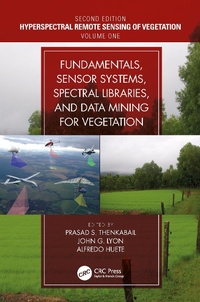
Fundamentals, Sensor Systems, Spectral Libraries, and Data Mining for Vegetation
2nd Edition
Published on 7. December 2018
489 pages
978-1-351-67329-7 (ISBN)
Description

Written by leading global experts, including pioneers in the field, the four-volume set on Hyperspectral Remote Sensing of Vegetation, Second Edition, reviews existing state-of-the-art knowledge, highlights advances made in different areas, and provides guidance for the appropriate use of hyperspectral data in the study and management of agricultural crops and natural vegetation.
Volume I, Fundamentals, Sensor Systems, Spectral Libraries, and Data Mining for Vegetation introduces the fundamentals of hyperspectral or imaging spectroscopy data, including hyperspectral data processes, sensor systems, spectral libraries, and data mining and analysis, covering both the strengths and limitations of these topics. This book also presents and discusses hyperspectral narrowband data acquired in numerous unique spectral bands in the entire length of the spectrum from various ground-based, airborne, and spaceborne platforms. The concluding chapter provides readers with useful guidance on the highlights and essence of Volume I through the editors' perspective.
Key Features of Volume I:
Provides the fundamentals of hyperspectral remote sensing used in agricultural crops and vegetation studies.
Discusses the latest advances in hyperspectral remote sensing of ecosystems and croplands.
Develops online hyperspectral libraries, proximal sensing and phenotyping for understanding, modeling, mapping, and monitoring crop and vegetation traits.
Implements reflectance spectroscopy of soils and vegetation.
Enumerates hyperspectral data mining and data processing methods, approaches, and machine learning algorithms.
Explores methods and approaches for data mining and overcoming data redundancy;
Highlights the advanced methods for hyperspectral data processing steps by developing or implementing appropriate algorithms and coding the same for processing on a cloud computing platform like the Google Earth Engine.
Integrates hyperspectral with other data, such as the LiDAR data, in the study of vegetation.
Includes best global expertise on hyperspectral remote sensing of agriculture, crop water use, plant species detection, crop productivity and water productivity mapping, and modeling.
Volume I, Fundamentals, Sensor Systems, Spectral Libraries, and Data Mining for Vegetation introduces the fundamentals of hyperspectral or imaging spectroscopy data, including hyperspectral data processes, sensor systems, spectral libraries, and data mining and analysis, covering both the strengths and limitations of these topics. This book also presents and discusses hyperspectral narrowband data acquired in numerous unique spectral bands in the entire length of the spectrum from various ground-based, airborne, and spaceborne platforms. The concluding chapter provides readers with useful guidance on the highlights and essence of Volume I through the editors' perspective.
Key Features of Volume I:
Provides the fundamentals of hyperspectral remote sensing used in agricultural crops and vegetation studies.
Discusses the latest advances in hyperspectral remote sensing of ecosystems and croplands.
Develops online hyperspectral libraries, proximal sensing and phenotyping for understanding, modeling, mapping, and monitoring crop and vegetation traits.
Implements reflectance spectroscopy of soils and vegetation.
Enumerates hyperspectral data mining and data processing methods, approaches, and machine learning algorithms.
Explores methods and approaches for data mining and overcoming data redundancy;
Highlights the advanced methods for hyperspectral data processing steps by developing or implementing appropriate algorithms and coding the same for processing on a cloud computing platform like the Google Earth Engine.
Integrates hyperspectral with other data, such as the LiDAR data, in the study of vegetation.
Includes best global expertise on hyperspectral remote sensing of agriculture, crop water use, plant species detection, crop productivity and water productivity mapping, and modeling.
Reviews / Votes
"Very comprehensive and an excellent reference, both for practitioners in the field as well as students hoping to learn more about the uses of Hyperspectral Data for characterizing a diverse set of vegetation...There are books by other authors on Hyperspectral approaches and vegetation characterization(non-hyperspectral), but I believe this book stands alone as the final word on Hyperspectral characterization of vegetation. In fact, all the premier works in literature on Hyperspectral characterization of vegetation have been authored by Thenkabail et al.!"--Dr. Thomas George, CEO, SaraniaSat Inc.
"The publication of the four-volume set, Hyperspectral Remote Sensing of Vegetation, Second Edition, is a landmark effort in providing an important, valuable, and timely contribution that summarizes the state of spectroscopy-based understanding of the Earth's terrestrial and near shore environments."
--Susan L. Ustin, John Muir Institute
"The second edition of the book is major revision effort and covers all the aspects most descriptively and explicitly for the students, academia and professionals across the discipline. The book provides breadth of innovative applications of mathematical techniques to extract information from the hyperspectral image data. The chapters are contributed by internationally renowned authors in their respective fields...The hand book Hyperspectral Remote Sensing of Vegetation by Prasad S. Thenkabail, John G. Lyon and Alfredo Huete is most comprehensive, designed for learning and the best book in the discipline today."
--Dr. P.S. Roy, ICRISAT-CGIAR
"This book is an absolute gem. The history, the contemporary and the future of hyperspectral remote sensing of vegetation is contained within these pages. New topics on data mining and machine learning are hugely helpful to understand how scientists can go about processing these massive data sets. With great societal challenges such as food security, sustainability, deforestation and land use change, the research presented in this book provides clear evidence that hyperspectral remote sensing has an important and valuable role to play.
The book is a great resource for undergraduate, postgraduate students, research and academics. There is something in this book for everyone. I want it on my shelf."
--Prof. Kevin Tansey, Leicester Institute for Space & Earth Observation "Very comprehensive and an excellent reference, both for practitioners in the field as well as students hoping to learn more about the uses of Hyperspectral Data for characterizing a diverse set of vegetation...There are books by other authors on Hyperspectral approaches and vegetation characterization(non-hyperspectral), but I believe this book stands alone as the final word on Hyperspectral characterization of vegetation. In fact, all the premier works in literature on Hyperspectral characterization of vegetation have been authored by Thenkabail et al.!"
--Dr. Thomas George, CEO, SaraniaSat Inc.
"The publication of the four-volume set, Hyperspectral Remote Sensing of Vegetation, Second Edition, is a landmark effort in providing an important, valuable, and timely contribution that summarizes the state of spectroscopy-based understanding of the Earth's terrestrial and near shore environments."
--Susan L. Ustin, John Muir Institute
"The second edition of the book is major revision effort and covers all the aspects most descriptively and explicitly for the students, academia and professionals across the discipline. The book provides breadth of innovative applications of mathematical techniques to extract information from the hyperspectral image data. The chapters are contributed by internationally renowned authors in their respective fields...The hand book Hyperspectral Remote Sensing of Vegetation by Prasad S. Thenkabail, John G. Lyon and Alfredo Huete is most comprehensive, designed for learning and the best book in the discipline today."
--Dr. P.S. Roy, ICRISAT-CGIAR
"This book is an absolute gem. The history, the contemporary and the future of hyperspectral remote sensing of vegetation is contained within these pages. New topics on data mining and machine learning are hugely helpful to understand how scientists can go about processing these massive data sets. With great societal challenges such as food security, sustainability, deforestation and land use change, the research presented in this book provides clear evidence that hyperspectral remote sensing has an important and valuable role to play.
The book is a great resource for undergraduate, postgraduate students, research and academics. There is something in this book for everyone. I want it on my shelf."
--Prof. Kevin Tansey, Leicester Institute for Space & Earth Observation
More details
Series
Edition
2nd edition
Language
English
Place of publication
London
United Kingdom
Publishing group
Taylor & Francis Ltd
Target group
Professional and scholarly
Illustrations
26 Tables, black and white; 118 Illustrations, color; 57 Illustrations, black and white
File size
15,69 MB
ISBN-13
978-1-351-67329-7 (9781351673297)
Copyright in bibliographic data and cover images is held by Nielsen Book Services Limited or by the publishers or by their respective licensors: all rights reserved.
Schweitzer Classification
Other editions
Additional editions
Prasad S. Thenkabail | John G. Lyon | Alfredo Huete
Fundamentals, Sensor Systems, Spectral Libraries, and Data Mining for Vegetation
Hyperspectral Remote Sensing of Vegetation
Book
01/2023
2nd Edition
CRC Press
€81.99
Shipment within 10-20 days
Prasad S. Thenkabail | John G. Lyon | Alfredo Huete
Fundamentals, Sensor Systems, Spectral Libraries, and Data Mining for Vegetation
Hyperspectral Remote Sensing of Vegetation
Book
12/2018
2nd Edition
CRC Press
€268.40
Shipment within 10-20 days
Persons
Dr. Prasad S. Thenkabail, Research Geographer-15, U.S. Geological Survey (USGS), is a world-recognized expert in remote sensing science with multiple major contributions in the field sustained over more than 30 years. He obtained his PhD from the Ohio State University in 1992 and has over 140+ peer-reviewed scientific publications. Dr. Thenkabail has conducted pioneering cutting-edge research in the area of hyperspectral remote sensing of vegetation (https://www.usgs.gov/wgsc/GHISA/) and in that of global croplands and their water use for food security (www.croplands.org). Dr. Thenkabail's contributions to series of leading edited books on remote sensing science along with his research and other contributions in the subject places his as a noted global expert in remote sensing science. He edited three-volume book entitled Remote Sensing Handbook published by Taylor and Francis, with 82 chapters and more than 2000 pages, widely considered a "magnus opus" encyclopedic standard reference for students, scholars, practitioners, and major experts in remote sensing science. He has recently completed editing four-volume Hyperspectral Remote Sensing of Vegetation. He has also edited a book on Remote Sensing of Global Croplands for Food Security. He is currently an editor-in-chief of the Remote Sensing open access journal published by MDPI; an associate editor of the journal Photogrammetric Engineering and Remote Sensing (PERS) of the American Society of Photogrammetry and Remote Sensing (ASPRS); and an editorial advisory board member of the International Society of Photogrammetry and Remote Sensing (ISPRS) Journal of Photogrammetry and Remote Sensing. NASA and USGS selected him on the Landsat Science team (2007-2011). Earlier, he served on the editorial board of Remote Sensing of Environment for many years (2007-2017). He has won three best paper awards from ASPRS for his publications in PE&RS. Detailed bio of Dr. Thenkabail can be found here: https://www.usgs.gov/staff-profiles/prasad-thenkabail
John G. Lyon has conducted scientific and engineering research and administrative functions throughout his career. He is formerly the senior physical scientist in the U.S. Environmental Protection Agency's Office of Research and Development (ORD) and Office of the Science Advisor in Washington, DC, where he co-led work on the Group on Earth Observations and the USGEO subcommittee of the Committee on Environment and Natural Resources, and research on geospatial issues. Lyon was director of ORD's Environmental Sciences Division for approximately eight years. He was educated at Reed College in Portland, Oregon, and the University of Michigan in Ann Arbor.
Professor Alfredo Huete leads the Ecosystem Dynamics Health and Resilience research program within the Climate Change Cluster (C3) at the University of Technology Sydney, Australia. His main research interest is in using remote sensing to study and analyze broad scale vegetation health and functioning. Recently, he used remote sensing and field measurements to understand the phenology patterns of tropical rainforests and savannas in the Amazon and Southeast Asia and his Amazon work was featured in a National Geographic television special entitled "The Big Picture". Currently his research involves coupling eddy covariance tower flux measurements with ground spectral sensors and satellite observations to study carbon and water cycling across Australian landscapes. He is actively involved with several international space programs, including the NASA-EOS MODIS Science Team, the Japanese JAXA GCOM-SGLI Science Team, the European PROBA-V User Expert Group, and NPOESS-VIIRS advisory group.
John G. Lyon has conducted scientific and engineering research and administrative functions throughout his career. He is formerly the senior physical scientist in the U.S. Environmental Protection Agency's Office of Research and Development (ORD) and Office of the Science Advisor in Washington, DC, where he co-led work on the Group on Earth Observations and the USGEO subcommittee of the Committee on Environment and Natural Resources, and research on geospatial issues. Lyon was director of ORD's Environmental Sciences Division for approximately eight years. He was educated at Reed College in Portland, Oregon, and the University of Michigan in Ann Arbor.
Professor Alfredo Huete leads the Ecosystem Dynamics Health and Resilience research program within the Climate Change Cluster (C3) at the University of Technology Sydney, Australia. His main research interest is in using remote sensing to study and analyze broad scale vegetation health and functioning. Recently, he used remote sensing and field measurements to understand the phenology patterns of tropical rainforests and savannas in the Amazon and Southeast Asia and his Amazon work was featured in a National Geographic television special entitled "The Big Picture". Currently his research involves coupling eddy covariance tower flux measurements with ground spectral sensors and satellite observations to study carbon and water cycling across Australian landscapes. He is actively involved with several international space programs, including the NASA-EOS MODIS Science Team, the Japanese JAXA GCOM-SGLI Science Team, the European PROBA-V User Expert Group, and NPOESS-VIIRS advisory group.
Content
Section I: Introduction to Hyperspectral Remote Sensing of Agricultural Crops and Vegetation 1. Advances in Hyperspectral Remote Sensing of Vegetation and Agricultural Crops Section II: Hyperspectral Sensor Systems 2. Hyperspectral Sensor Characteristics: Airborne, Spaceborne, Hand-Held, and Truck-Mounted; Integration of Hyperspectral Data with LiDAR 3. Hyperspectral Remote Sensing in Global Change Studies Section III: Hyperspectral Libraries of Agricultural Crops and Vegetation 4. Monitoring Vegetation Diversity and Health through Spectral Traits and Trait Variations Based on Hyperspectral Remote Sensing 5. The Use of Hyperspectral Proximal Sensing for Phenotyping of Plant Breeding Trials 6. Linking Online Spectral Libraries with Hyperspectral Test Data through Library Building Tools and Code 7. The Use of Spectral Databases for Remote Sensing of Agricultural Crops 8. Characterization of Soil Properties Using Reflectance Spectroscopy Section IV: Hyperspectral Data Mining, Data Fusion, and Algorithms 9. Spaceborne Hyperspectral EO-1 Hyperion Data Pre-Processing: Methods, Approaches, and Algorithms 10. Hyperspectral Image Data Mining 11. Hyperspectral Data Processing Algorithms 12. Methods for Linking Drone and Field Hyperspectral Data to Satellite Data 13. Integrating Hyperspectral and LiDAR Data in the Study of Vegetation 14. Fifty-Years of Advances in Hyperspectral Remote Sensing of Agriculture and Vegetation-Summary, Insights, and Highlights of Volume I: Fundamentals, Sensor Systems, Spectral Libraries, and Data Mining for Vegetation
