

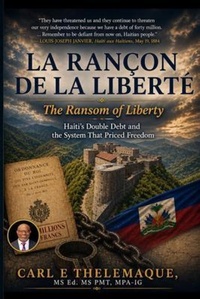
LA RANÇON DE LA LIBERTÉ The Ransom of Liberty
Description

In April 1825, the baron de Mackau arrived in Port-au-Prince harbor at the head of fourteen warships armed with five hundred twenty-two cannons. He carried an ordinance from King Charles X: France would recognize Haitian independence in exchange for 150 million francs - ten times Haiti's annual revenues - payable to the former colonists who had lost their "property" in the Haitian Revolution. The last payment on that debt cleared in 1947, one hundred forty-two years after independence.
The Ransom of Liberty: Haiti's Double Debt and the System That Priced Freedom traces the full two-century architecture of what historian Carl E. Thélémaque calls the double debt: the Independence Ransom of 1825 and the Occupation Debt of 1922, the mechanism by which a sovereign state was made to finance the conditions of its own subordination.
The book introduces a new analytical framework - Calendar Warfare - to describe the systematic use of dates as instruments of sovereignty suppression. Anniversaries, commemorations, and historical milestones were not passive markers of time. They were political weapons: the 1825 ordinance arrived precisely when Haiti was most vulnerable to economic isolation; the 1915 occupation foreclosed the debt's renegotiation; the coup of February 29, 2004 came fifty-nine days after Haiti's bicentennial, suppressing a $21 billion restitution claim that Jean-Bertrand Aristide had prepared for presentation on independence day.
Moving from the negotiations that preceded the 1825 ordinance through Louis-Joseph Janvier's 1884 diagnosis of debt as political control, through the U.S. occupation and the terminal account of 1947, through the Aristide restitution campaign and its violent suppression, and forward to the bicentennial of the ordinance in April 2025 - when France announced a binational commission and the French National Assembly filed Resolution No. 1267 calling for formal recognition of the historical debt - The Ransom of Liberty makes a single argument: the double debt was not an accident of history. It was a system. A system whose logic is still operating.
Engaging the scholarship of Michel-Rolph Trouillot, Laurent Dubois, Brenda Gayle Plummer, Peter James Hudson, and the 2022 New York Times investigation into the ransom, and drawing on primary sources from the Quai d'Orsay to the archives of the Haitian National Bank, The Ransom of Liberty is both a work of historical reconstruction and a framework for understanding how formal sovereignty can be made structurally empty - and what a full accounting would require.
