

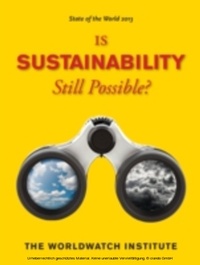
State of the World 2013
Description

Every day, we are presented with a range of "sustainable" products and activities-from "green" cleaning supplies to carbon offsets-but with so much labeled as "sustainable," the term has become essentially sustainababble, at best indicating a practice or product slightly less damaging than the conventional alternative. Is it time to abandon the concept altogether, or can we find an accurate way to measure sustainability? If so, how can we achieve it? And if not, how can we best prepare for the coming ecological decline? In the latest edition of Worldwatch Institute's State of the World series, scientists, policy experts, and thought leaders tackle these questions, attempting to restore meaning to sustainability as more than just a marketing tool. In State of the World 2013: Is Sustainability Still Possible?, experts define clear sustainability metrics and examine various policies and perspectives, including geoengineering, corporate transformation, and changes in agricultural policy, that could put us on the path to prosperity without diminishing the well-being of future generations. If these approaches fall short, the final chapters explore ways to prepare for drastic environmental change and resource depletion, such as strengthening democracy and societal resilience, protecting cultural heritage, and dealing with increased conflict and migration flows. State of the World 2013 cuts through the rhetoric surrounding sustainability, offering a broad and realistic look at how close we are to fulfilling it today and which practices and policies will steer us in the right direction. This book will be especially useful for policymakers, environmental nonprofits, and students of environmental studies, sustainability, or economics.
All prices
More details
Other editions
Additional editions
Person
Founded in 1974 by farmer and economist Lester Brown, Worldwatch was the first independent research institute devoted to the analysis of global environmental concerns. Worldwatch quickly became recognized by opinion leaders around the world for its accessible, fact-based analysis of critical global issues. Now under the leadership of population expert and author Robert Engelman, Worldwatch develops innovative solutions to intractable problems, emphasizing a blend of government leadership, private sector enterprise, and citizen action that can make a sustainable future a reality.
Content
Acknowledgments
State of the World: A Year in Review Alison Singer
1 Beyond Sustainababble Robert Engelman
THE SUSTAINABILITY METRIC
2 Respecting Planetary Boundaries and Reconnecting to the Biosphere Carl Folke
3 Defining a Safe and Just Space for Humanity Kate Raworth
4 Getting to One-Planet Living Jennie Moore and William E. Rees
5 Sustaining Freshwater and Its Dependents Sandra Postel
6 Sustainable Fisheries and Seas: Preventing Ecological Collapse Antonia Sohns and Larry Crowder
7 Energy as Master Resource Eric Zencey
8 Renewable Energy's Natural Resource Impacts Shakuntala Makhijani and Alexander Ochs
9 Conserving Nonrenewable Resources Gary Gardner
GETTING TO TRUE SUSTAINABILITY
10 Re-engineering Cultures to Create a Sustainable Civilization Erik Assadourian
11 Building a Sustainable and Desirable Economy-in-Society-in-Nature Robert Costanza, Gar Alperovitz, Herman Daly, Joshua Farley, Carol Franco, Tim Jackson, Ida Kubiszewski, Juliet Schor, and Peter Victor
12 Transforming the Corporation into a Driver of Sustainability Pavan Sukhdev
13 Corporate Reporting and Externalities Jeff Hohensee
14 Keep Them in the Ground: Ending the Fossil Fuel Era Thomas Princen, Jack P. Manno, and Pamela Martin
15 Beyond Fossil Fuels: Assessing Energy Alternatives T. W. Murphy, Jr.
16 Energy Efficiency in the Built Environment Phillip Saieg
17 Agriculture: Growing Food-and Solutions Danielle Nierenberg
18 Protecting the Sanctity of Native Foods Melissa K. Nelson
19 Valuing Indigenous Peoples Rebecca Adamson, Danielle Nierenberg, and Olivia Arnow
20 Crafting a New Narrative to Support Sustainability Dwight E. Collins, Russell M. Genet, and David Christian
21 Moving Toward a Global Moral Consensus on Environmental Action Kathleen Dean Moore and Michael P. Nelson
22 Pathways to Sustainability: Building Political Strategies Melissa Leach
23 Moving from Individual Change to Societal Change Annie Leonard
OPEN IN CASE OF EMERGENCY
24 Teaching for Turbulence Michael Maniates
25 Effective Crisis Governance Brian Martin
26 Governance in the Long Emergency David W. Orr
27 Building an Enduring Environmental Movement Erik Assadourian
28 Resistance: Do the Ends Justify the Means? Bron Taylor
29 The Promises and Perils of Geoengineering Simon Nicholson
30 Cuba: Lessons from a Forced Decline Pat Murphy and Faith Morgan
31 Climate Change and Displacements Michael Renner
32 Cultivating Resilience in a Dangerous World Laurie Mazur
33 Shaping Community Responses to Catastrophe Paula Green
34 Is It Too Late? Kim Stanley Robinson
Notes
Index.

