

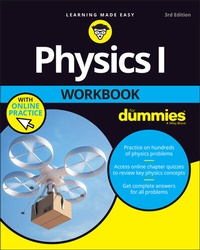
Physics I Workbook For Dummies with Online Practice
Description

Physics isn't the easiest part of high school, but it doesn't have to be pull-your-hair-out hard. In Physics I Workbook For Dummies, you get practical guidance to reinforce what you already know and master new physics concepts. You'll gain confidence in critical subject areas like motion, thermodynamics, and electromagnetism while setting yourself up for success in college- and university-level physics courses.
This book offers hands-on practice exercises in the book and on an online test bank that come with plain-English answers and step-by-step explanations so you can see what you did right and where you need practice. The perfect combination of instruction and application, Physics I Workbook For Dummies also provides:
* Understandable explanations of central physics concepts and the techniques you need to solve common problems
* Practice questions with complete answer explanations to test your knowledge as you progress
* Highlights of the ten most common pitfalls and traps that students encounter in physics assignments and exams and how to avoid them
* A collection of the ten most useful online physics resources, along with free, 1-year access to online chapter quizzes
Whether you're planning to tackle the MCAT one day or just want to improve your performance on your next physics test, Physics I Workbook For Dummies offers you an opportunity to master a rewarding and challenging subject that unlocks countless educational and career opportunities.
More details
Other editions
Additional editions
Person
Content
Chapter 1
Reviewing Physics Basics
IN THIS CHAPTER
Laying down measurements
Simplifying with scientific notation
Practicing conversions
Drawing on algebra and trigonometry
This chapter gets the ball rolling by discussing some fundamental physics measurements. At its root, physics is all about making measurements (and using those measurements as the basis of predictions), so it's the perfect place to start! As you go through the process of converting measurements from one unit to another, you'll practice applying math skills to physics problems.
Measuring the Universe
A great deal of physics has to do with making measurements - that's the way all physics gets started. For that reason, physics uses a number of measurement systems, such as the CGS (centimeter-gram-second) system and the MKS (meter-kilogram-second) system. You also use the standard English system of inches and feet and so on - that's the FPI (foot-pound-inch) system.
In physics, most measurements have units, such as meters or seconds. For example, when you measure how far and how fast a hockey puck slid, you need to measure both the distance in centimeters and the time in seconds.
For reference, Table 1-1 gives you the primary units of measurement in the MKS system.
Table 1-1 MKS Units of Measurement
Measurement
Unit
Abbreviation
Length
meter
m
Mass
kilogram
kg
Time
second
s or sec
Force
newton
N
Energy
joule
J
Pressure
pascal
P
Electric current
ampere
A
Magnetism
tesla
T
Electric charge
coulomb
C
These are the measuring sticks that will become familiar to you as you solve problems and triumph over the math in this workbook. Also for reference, Table 1-2 shows the primary units of measurement (and their abbreviations) in the CGS system. (Don't bother memorizing the ones you're not familiar with now; you can come back to them later as needed.)
Table 1-2 CGS Units of Measurement
Measurement
Unit
Abbreviation
Length
centimeter
cm
Mass
gram
g
Time
second
s or sec
Force
dyne
dyn
Energy
erg
erg
Pressure
barye
Ba
Electric current
biot
Bi
Magnetism
gauss
G
Electric charge
franklin
Fr
Q. You're told to measure the length of a racecar track using the MKS system. What unit(s) will your measurement be in?
A. The correct answer is meters. The unit of length in the MKS system is the meter.
1 You're told to measure the mass of a marble using the CGS system. What unit(s) will your measurement be in?
2 You're asked to measure the time it takes the moon to circle the Earth using the MKS system. What will your measurement's units be?
3 You need to measure the force a tire exerts on the road as it's moving using the MKS system. What are the units of your answer?
4 You're asked to measure the amount of energy released by a firecracker when it explodes using the CGS system. What are the units of your answer?
Putting Scientific Notation to Work
Physics deals with some very large and very small numbers. To work with such numbers, you use scientific notation. Scientific notation is expressed as a number multiplied by a power of 10.
For example, suppose you're measuring the mass of an electron in the MKS system. You put an electron on a scale (in practice, electrons are too small to measure on a scale - you have to see how they react to the pull of magnetic or electrostatic forces to measure their mass), and you measure the following:
What the heck is that? That's a lot of zeros, and it makes this number very unwieldy to work with. Fortunately, you know all about scientific notation, so you can convert the number into the following:
That is, 9.1 multiplied by a power of 10, . Scientific notation works by extracting the power of 10 and putting it on the side, where it's handy. You convert a number to scientific notation by counting the number of places you have to move the decimal point to get the first digit in front of that decimal point. For example, 0.050 is because you move the decimal point two places to the right to get 5.0. Similarly, 500 is because you move the decimal point two places to the left to get 5.0.
Check out this example question about scientific notation:
Q. What is 0.000037 in scientific notation?
A. The correct answer is . You have to move the decimal point five times to the right to get 3.7.
5 What is 0.0043 in scientific notation?
6 What is 430,000.0 in scientific notation?
7 What is 0.00000056 in scientific notation?
8 What is 6,700.0 in scientific notation?
Converting between Units
Physics problems frequently ask you to convert between different units of measurement. For example, you may measure the number of feet your toy car goes in three minutes and thus be able to calculate the speed of the car in feet per minute, but that's not a standard unit of measure, so you need to convert feet per minute to miles per hour, or meters per second, or whatever the physics problem asks for.
For another example, suppose you have 180 seconds - how much is that in minutes? You know that there are 60 seconds in a minute, so 180 seconds equals three minutes. Here are some common conversions between units:
The conversion between CGS and MKS almost always involves factors of 10 only, so converting between the two is simple. But what about converting to and from the FPI and other systems of measurement? Here are some handy conversions that you can come back to as needed:
- Length:
- Mass:
- Force:
- Energy:
- Power:
Because conversions are such an important part of physics problems, and because you have to keep track of them so carefully, there's a systematic way of handling conversions: You multiply by a conversion constant that equals 1, such that the units you don't want cancel out.
Q. A ball drops 5 meters. How many centimeters did it drop?
A. The correct answer is 500 centimeters. To perform the conversion, you do the following calculation:
Note that 100 centimeters divided by 1 meter equals 1 because there are 100 centimeters in a meter. In the calculation, the units you don't want - meters - cancel out.
9 How many centimeters are in 2.35 meters?
10 How many seconds are in 1.25 minutes?
11 How many inches are in 2.0 meters?
12 How many grams are in 3.25 kg?
Converting through Multiple Units
Sometimes you have to make multiple conversions to get what you want. That demands multiple conversion factors. For example, if you want to convert from inches to meters, you can use the conversion that 2.54 centimeters equals 1 inch - but then you have to convert from centimeters to meters, which means using another conversion factor.
Try your hand at this example question that involves multiple conversions:
Q. Convert 10 inches into meters.
A. The correct answer is 0.254 m.
- You know that , so start with that conversion...
