

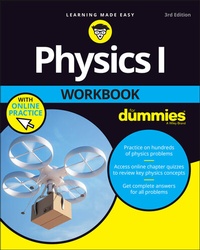
Physics I Workbook For Dummies with Online Practice
3rd Edition
Published on 25. November 2021
352 pages
978-1-119-71648-8 (ISBN)
Description

Nail your next physics exam and prepare yourself for the next level of physics education
Physics isn't the easiest part of high school, but it doesn't have to be pull-your-hair-out hard. In Physics I Workbook For Dummies, you get practical guidance to reinforce what you already know and master new physics concepts. You'll gain confidence in critical subject areas like motion, thermodynamics, and electromagnetism while setting yourself up for success in college- and university-level physics courses.
This book offers hands-on practice exercises in the book and on an online test bank that come with plain-English answers and step-by-step explanations so you can see what you did right and where you need practice. The perfect combination of instruction and application, Physics I Workbook For Dummies also provides:
* Understandable explanations of central physics concepts and the techniques you need to solve common problems
* Practice questions with complete answer explanations to test your knowledge as you progress
* Highlights of the ten most common pitfalls and traps that students encounter in physics assignments and exams and how to avoid them
* A collection of the ten most useful online physics resources, along with free, 1-year access to online chapter quizzes
Whether you're planning to tackle the MCAT one day or just want to improve your performance on your next physics test, Physics I Workbook For Dummies offers you an opportunity to master a rewarding and challenging subject that unlocks countless educational and career opportunities.
Physics isn't the easiest part of high school, but it doesn't have to be pull-your-hair-out hard. In Physics I Workbook For Dummies, you get practical guidance to reinforce what you already know and master new physics concepts. You'll gain confidence in critical subject areas like motion, thermodynamics, and electromagnetism while setting yourself up for success in college- and university-level physics courses.
This book offers hands-on practice exercises in the book and on an online test bank that come with plain-English answers and step-by-step explanations so you can see what you did right and where you need practice. The perfect combination of instruction and application, Physics I Workbook For Dummies also provides:
* Understandable explanations of central physics concepts and the techniques you need to solve common problems
* Practice questions with complete answer explanations to test your knowledge as you progress
* Highlights of the ten most common pitfalls and traps that students encounter in physics assignments and exams and how to avoid them
* A collection of the ten most useful online physics resources, along with free, 1-year access to online chapter quizzes
Whether you're planning to tackle the MCAT one day or just want to improve your performance on your next physics test, Physics I Workbook For Dummies offers you an opportunity to master a rewarding and challenging subject that unlocks countless educational and career opportunities.
More details
Other editions
Additional editions
Consumer Dummies
Physics I Workbook For Dummies with Online Practice
Book
02/2022
Wiley
€27.50
Shipment within 15-20 days
Person
The Experts at Dummies are smart, friendly people who make learning easy by taking a not-so-serious approach to serious stuff.
Content
- Intro
- Title Page
- Copyright Page
- Table of Contents
- Introduction
- About This Book
- Foolish Assumptions
- Icons Used in This Book
- Beyond the Book
- Where to Go from Here
- Part 1 Getting Started with Physics
- Chapter 1 Reviewing Physics Basics
- Measuring the Universe
- Putting Scientific Notation to Work
- Converting between Units
- Converting through Multiple Units
- Converting Times
- Counting Significant Figures
- Coming Prepared with Some Algebra
- Being Prepared with Trigonometry
- Answers to Problems about Physics Basics
- Chapter 2 The Big Three: Displacement, Velocity, and Acceleration
- From Point A to B: Displacement
- Reading That Speedometer
- Putting Pedal to Metal: Acceleration
- Connecting Acceleration, Time, and Displacement
- Connecting Velocity, Acceleration, and Displacement
- Answers to Problems about Displacement, Velocity, and Acceleration
- Chapter 3 Vectors: Knowing Where You're Headed
- Creating a Vector
- Understanding Vector Components
- Finding a Vector's Components
- Finding a Vector's Magnitude and Direction
- Adding Vectors Together
- Handling Velocity as a Vector
- Answers to Problems about Vectors
- Part 2 May the Forces Be with You
- Chapter 4 Applying Force
- Newton's First Law of Motion
- Newton's Second Law of Motion
- Force Is a Vector
- Calculating Net Force and Acceleration
- Sorting Out Weight and Mass
- The Balancing Act of Equilibrium
- Newton's Third Law of Motion
- Answers to Problems about Force
- Chapter 5 Working with Inclined Planes
- Breaking Ramps Up into Vectors
- Acceleration and Inclined Planes
- Running Down Ramps: Speed
- Friction on Inclined Planes
- Starting from zero: Static friction
- Already in motion: Kinetic friction
- Static Friction along Ramps
- Kinetic Friction along Ramps
- Acceleration along Ramps Including Friction
- Answers to Problems about Inclined Planes
- Chapter 6 Round and Round: Circular Motion
- Converting between Angles
- Period and Frequency
- Getting into Angular Velocity
- Whipping Around with Angular Acceleration
- Connecting Angular Velocity and Angular Acceleration to Angles
- Connecting Angular Acceleration and Angle to Angular Velocity
- Handling Centripetal Acceleration
- Getting Forceful: Centripetal Force
- Answers to Problems about Circular Motion
- Part 3 Being Energetic: Work
- Chapter 7 Working the Physics Way
- A Different Kind of Work
- Dealing with the Net Force
- Getting Energetic: Kinetic Energy
- Getting Kinetic Energy from Work
- Storing Your Energy: Potential Energy
- Powering It Up
- Answers to Problems about Work
- Chapter 8 Getting Things to Move: Momentum and Kinetic Energy
- Acting on Impulse
- Getting Some Momentum
- Relating Impulse and Momentum
- Conserving Momentum
- Conserving Kinetic Energy - or Not
- Collisions in Two Dimensions
- Answers to Problems about Momentum and Kinetic Energy
- Chapter 9 Winding It Up: Rotational Motion and Torque
- Finding Tangential Speed
- Targeting Tangential Acceleration
- Angular Velocity as a Vector
- Angular Acceleration as a Vector
- Doing the Twist: Torque
- The Balancing Act: Rotational Equilibrium
- Answers to Problems about Rotational Motion and Torque
- Chapter 10 Getting Dizzy with Rotational Dynamics
- Putting Newton on Wheels
- Moments of Inertia for Everyone
- Doing Some Rotational Work
- Round and Round: Rotational Kinetic Energy
- Working with Ramps Again
- Can't Stop This: Angular Momentum
- Answers to Problems about Rotational Dynamics
- Chapter 11 Simple Harmonic Motion
- Hooking into Hooke's Law
- Simply Simple Harmonic Motion
- Getting Periodic
- Considering Velocity
- Figuring the Acceleration
- Bouncing Around with Springs
- Talking about Energy
- Following the Ticktock of Pendulums
- Answers to Problems about Simple Harmonic Motion
- Part 4 Obeying the Laws of Thermodynamics
- Chapter 12 You're Getting Warm: Thermodynamics
- Converting between Temperature Scales
- Getting Bigger: Linear Expansion
- Plumping It Up: Volume Expansion
- Getting Specific with Heat Capacity
- Changes of Phase: Latent Heat
- Answers to Problems about Thermodynamics
- Chapter 13 Under Pressure: From Solid to Liquid to Gas
- How Heat Flows: Convection
- How Heat Is Produced: Conduction
- How Heat Is Produced: Radiation
- A Biggie: Avogadro's Number
- Ideally Speaking: The Ideal Gas Law
- Molecules in Motion
- Answers to Problems about Pressure
- Chapter 14 All about Heat and Work
- The First Law of Thermodynamics
- Constant Pressure: Isobaric Processes
- Constant Volume: Isochoric Processes
- Constant Temperature: Isothermal Processes
- At Constant Heat: Adiabatic
- The Direction of Heat: The Second Law of Thermodynamics
- Making Heat Work: Heat Engines
- Maximum Efficiency: Carnot Heat Engines
- The Third Law of Thermodynamics
- Answers to Problems about Heat and Work
- Part 5 Zap: Electricity
- Chapter 15 Static Electricity: Electrons at Rest
- Talking about Electric Charges
- Getting Forceful with Charges
- Electrical Forces Are Vectors
- Force at a Distance: Electric Fields
- Easy Electric Field: Parallel Plate Capacitors
- Ramping Up Some Voltage
- Electric Potential from Point Charges
- Answers to Problems about Static Electricity
- Chapter 16 Electrons in Motion: Circuits
- Electrons in a Whirl: Current
- Giving You Some Resistance: Ohm's Law
- Powering It Up
- One after the Other: Series Circuits
- All for One: Parallel Circuits
- The Whole Story: Kirchhoff's Rules
- Answers to Problems about Circuits
- Part 6 The Part of Tens
- Chapter 17 Ten Common Mistakes People Make When Solving Problems
- Mixing Units
- Expressing the Answer in the Wrong Units
- Swapping Radians and Degrees
- Getting Sines and Cosines Mixed Up
- Failing to Treat Vectors as Vectors
- Neglecting Latent Heat
- Getting the Direction of Forces Wrong
- Getting the Signs Wrong in Kirchhoff Loops
- Adding Resistors Incorrectly
- Using the Wrong Temperature in the Ideal Gas Law
- Chapter 18 Ten Wild Physics Theories
- The Universal Speed Limit
- Through the Looking Glass, and What Chien-Shiung Found There
- Wanted: Dead and Alive
- Quantum Objects Can Tunnel
- Mass Is a Kind of Energy
- Vacuum Is Not Just Empty Space
- "Constants" in Physics Change
- Stuck in the Middle of a Proton
- The Expansion of the Universe Is Accelerating
- Some Things Never Change
- Index
- EULA
