

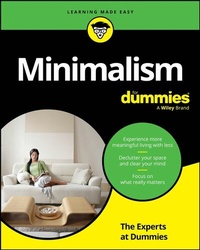
Minimalism For Dummies
Description

Start your journey toward a more intentional, less cluttered life
Tired of feeling buried under your belongings? Ready to break free from the cycle of buying, storing, and managing stuff that doesn't actually make you happier? Minimalism For Dummies shows you how to create space for what truly matters by letting go of what doesn't.
This practical guide covers the fundamentals of minimalist living, from your first decluttering session to mindful spending strategies. You'll learn how to downsize without sacrifice, build budgets that align with your values, and even explore game-changing concepts like the F.I.R.E. movement that's helping people retire decades early.
- Start your minimalist journey with confidence-even if you're a natural collector
- Transform cluttered spaces into calm, functional environments
- Make smarter money decisions that fund experiences over possessions
- Join a community of people choosing intention over accumulation
Stop managing your stuff and start designing your life. Your journey to freedom, clarity, and genuine contentment starts here.
More details
Other editions
Additional editions
Person
The Experts at Dummies The wisdom of authors including Athena Valentine Lent, Jane Stoller, Eric Tyson, Ralph R. Roberts, Kathleen Roberts, Eileen Roth, Elizabeth Miles, Paula N. Mugabi, David N. Greenfield, Shamash Alidina, and more.
Content
Introduction 1
Part 1: Getting into a Minimalist Mindset 5
CHAPTER 1: Meeting Minimalism 7
CHAPTER 2: Realizing How Less Really Is More 15
CHAPTER 3: Defining "Enough" and Setting Goals to Get There 27
Part 2: Living Lighter, One Room at a Time 41
CHAPTER 4: Creating Functional Minimalist Spaces 43
CHAPTER 5: Restoring Simplicity to Getting Dressed 57
CHAPTER 6: Creating Calm Where You Rest and Refresh 79
CHAPTER 7: Clearing the Kitchen 101
CHAPTER 8: Simplifying Where You Work and Unwind 121
CHAPTER 9: Practicing Mindful Consumption and Quality Care 141
Part 3: Aligning Your Money with What Matters 153
CHAPTER 10: Aligning Your Purchases with Your Priorities 155
CHAPTER 11: Bringing Intention to Your Spending 163
CHAPTER 12: Ditching Debt to Lighten Your Minimalist Load 183
CHAPTER 13: Building Wealth without Building Stress 201
Part 4: Dialing Down the Digital Overload 211
CHAPTER 14: Understanding Digital Overload 213
CHAPTER 15: Bringing Order to Digital Chaos 223
CHAPTER 16: Getting Minimalist When Sharing, Watching, and Playing 239
Part 5: Following a Minimalist Lifestyle 249
CHAPTER 17: Simplifying Your Meals, Moves, and Moments 251
CHAPTER 18: Planning for Major Life Transitions 265
Part 6: The Part of Tens 283
CHAPTER 19: Ten Benefits of Minimalism 285
CHAPTER 20: Ten Tips to Make Minimizing Easier 291
CHAPTER 21: Ten Ways to Reduce Your Living Expenses 297
CHAPTER 22: Ten Ways to Support Minimalism with Mindfulness 303
Index 315
Chapter 1
Meeting Minimalism
IN THIS CHAPTER
Understanding what minimalism is and how it can help you
Removing too much stuff and creating clutter-free, quieter spaces
Bringing intention to your decisions
The stereotypes of a minimalist abound. Owns one chair; it's uncomfortable. Rotates between seven identical black shirts. Reuses zip-top baggies from five years ago. Chooses a flip phone "for clarity." These are certainly "less" versus "more" choices. Are they the right choices for you? Maybe.
But your version could tilt more toward a family room with cozy seating for eight and still space for an impromptu dance party. Or a closet where hangers don't touch and enough options so you feel confident dressing for any occasion. Or a phone with the apps you need and photos you can find the first time you look for them.
Grab your one fork and let's dig in.
Getting the Lowdown on Minimalism
Most of us don't set out to live cluttered, distracted lives - it just gradually and quietly happens. Stuff accumulates because we keep more than we get rid of. Schedules fill up and we bob from one activity to another as life ever accelerates. Money decisions start to feel reactive as we try to keep up with day-to-day living while not completely losing sight of the future. And our phones and other technology compete for every spare moment of attention, at stop lights, before going to sleep, and any time we have more than ten seconds to wait.
Somewhere along the way, it gets harder to focus on what actually matters. That's where minimalism comes in - not as a trend or a set of strict rules, but as a way to mindfully live your life.
Mentioning minimalism's meaning
Many people's definition of minimalism is pretty spare - few possessions, little color, lots of negative space, modern aesthetic. That's certainly the stereotype. And we agree with some of it. A minimalist life helps you feel calm and in control in a world that can feel overloaded and chaotic, and it can help you focus on what matters.
We don't think minimalism means owning little (although it likely means owning less), and we don't care what type of furniture you have or how seldom you check email.
For us, minimalism is about making choices on purpose - getting rid of distractions so you can focus on what really matters, and making more intentional choices about your stuff, your money, and your digital life so you can better appreciate this world and the people in it.
Your definition of what's important and what's distraction won't necessarily be the same as your best friend's, and it may not match the thinking of the latest minimalist influencer. And that's okay. What's important is that you decide what makes sense for you. And your priorities and goals will change as your life changes, so as you navigate this book and determine what minimalism means to you, know that you may rejigger that definition more than once as you move through life's seasons.
Gaining more by having less
You might be drawn to minimalism because you want more calm, more clarity, and more space for the people, goals, and moments that make life feel meaningful again.
In the face of a lot of stuff, which most of us have too much of, a minimalist lifestyle can make everyday life feel more manageable and less distracting. By owning less (and making sure what you own feels meaningful), being more thoughtful about how you use your money, and setting boundaries around technology, it becomes easier to pay attention to what matters to you. Decisions take less effort because there are fewer to make, and there's less in the background competing for your attention. Take a look at Chapter 2 for a deeper dive into minimalism and its benefits and Chapter 3 to determine what "enough" means to you.
Over time, minimalism helps you align daily habits with your priorities, rather than reacting to whatever's most loudly demanding a response. The goal isn't perfection or deprivation, but a steadier, calmer way of living that leaves more room for the people, activities, and values you care about. Chapter 3 can help you determine your goals and priorities, which then guide decisions about what you own, how you spend your money, and how you spend your time.
Decluttering Your Physical Spaces
Whether your definition of minimalism is strict and includes only the bare necessities, or it's expansive and includes many nice-to-haves, a minimalist house is one without clutter. By the time you're done decluttering, every piece of furniture, every article of clothing, every kitchen gadget and office accessory will have been thoughtfully reviewed and retained because they support your minimalist goals, or removed because they don't.
Considering how long it'll take
Getting to a decluttered state isn't quick and it's sometimes not easy; you may feel a lot of feelings as you take numerous trips down memory lane. But paring back your possessions is more time-consuming than it is difficult. If you've had a couple of decades or more to accumulate all that you own, it'll take more than a few weeks to review and get rid of all of the items that you don't want anymore. It could take you several months, depending on how much time you can allocate to the declutter process. But that's okay. Modest progress is still progress, and that's worth celebrating.
Getting going, one space at a time
Start by gathering supplies and developing a game plan (see Chapter 4). Having some bins or boxes on-hand to categorize keepers from the rest makes it easier to organize items once you're done. Then go through your home room by room, reviewing everything you own and deciding what to keep and what to get rid of (and what to do with the stuff you don't want it anymore). You can start anywhere you want; this book kicks off with the closet and all your clothes, shoes, and accessories (see Chapter 5), but you can start elsewhere if you'd rather. And it can be hard for some people to get going - if your closet is packed full, or even if there's still plenty of room to maneuver items, you may struggle to take the first step.
The idea of reviewing your whole home can be a bit much for even the most decisive among us. So we recommend starting with something small - your shoes, your jewelry, your baseball hat collection. Action creates momentum, and once you get going it's easier to continue.
You'll hit all the main spaces in your home - bedrooms and bathrooms (Chapter 6); the kitchen (Chapter 7); and your living space, your workspace, and storage areas (Chapter 8).
Get the kids to help if you've got any living at home (earning their keep, especially if they're older!), enlist the help of friends, and grab your partner or roommate to assist at least with areas you frequently share with them. Although you'll probably want to make the keep/discard call on some precious items, you can easily give broad guidelines that'll allow helpers to make decisions for about 80 percent of the items that cross their paths.
Once you've decided what to keep, make sure to take care of the items so they have a good long life; Chapter 9 gives you tips to do so.
Being Minimalist with Your Money
Minimalism isn't just for where you live and work. As with general minimalism, having a minimalist mindset about your finances can help you understand (or establish) your financial goals (see Chapter 10) and then make decisions that help you achieve them. Regardless of how much money you make or how much savings or debt you have, aligning your financial decisions with what's important to you helps remove distractions so you can stay focused on what matters.
Benefiting from a budget
We think a smart first step is to establish a budget. We firmly believe that living within your means is a goal everyone should have, particularly minimalists who are seeking to escape the trappings of excess, and the easiest way to do that is to create a budget and then monitor your spending so you stick to your monthly financial plan. Chapter 11 helps you figure out where you're spending your money so you can align your spending with your income, if needed, and so you can create a budget based on your needs.
Ditching debt
Another important step in financial minimalism (and a good personal finance practice in general) is to get rid of debt. Unless you've borrowed money with no interest and an infinite time to repay it, you want to eliminate your debt as soon as your circumstances allow - the longer you owe money to a person or a lender, the more interest you're paying, and you'd rather keep that money for yourself! Chapter 12 gives lots of tips on chipping away at and finally eliminating debt that you owe.
Making investments
Once your debt's paid off, it's time to make your money earn for you. Enter Chapter 13, which covers investments. We think lending investments (such as high-yield savings and bonds) are preferable, low-risk choices. And ownership investments,...
