

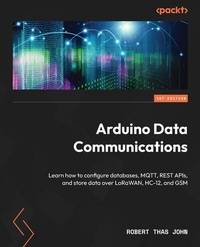
Arduino Data Communications
Description

Key Features
Set up databases to store and retrieve information collected from various sensors
Ingest your data into your database for storage with REST APIs and MQTT
Communicate with your application layer using different communication technologies from Arduino MKR and Portenta H7
Purchase of the print or Kindle book includes a free PDF eBook
Book DescriptionIn our modern, internet-connected world, where billions of devices constantly collect and send data to systems to be stored and processed, it's surprising how the intricacies of data transmission and storage are often overlooked in the IoT domain. With Arduino Data Communications, you'll bridge the knowledge gap and become an expert in collecting data from IoT sensors, transmitting data, and configuring your own databases. This book is an exploration of IoT's inner workings, guiding you through the process of setting up an end-to-end system that you can employ to prototype your own IoT solutions, using easy-to-follow examples. It begins with a general overview of the Arduino ecosystem, acquainting you with various sensors and shields and unveiling the art of data collection. You'll then explore data formats and methods to store data, both locally and on database servers. As you progress through the chapters, you'll learn how to set up REST and MQTT infrastructure to communicate with databases and get hands-on with LoRaWAN, Ethernet, cellular, HC-12, and RS-485. The final chapters are your training ground for real-world projects, imparting the essential knowledge you need to tackle complex challenges with confidence. By the end of this Arduino book, you'll have seamlessly configured an end-to-end system, all while immersing yourself in practical scenarios that bring the world of IoT to life.What you will learn
Explore data storage formats for both local and remote storage solutions
Build projects that leverage the variety of communication standards
Set up a database to host data transmitted from various projects
Use MQTT and RESTful APIs to send data from devices to remote systems
Prepare for multiple devices using high availability measures
Use LoRa by implementing a gateway and a client
Transmit temperature and humidity data over RS-485 and HC-12
Who this book is forThis book is for embedded systems engineers and electronics engineers who want to build IoT devices and gain insights into storing data collected from these devices, as well as establish communication between devices. The skills you learn in this book will come in handy even if your final product isn't built on Arduino. While prior experience with computers is assumed, expertise with embedded systems such as Arduino is not a prerequisite. Familiarity with Arduino programming will be beneficial, but not necessary.
All prices
More details
Other editions
Additional editions

Person
He started his career as a software engineer with work that has spanned various industries. His first experience with embedded systems was in programming payment terminals.
Content
Getting Started with Arduino
Leveraging Various Sensors for Data Acquisition
Prototyping with Shields
Storing Data Collected from Sensors
Implementing REST and MQTT Protocols for Communication
Utilizing Various Communication Technologies
Communicating with LoRaWAN
Working with Ethernet
Leveraging Cellular Communication Technology
Communicating via HC-12
Managing Communication with RS-485
Enhancing Security for Reducing Risk
Scaling for High Availability
Building and Manufacturing Hardware
Preface
I spent nearly two decades of my life writing software, training and deploying machine learning models, and speaking and teaching about these topics. I got introduced to Stephen Ozoigbo at ARM, who asked whether I had any experience speaking about ML on microcontrollers. I didn't, but I was willing to look into that. That was the beginning of my journey into TinyML. He sent me some kits from SparkFun Electronics, which I used for a 20-person workshop in 2021. I spent the next 12 months talking to developer communities in Sub-Saharan Africa about ML on the Arduino Nano RP2040 Connect. I also organized something I called the Embedded Learning Challenge, with microcontrollers paid for by ARM. All this exposed a knowledge gap on the continent when it comes to a basic understanding of microcontrollers. This book is meant to serve as an introduction to programming Arduinos. The choice of the Arduino MKR is because of the existence of certain shields that are good for learning how to work with these components without learning how to solder. My hope for you is that you will use this as a stepping stone toward solving real-world problems.
Who this book is for
If you have never programmed a microcontroller and you are wondering what all the buzz is about, especially around the Internet of Things (IoT), then this book is a great starter. If you have programmed microcontrollers but don't know about the infrastructure that stores data, this book will serve as an introduction to databases and data storage.
What this book covers
Chapter 1, Getting Started with Arduino, introduces you to the Arduino ecosystem and teaches you how to write your first lines of code.
Chapter 2, Leveraging Various Sensors for Data Acquisition, looks at various categories of sensors that exist within the Arduino ecosystem for reading data from the environment.
Chapter 3, Prototyping with Shields, gives an introduction to shields, which extend microcontrollers with various capabilities without requiring soldering knowledge.
Chapter 4, Storing Data Collected from Sensors, shows how to store data in files on a micro-SD card.
Chapter 5, Implementing REST and MQTT Protocols for Communication, teaches you how to set up REST APIs to read from and write to databases.
Chapter 6, Utilizing Various Communication Technologies, gives a brief overview of various communication options and which ones to consider based on the distance you need to cover.
Chapter 7, Communicating with LoRaWAN, shows how to set up a gateway and send data to The Things Network.
Chapter 8, Working with Ethernet, shows how to read data from a weather API over Ethernet and use that to make decisions when the situation doesn't allow for wireless communications.
Chapter 9, Leveraging Cellular Communication Technology, looks at how to choose a cellular radio, send and receive data over SMS and GPRS, and make phone calls.
Chapter 10, Communicating via HC-12, shows how to set up HC-12 modules, and how to send and receive data using them.
Chapter 11, Managing Communication with RS-485, looks at communicating over RS-485 and Modbus in an environmental setting.
Chapter 12, Enhancing Security for Reducing Risk, explains the threat that exists when you transmit or store data, and how you can reduce such risks.
Chapter 13, Scaling for High Availability, explores why you need to ensure that the systems that collect and store your data are available a majority of the time and strategies to consider in order to make that happen.
Chapter 14, Building and Manufacturing Hardware, discusses going from solutions based on breadboards and shields to products that you can take out into the field and test.
To get the most out of this book
You will need a version of the Arduino IDE installed on your computer. All code examples have been tested with Arduino IDE 2.2.1 running on a MacBook Pro with Intel Core but should work on other operating systems and future versions of the Arduino IDE.
Software/hardware covered in the book
Operating system requirements
Arduino IDE 2.2.1
Windows, macOS, or Linux
Python 3.7
JavaScript
Arduino MKR WiFi 1010
You will need an Arduino Portenta together with an Arduino Portenta Vision Shield - Ethernet for the code examples in Chapter 8. A little knowledge of either JavaScript or Python will help you understand the code examples in Chapter 5.
If you are using the digital version of this book, we advise you to type the code yourself or access the code from the book's GitHub repository (a link is available in the next section). Doing so will help you avoid any potential errors related to the copying and pasting of code.
Download the example code files
You can download the example code files for this book from GitHub at https://github.com/PacktPublishing/Arduino-Data-Communications/. If there's an update to the code, it will be updated in the GitHub repository.
We also have other code bundles from our rich catalog of books and videos available at https://github.com/PacktPublishing/. Check them out!
Code in Action
The Code in Action videos for this book can be viewed at https://packt.link/fglee.
Conventions used
There are a number of text conventions used throughout this book.
Code in text: Indicates code words in text, database table names, folder names, filenames, file extensions, pathnames, dummy URLs, user input, and Twitter handles. Here is an example: "The first section, void setup() {}, holds code that will be run exactly once when the microcontroller boots up."
A block of code is set as follows:
#include "Display.hpp" void setup() { Display::initialize(); Display::print_lcd("Hello, world", "of embedded"); } void loop() { }When we wish to draw your attention to a particular part of a code block, the relevant lines or items are set in bold:
#include "MyEnv.hpp" #include "MyNTPClient.hpp" #include <Arduino_MKRENV.h> #include <SPI.h> #include <SD.h>Any command-line input or output is written as follows:
mkdir MyAPI cd MyAPIBold: Indicates a new term, an important word, or words that you see onscreen. For instance, words in menus or dialog boxes appear in bold. Here is an example: "Click on Install, below the library provided by DFRobot."
Tips or important notes
Appear like this.
Get in touch
Feedback from our readers is always welcome.
General feedback: If you have questions about any aspect of this book, email us at customercare@packtpub.com and mention the book title in the subject of your message.
Errata: Although we have taken every care to ensure the accuracy of our content, mistakes do happen. If you have found a mistake in this book, we would be grateful if you would report this to us. Please visit www.packtpub.com/support/errata and fill in the form.
Piracy: If you come across any illegal copies of our works in any form on the internet, we would be grateful if you would provide us with the location address or website name. Please contact us at copyright@packt.com with a link to the material.
If you are interested in becoming an author: If there is a topic that you have expertise in and you are interested in either writing or contributing to a book, please visit authors.packtpub.com.
Share Your Thoughts
Once you've read Arduino Data Communications, we'd love to hear...
