

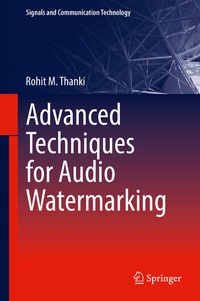
Advanced Techniques for Audio Watermarking
Description

This book provides information on digital audio watermarking, its applications, and its evaluation for copyright protection of audio signals - both basic and advanced. The author covers various advanced digital audio watermarking algorithms that can be used for copyright protection of audio signals. These algorithms are implemented using hybridization of advanced signal processing transforms such as fast discrete curvelet transform (FDCuT), redundant discrete wavelet transform (RDWT), and another signal processing transform such as discrete cosine transform (DCT). In these algorithms, Arnold scrambling is used to enhance the security of the watermark logo. This book is divided in to three portions: basic audio watermarking and its classification, audio watermarking algorithms, and audio watermarking algorithms using advance signal transforms. The book also covers optimization based audio watermarking.
- Describes basic of digital audio watermarking and its applications, including evaluation parameters for digital audio watermarking algorithms;
- Provides audio watermarking algorithms using advanced signal transformations;
- Provides optimization based audio watermarking algorithms.
More details
Other editions
Additional editions
Person
Dr. Rohit M. Thanki earned his Ph.D. in multibiometric system security using the compressive sensing theory and watermarking from C. U. Shah University, Wadhwan City, Gujarat, India, in 2017. His areas of research are digital watermarking, the biometrics system, security, compressive sensing, pattern recognition, and image processing. He has published 10 books, 13 book chapters, and more than 25 research papers in refereed and indexed journals, and has participated in conferences at the international and national level. His international recognition includes professional memberships and services in refereed organizations and program committees and being a reviewer for journals published by the Institute of Electrical and Electronics Engineers (IEEE), Elsevier, Taylor & Francis, Springer, and IGI Global.
Content
Chapter 1. Introduction.- Chapter 2. Mathematical Preliminaries.- Chapter 3. Fundamentals of Audio Watermarking.- Chapter 4. Blind Audio Watermarking.- Chapter 5. Audio Watermarking with Encryption.- Chapter 6. Optimization based Audio Watermarking.- Chapter 7 Summary of Book.
