

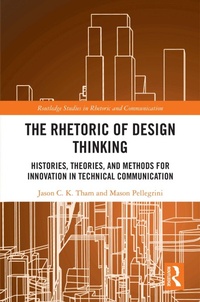
The Rhetoric of Design Thinking
Histories, Theories, and Methods for Innovation in Technical Communication
Published on 10. November 2025
216 pages
978-1-040-50377-5 (ISBN)
Description

This book offers a comprehensive exploration of design thinking, positioning it as an evolving, multidisciplinary framework essential to advancing technical and professional communication (TPC).
Recognizing design thinking as both practice and philosophy, the book traces its historical evolution and theoretical foundations, examining how it operates within and across various fields. The text critically investigates popular design thinking models, highlighting their adaptability and potential for fostering innovation, empathy, and equity in outcomes. It also critiques design thinking as a matter of practice and a reality of life by identifying and challenging the limitations of technologies, tools, and design techniques. Drawing on rhetoric, cognitive psychology, ethics, and technology, the book illustrates design thinking's capacity to transcend traditional disciplinary silos, through new discussions about the power dynamics of design methodologies.
This book encourages thoughtful integration of design thinking into communication practices to promote a more inclusive, global approach to innovation and problem-solving. It provokes deeper critical engagement among scholars, educators, and practitioners in the fields of Technical Communication, Rhetoric, Design Studies, and Communication Studies.
Recognizing design thinking as both practice and philosophy, the book traces its historical evolution and theoretical foundations, examining how it operates within and across various fields. The text critically investigates popular design thinking models, highlighting their adaptability and potential for fostering innovation, empathy, and equity in outcomes. It also critiques design thinking as a matter of practice and a reality of life by identifying and challenging the limitations of technologies, tools, and design techniques. Drawing on rhetoric, cognitive psychology, ethics, and technology, the book illustrates design thinking's capacity to transcend traditional disciplinary silos, through new discussions about the power dynamics of design methodologies.
This book encourages thoughtful integration of design thinking into communication practices to promote a more inclusive, global approach to innovation and problem-solving. It provokes deeper critical engagement among scholars, educators, and practitioners in the fields of Technical Communication, Rhetoric, Design Studies, and Communication Studies.
Reviews / Votes
"The Rhetoric of Design Thinking forwards methodological discussions of design, and helps readers view design thinking as a lens for understanding innovation. This book is a needed contribution to the ongoing conversation about how we can use design thinking to make the world a better, safer place for everyone. Not only does the book help readers bring about better design outcomes, but it also advances existing conversations by synthesizing multiple, sometimes disparate, strands of knowledge across disciplines. As someone who facilitates design thinking in multiple domains, I've found the discussions in this book helpful for establishing the historical and technological context surrounding design thinking practices and how this context informs group dynamics."Ben Lauren, University of Miami, USA
"What does design thinking have to do with technical and professional communication? Quite a lot, as Tham and Pellegrini demonstrate in this book. Not only do they provide historical, theoretical, and practical insights into design thinking, they also reinterpret it in terms of TPC's theories, concerns, and design methodologies. Along the way, they consider ethical research principles; discuss how to make design thinking more inclusive, ethical, and interdisciplinary; and consider how to develop design thinking further to meet TPC-specific needs. This useful, far-ranging guide will help technical and professional communicators seeking to understand their audiences, ethically with their felt problems, and codesign solutions that respond to the ethical, social, and technological dimensions of those problems."
Clay Spinuzzi, University of Texas at Austin, USA
"The Rhetoric of Design Thinking is a much-needed addition to the field of professional and technical communication, offering a comprehensive framework for understanding design thinking as more than an industry buzzword. Tham and Pellegrini helpfully contextualize design thinking's historical, rhetorical, and technological foundations, making the case for its relevance to both TPC scholars and practitioners. The authors move beyond surface-level treatments to position design thinking as a rhetorical and ethical methodology that promotes equity, interdisciplinarity, and user-centered inquiry. This accessible work not only expands the theoretical landscape of the field but also equips it to better address complex communicative and societal challenges with empathy and agility."
Erin Friess, University of North Texas, USA
More details
Series
Language
English
Place of publication
London
United Kingdom
Publishing group
Taylor & Francis Ltd
Target group
College/higher education
Professional and scholarly
Illustrations
3 Tables, black and white; 11 Line drawings, black and white; 9 Halftones, black and white; 20 Illustrations, black and white
File size
6,13 MB
ISBN-13
978-1-040-50377-5 (9781040503775)
Copyright in bibliographic data and cover images is held by Nielsen Book Services Limited or by the publishers or by their respective licensors: all rights reserved.
Schweitzer Classification
Other editions
Additional editions
Jason C.K. Tham | Mason Pellegrini
The Rhetoric of Design Thinking
Histories, Theories, and Methods for Innovation in Technical Communication
Book
11/2025
1st Edition
Routledge
€206.20
Shipment within 10-20 days
Persons
Jason C. K. Tham is an Associate Professor of Technical Communication and Rhetoric at Texas Tech University, USA. His recent publications include Design Thinking in Technical Communication (2021), Designing Technical and Professional Communication (2021), UX Writing (2023), and Designing for Social Justice (2025). He is chief editor of Computers and Composition.
Mason Pellegrini is an Assistant Professor of Technical Communication and Rhetoric at Texas Tech University, USA.
Mason Pellegrini is an Assistant Professor of Technical Communication and Rhetoric at Texas Tech University, USA.
Content
Preface Acknowledgements Author Information 1. Introduction 2. Historical Overview of Design Thinking 3. Essential Theories of Design Thinking 4. Rhetorical Concepts and Design Thinking 5. From Discovery to Definition 6. From Ideas to Delivery 7. Technologies of Design Thinking for Innovation 8. Conclusion
