

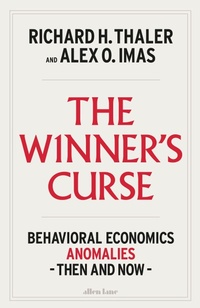
The Winner's Curse
Behavioral Economics Anomalies Then and Now
Published on 21. October 2025
352 pages
978-1-83731-100-2 (ISBN)
Description

Nobel Prize-winner and co-author of Nudge, Richard Thaler, and rising star economist Alex Imas explore behavioral economics in this fully updated edition of the seminal work The Winner's Curse
Why do people cooperate with one another when they have no incentive to do so? Why do we hold onto possessions of little value? And why is the winner of an auction so often disappointed?
Over thirty years ago, Richard Thaler introduced readers to behavioral economics in his seminal Anomalies column, written with collaborators including Daniel Kahneman and Amos Tversky. These provocative articles challenged the fundamental idea at the heart of economics that people are selfish, rational optimizers, and provided the foundation for what became behavioral economics. That was then. Now, three decades later, Thaler has teamed up with economist Alex Imas to write a new book. Every chapter starts with an original Anomaly, retaining the spirit of its timestamp. Then, shifting to the present, they provide current updates to each, asking how the original findings have held up and how the field has evolved since then.
It turns out these findings still show up almost everywhere. Anomalies pop up in people's decisions to save for retirement and how they carry outstanding credit card debt. Even experts fail to optimize. The key concept of loss aversion explains missed putts by golf pros and the selection of which stocks to sell by portfolio managers. In this era of meme stocks and Dogecoin, it is hard to defend the view that financial markets are highly efficient. The good news, however, is that the anomalies have got much funnier.
With both readability and rigor, The Winner's Curse illuminates these ideas for anyone - from those with a cursory understanding of economics to fellow economists. Each chapter provides a key insight into human behavior so readers learn how to better understand the choices made by their friends, colleagues, and customers, and might just become better at making decisions themselves.
Why do people cooperate with one another when they have no incentive to do so? Why do we hold onto possessions of little value? And why is the winner of an auction so often disappointed?
Over thirty years ago, Richard Thaler introduced readers to behavioral economics in his seminal Anomalies column, written with collaborators including Daniel Kahneman and Amos Tversky. These provocative articles challenged the fundamental idea at the heart of economics that people are selfish, rational optimizers, and provided the foundation for what became behavioral economics. That was then. Now, three decades later, Thaler has teamed up with economist Alex Imas to write a new book. Every chapter starts with an original Anomaly, retaining the spirit of its timestamp. Then, shifting to the present, they provide current updates to each, asking how the original findings have held up and how the field has evolved since then.
It turns out these findings still show up almost everywhere. Anomalies pop up in people's decisions to save for retirement and how they carry outstanding credit card debt. Even experts fail to optimize. The key concept of loss aversion explains missed putts by golf pros and the selection of which stocks to sell by portfolio managers. In this era of meme stocks and Dogecoin, it is hard to defend the view that financial markets are highly efficient. The good news, however, is that the anomalies have got much funnier.
With both readability and rigor, The Winner's Curse illuminates these ideas for anyone - from those with a cursory understanding of economics to fellow economists. Each chapter provides a key insight into human behavior so readers learn how to better understand the choices made by their friends, colleagues, and customers, and might just become better at making decisions themselves.
Reviews / Votes
It's fun and nerdy in the best way, and I have no hesitation at recommending it -- Tim Harford, Financial Times Best Books of 2025 Thaler and Imas gleefully trash numerous central dogmas of modern-day economics and instead foreground how knee-jerk intuitions, fuzzy rules of thumb, and social pressure rule human decision-making. It's a sophisticated discussion, complete with a few equations, but lay readers will enjoy the lucid prose and down-home conclusions. The result is an enlightening analysis of economic choice as a stubbornly flawed and human endeavor * Publisher's Weekly * part of the canon of behavioral economics -- Greg Rosalsky * Planet Money, NPR * contains a wealth of empirical evidence to describe how people deviate from the ideal theory presented in a narrative that is easily accessible to non-economists -- Matthew Lucky * Promarket *More details
Edition
New edition
Language
English
Place of publication
United Kingdom
Publishing group
Penguin Books Ltd
Edition type
New edition
File size
1,82 MB
ISBN-13
978-1-83731-100-2 (9781837311002)
Copyright in bibliographic data and cover images is held by Nielsen Book Services Limited or by the publishers or by their respective licensors: all rights reserved.
Schweitzer Classification
Other editions
Additional editions
Book
approx. 07/2026
Penguin Books Ltd
€16.50
Not yet published
Book
10/2025
Allen Lane
€31.50
Available immediately
Persons
Richard H. Thaler (Author)
Richard H. Thaler received the 2017 Nobel Prize in Economic Sciences. He is a distinguished service professor of economics and behavioral science at the University of Chicago's Booth School of Business. He is the New York Times bestselling coauthor of Nudge: Improving Decisions about Health, Wealth, and Happiness (with Cass Sunstein) and the author of Misbehaving: The Making of Behavioral Economics.
Alex O. Imas (Author)
Alex O. Imas is Professor of Behavioral Science and Economics at the University of Chicago School's Booth School of Business. He is the recipient of the 2023 Alfred P. Sloan Research Fellowship, the Review of Financial Studies Rising Scholar Award, the New Investigator Award from the Behavioral Science and Policy Association, the Hillel Einhorn New Investigator Award from the Society of Judgment and Decision Making, the Distinguished CESifo Affiliate Award, and the NSF Graduate Research Fellowship. Previously, he was Assistant Professor of Behavioral Economics at Carnegie Mellon University.
Richard H. Thaler received the 2017 Nobel Prize in Economic Sciences. He is a distinguished service professor of economics and behavioral science at the University of Chicago's Booth School of Business. He is the New York Times bestselling coauthor of Nudge: Improving Decisions about Health, Wealth, and Happiness (with Cass Sunstein) and the author of Misbehaving: The Making of Behavioral Economics.
Alex O. Imas (Author)
Alex O. Imas is Professor of Behavioral Science and Economics at the University of Chicago School's Booth School of Business. He is the recipient of the 2023 Alfred P. Sloan Research Fellowship, the Review of Financial Studies Rising Scholar Award, the New Investigator Award from the Behavioral Science and Policy Association, the Hillel Einhorn New Investigator Award from the Society of Judgment and Decision Making, the Distinguished CESifo Affiliate Award, and the NSF Graduate Research Fellowship. Previously, he was Assistant Professor of Behavioral Economics at Carnegie Mellon University.
