

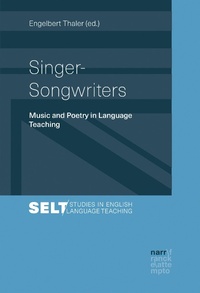
Singer-Songwriters
Music and Poetry in Language Teaching
1st Edition
Published on 16. July 2018
209 pages
978-3-8233-9238-5 (ISBN)
Description

The times they are a-changing: Who would have expected Bob Dylan to receive the Nobel Prize for Literature as the first songwriter ever? And the British Bob Dylan, i.e. Donovan, stated: Wir haben die Poesie, die Philosophie und Literatur, wir haben Mythen und Legenden in das Musikbusiness gebracht.
These are some of the reasons why this book is dedicated to the use of songwriters in English Language Teaching. As all edited volumes in the SELT (Studies in English Language Teaching) series, it follows a triple aim:
1.Linking TEFL with related academic disciplines,
2.Balancing TEFL research and classroom practice,
3.Combining theory, methodology and exemplary lessons. This triple aim is reflected in the three-part structure of this volume: Part A (Theory), Part B (Methodology), Part C (Classroom) with six concrete lesson plans.
More details
Other editions
Additional editions
Book
07/2018
1st Edition
Narr Francke Attempto
€39.00
Shipment within 5-7 days
Person
Prof. Dr. Engelbert Thaler ist Inhaber des Lehrstuhls für Didaktik des Englischen an der Universität Augsburg. Seine über 500 wissenschaftlichen Publikationen befassen sich mit Verbesserung der Unterrichtsqualität, Lehrerausbildung, Medien- und Literaturdidaktik, interkulturellem Lernen, Entwicklung von Lehrwerken.
Content
- Intro
- Contents
- Introduction
- Bibliography
- A. Theory
- Singer-Songwriters - Poetries, Pop-try, Poe-try
- 1. Current State
- 2. Poetries
- 3. Pop-try
- 4. Poe-try
- a) Distorted lyrics
- b) Singing and reciting
- c) Creative activities
- d) Intermediality
- e) Current songwriters
- f) Becoming a songwriter
- 5. Conclusion
- Bibliography
- Anacreon in Baltimore: the "Star-Spangled Banner" as Poem, Song and National Anthem
- The Song
- The Poem
- America Made Audible
- Bibliography
- From Sidestream to Mainstream
- 1. Text in Context
- 1.1. What It Is
- 1.2. Song (more than Music)
- 1.3. Other Dimensions
- 1.4. It Comes in many Versions
- 1.5. What It Is: America Song
- 2. Circumambulating Protest Songs: Five Questions to Keep in Mind
- 3. Protest Songs: a Selection
- 3.1. Choice of Protest Songs
- 3.2. Songs Performed
- 3.2.1. Yankee Doodle (Version No. 1)
- 3.2.2. Yankee Doodle (Version No. 2)
- 3.2.3. John Brown's Body (Version No. 1)
- 3.2.4. John Brown's Body (Version No. 2)
- 3.2.5. Jesse James
- 3.2.6. Fortunate Son
- 3.2.7. Obama Sings Amazing Grace during Pinckney Eulogy
- Bibliography
- Appendix: US Protest Songs
- B. Methodology
- The Pet Shop Boys: Teaching Pop Lyrics in the Post-Truth Era
- 1. The Pet Shop Boys's Hits: Floating like a Butterfly, Stinging like a Bee
- 2. Post-truth: Teaching the Representation of "Truth"
- 3. Focus on Language and Language Awareness: the "Deviant" Nature of Poetry
- 4. Four Pet Shop Boys Songs: Focus on Ambiguity, Persona, Unreliable Narration
- 5. Awareness-Raising Activites: Wordle and Sting
- 6. "Opportunity (Let's Make Lots of Money)"
- 7. "Rent"
- 8. "The Dictator Decides"
- 9. "Love is a Bourgeois Construct"
- 10. Conclusion
- Bibliography
- Primary sources (www.songtexte.com, last accessed: 10/02/18)
- Secondary sources
- "If Music Be the Food of Love, Play on ." - Shakespeare in Popular Music
- 1. Introduction: the Role of Music in Shakespeare's Work
- 2. Music in the EFL Classroom
- 3. Why Shakespeare's Musical Adaptations in the EFL Classrom?
- 4. From Classical Music, Opera Adaptations and Musicals to Current Songs
- 5. Songs Inspired by Shakespeare - Examples for Teaching
- 6. Conclusion
- Bibliography
- Making Music, Filling Gaps. Developing Audio Literacy with Musical Activities
- 1. Audio Literacy and (Making) Music
- 2. Physical and Vocal Performances - Filling Spatial and Oral Gaps
- 2.1 Using Body & Rhythm
- 2.1.1 Loud & Silent Counting
- 2.1.2 Body Percussion
- 2.1.3 Room Walks
- 2.2 Singing in the Classroom
- 2.2.1 Live-Arrangements with Sounds, Melodies and Harmonies
- 2.2.2 Co-Writing Melodies and Song Lines in Live-Arrangements
- 3. Songwriting as Making Music - Filling Literary Gaps
- 4. Conclusion
- Bibliography
- The Poem Day Project - Developing Oral Fluency
- 1. Poetry in the EFL Classroom and the Goal of the Poem Day Project
- 2. Oral Communication in the EFL Classroom: Past, Present (And Future?)
- 3. The Complexity of Oral Communication in a Foreign Language
- 4. . But How?
- 5. Meaningfulness and Authenticity in Task-Based Language Learning
- 6. The Poem Day Project
- 6.1 What Is the Overall Objective of the Task?
- 6.2 Why Poems?
- 6.3 What Kind of Support Do Students Need to Complete the Task?
- 6.4 How to Choose the Poems That Students Are Going to Present?
- 6.5 Where Can You Find Adequate Poems for Young Learners?
- 7. Six TBL-Criteria of the Poem Day Project
- 8. Conclusion
- Bibliography
- Where Music and Curriculum Meet
- 1. Music Matters
- 2. Everyday Methodology: Chants and Challenges
- 3. Examples from Teaching in the EFL Classroom
- 3.1 As Musical as Kids: Jack Johnson and Lenka (Yr 5-6)
- 3.2 She won't Cooperate: Green Day's Gloria (Yr 7-10)
- 3.3 The Two Williams: Shakespeare and Robbie (Q 11-12)
- 4. Better Said than Sung?
- Bibliography
- Tune Into Ideas: Philosophy and Bob Dylan's Music
- Bibliography
- C. Lessons
- Scars to Your Beautiful
- 1. Introduction
- 2. Procedure
- 3. Materials
- 4. Solutions
- Bibliography
- Fight Song
- 1. Introduction
- 2. Procedure
- 3. Materials
- 4. Solutions
- 5.a) Features of an empowerment song
- 6.b) An interview with Rachel Platten
- 7.a) Comment on another empowerment song
- 7.b) Fights in your life
- M6: Phrasal verbs
- Bibliography
- Man in the Mirror
- 1. Introduction
- 2. Procedure
- 3. Materials
- 4. Solutions
- Homework: Sample solutions
- Bibliography
- Pictures:
- Galway Girl
- 1. Introduction
- 2. Procedure
- 3. Materials
- 4. Solutions
- Same Love
- 1. Introduction
- 2. Procedure
- 3. Materials
- 4. Solutions
- A.2. Heartstorming
- C.2.: Discussing the third picture a second time
- C.3.: Summary of content and message of the song
- C.4.: Macklemore & Ryan Lewis: Same Love
- F.2.: Mindmap
- F.6.: Presentation of group work
- G.2.: Homework (students' answers)
- Bibliography
- Mama Said
- 1. Introduction
- 2. Procedure
- (1) Working with the title
- (2) Jumbled lines
- (3) Headlining
- (4) Changing the perspective
- (5) Creating an acrostic
- 4. Solutions
- (1) Working with the title
- (3) Headlining
- (4) Changing the perspective
- (5) Creating an acrostic
- Bibliography
- Contributors
