

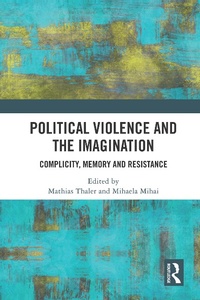
Political Violence and the Imagination
Complicity, Memory and Resistance
1st Edition
Published on 10. September 2020
156 pages
978-1-000-09063-5 (ISBN)
Description

Using a variety of theoretical reflections and empirically grounded case studies, this book examines how certain kinds of imagination - political, artistic, historical, philosophical - help us tackle the challenge of comprehending and responding to various forms of political violence.
Understanding political violence is a complex task, which involves a variety of operations, from examining the social macro-structures within which actors engage in violence, to investigating the motives and drives of individual perpetrators. This book focuses on the faculty of imagination and its role in facilitating our normative and critical engagement with political violence. It interrogates how the imagination can help us deal with past as well as ongoing instances of political violence. Several questions, which have thus far received too little attention from political theorists, motivate this project: Can certain forms of imagination - artistic, historical, philosophical - help us tackle the challenge of comprehending and responding to unprecedented forms of violence? What is the ethical and political value of artworks depicting human rights violations in the aftermath of conflicts? What about the use of thought experiments in justifying policy measures with regard to violence? What forms of political imagination can foster solidarity and catalyse political action?
This book opens up a forum for an inclusive and reflexive debate on the role that the imagination can play in unpacking complex issues of political violence.
The chapters in this book were originally published in a special issue of the journal, Critical Review of International Social and Political Philosophy.
Understanding political violence is a complex task, which involves a variety of operations, from examining the social macro-structures within which actors engage in violence, to investigating the motives and drives of individual perpetrators. This book focuses on the faculty of imagination and its role in facilitating our normative and critical engagement with political violence. It interrogates how the imagination can help us deal with past as well as ongoing instances of political violence. Several questions, which have thus far received too little attention from political theorists, motivate this project: Can certain forms of imagination - artistic, historical, philosophical - help us tackle the challenge of comprehending and responding to unprecedented forms of violence? What is the ethical and political value of artworks depicting human rights violations in the aftermath of conflicts? What about the use of thought experiments in justifying policy measures with regard to violence? What forms of political imagination can foster solidarity and catalyse political action?
This book opens up a forum for an inclusive and reflexive debate on the role that the imagination can play in unpacking complex issues of political violence.
The chapters in this book were originally published in a special issue of the journal, Critical Review of International Social and Political Philosophy.
More details
Edition
1. Auflage
Language
English
Place of publication
London
United Kingdom
Publishing group
Taylor & Francis Ltd
Target group
College/higher education
Product notice
Reflowable
ISBN-13
978-1-000-09063-5 (9781000090635)
Copyright in bibliographic data and cover images is held by Nielsen Book Services Limited or by the publishers or by their respective licensors: all rights reserved.
Schweitzer Classification
Other editions
Additional editions
Mathias Thaler | Mihaela Mihai
Political Violence and the Imagination
Complicity, Memory and Resistance
Book
01/2024
1st Edition
Routledge
€76.20
Shipment within 15-20 days
Mathias Thaler | Mihaela Mihai
Political Violence and the Imagination
Complicity, Memory and Resistance
Book
07/2020
1st Edition
Routledge
€217.30
Shipment within 15-20 days
Persons
Mathias Thaler is Senior Lecturer in Political Theory at the University of Edinburgh. His main research interest is in contemporary political theory. He is currently working on a project analysing the utopian dimensions in current debates around climate change.
Mihaela Mihai is Senior Lecturer in Political Theory at the University of Edinburgh. Her research interests cut across political and social theory, history and aesthetics. More precisely, she has written on political emotions, political judgment, the politics of memory, art and politics.
Mihaela Mihai is Senior Lecturer in Political Theory at the University of Edinburgh. Her research interests cut across political and social theory, history and aesthetics. More precisely, she has written on political emotions, political judgment, the politics of memory, art and politics.
Content
Political violence and the imagination: an introduction
1. Understanding complicity: memory, hope and the imagination
2. The arts of refusal: tragic unreconciliation, pariah humour, and haunting laughter
3. How America disguises its violence: colonialism, mass incarceration, and the need for resistant imagination
4. The subversive potential of Leo Tolstoy's 'defamiliarisation': a case study in drawing on the imagination to denounce violence
5. Our wildest imagination: violence, narrative, and sympathetic identification
6. On representation(s): art, violence and the political imaginary of South Africa
7. The art and politics of imagination: remembering mass violence against women
1. Understanding complicity: memory, hope and the imagination
2. The arts of refusal: tragic unreconciliation, pariah humour, and haunting laughter
3. How America disguises its violence: colonialism, mass incarceration, and the need for resistant imagination
4. The subversive potential of Leo Tolstoy's 'defamiliarisation': a case study in drawing on the imagination to denounce violence
5. Our wildest imagination: violence, narrative, and sympathetic identification
6. On representation(s): art, violence and the political imaginary of South Africa
7. The art and politics of imagination: remembering mass violence against women
