

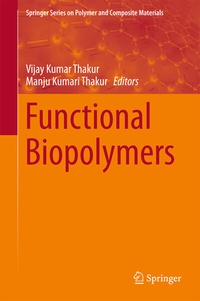
Functional Biopolymers
Description

This book presents the synthesis, processing and application of selected functional biopolymers as new advanced materials. It reviews theoretical advances as well as experimental results, opening new avenues for researchers in the field of polymers and sustainable materials. The book covers various aspects, including the structural analysis of functional biopolymers based materials; functional biopolymer blends; films, fibers, foams, composites and different advanced applications. A special emphasis is on cellulose-based functional polymers, but other types of functional biopolymers (e.g. from chitosan, starch, or plant oils) are also described.
More details
Other editions
Additional editions
Persons
Prior to commencing in the School of Aerospace, Transport and Manufacturing at Cranfield University, Dr. Vijay Kumar Thakur was working as a Staff Scientist in the School of Mechanical and Materials Engineering at Washington State University, U.S.A (2013-2016). Some of his other prior significant appointments include being a Research Scientist in Temasek Laboratories at Nanyang Technological University, Singapore (2009-2012) and a Visiting Research Fellow in the Department of Chemical and Materials Engineering at LHU-Taiwan. He did his post-doctoral study in Materials Science & Engineering at Iowa State University and received Ph.D. in Polymer Chemistry (2009).
In his academic career, he has published more than 100 SCI journal research articles in the field of chemical sciences/materials science and holds one United States patent. He has also published 33 books and 35 book chapters on the advanced state-of-the-art of polymer science/materials science/nanotechnology withnumerous publishers. His research interests include the synthesis and processing of bio-based polymers, composites; nanostructured materials, hydrogels, polymer micro/nanocomposites, nanoelectronic materials, novel high dielectric constant materials, engineering nanomaterials, electrochromic materials, green synthesis of nanomaterials, and surface functionalization of polymers/nanomaterials. Application aspects range from automotive to aerospace, energy storage, water purification and biomedical fields.
Vijay is an editorial board member of several international journals, as well as a member of scientific bodies around the globe. Some of his significant appointments include Associate Editor for Materials Express (SCI); Advisory Editor for SpringerPlus (SCI); Editor for Energies (SCI); Editor for Cogent Chemistry (SCI); Associate Editor for Current Smart Materials; Associate Editor for Current Applied Polymer Science; Regional Editor for Recent Patents on Materials Science (Scopus); and Regional Editor for Current Biochemical Engineering (CAS). He also serves on the Editorial Advisory Board of Polymers for Advanced Technologies (SCI) and is on the Editorial Board of Journal of Macromolecular Science, Part A: Pure and Applied Chemistry (SCI), International Journal of Industrial Chemistry (SCI), Biointerface Research in Applied Chemistry (SCI) and Advances in Natural Sciences: Nanoscience and Nanotechnology (SCI).
Dr. Manju Kumari Thakur has been working as an Assistant Professor of Chemistry at the Division of Chemistry, Govt. Degree College Sarkaghat, Himachal Pradesh University, Shimla, India, since June 2010. She received her B.Sc. in Chemistry, Botany, and Zoology; M.Sc. and M. Phil in Organic Chemistry, and Ph.D. in polymer chemistry from the Chemistry Department at Himachal Pradesh University, Shimla, India. She has a rich experience in the field of organic chemistry, biopolymers, composites/nanocomposites, hydrogels, applications of hydrogels in the removal of toxic heavy metal ions, drug delivery, etc. She has published more than 30 scientific research papers in several international journals, coauthored ten books, and has also published 28 book chapters in the field of polymer/nano materials.
Content
Part I Introduction: Bio based functional materials: an introduction.- Part II Synthesis, Processing, and characterization: Thermoplastic processing and characterization of protein based functional materials: a review.- Synthesis and properties of functional biopolymeric composites.- Electroconductive modification of functional biopolymers.- Valorization of agricultural by-products to develop functional materials.- Free radical polymerization of regular and conjugated soybean oil for functional biocomposites.- Effect of nanotubes on properties of functional biopolymers.- Part III Cellulose-based functional polymers: Structure and properties of cellulose basesd functional polymers.- Functional biopolymer nanocomposites from nanocellulose.- Functional green cellulose nanocrystals for polymer nanocomposites.- Functional cellulose-based systems for biomedical applications.- Part IV Other types of functional biopolymers: Chitosan based functional nanocomposites: structure and chemistry.- Effect of boron nitride nanoparticles on properties of starch.- Bio-based and plant oil-based functional polyhydroxyalkanoates.- Soy protein based functional polymer blend materials.
