

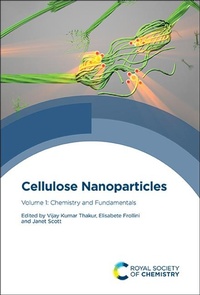
Cellulose Nanoparticles
Volume 1: Chemistry and Fundamentals
1st Edition
Published on 1. July 2021
628 pages
978-1-78801-952-1 (ISBN)
Description

Cellulose nanoparticles (CNP) are a class of bio-based nanoscale materials, which are of interest due to their unique structural features and properties such as biocompatibility, biodegradability, and renewability. They are promising candidates for applications including in biomedicine, pharmaceuticals, electronics, barrier films, nanocomposites, membranes, and supercapacitors. New resources, extraction procedures and treatments are currently under development to satisfy increasing demands for cost-effective and sustainable methods of manufacturing new types of cellulose nanoparticle-based materials on an industrial scale. Cellulose Nanoparticles: Chemistry and Fundamentals covers the synthesis, characterization and processing of cellulose nanomaterials. It aims to address the recent progress in the production methodologies for cellulose nanoparticles, covering principal cellulose resources and the main processes used for isolation. Chapters cover the preparation and characterisation of cellulose nanocrystals and nanofibrils. Together with Volume 2, these books form a useful reference work for graduate students and researchers in chemistry, materials science, nanoscience and green nanotechnology.
More details
Language
English
Place of publication
Cambridge
United Kingdom
Target group
College/higher education
Professional and scholarly
File size
24,33 MB
ISBN-13
978-1-78801-952-1 (9781788019521)
DOI
10.1039/9781788019521
Copyright in bibliographic data and cover images is held by Nielsen Book Services Limited or by the publishers or by their respective licensors: all rights reserved.
Schweitzer Classification
Other editions
Additional editions
Vijay Kumar Thakur | Elisabete Frollini | Janet Scott
Cellulose Nanoparticles
Volume 1: Chemistry and Fundamentals
Book
07/2021
Royal Society of Chemistry
€253.50
Shipment within 3-4 weeks
Vijay Kumar Thakur | Elisabete Frollini | Janet Scott
Cellulose Nanoparticles
Volume 1: Chemistry and Fundamentals
E-Book
07/2021
1st Edition
Royal Society of Chemistry
€270.99
Available for download
Persons
Vijay Kumar Thakur is currently a Professor in New Products from Biomass in the Biorefining and Advanced Materials Research Centre at SRUC, Edinburgh, UK, and also holds an Adjunct Professor position in the Research School of Polymeric Materials, Jiangsu University, China and is a Visiting Professor at Shiv Nadar University (India), Riga Technical University (Latvia) and Visitor at Cranfield University, UK. He has previously held faculty positions at Cranfield University, UK, Washington State University, USA, and Nanyang Technological University, Singapore. His research activities span the disciplines of Biorefining, Chemistry, Chemical Engineering, Manufacturing, Materials Science, and Nanotechnology, as well as all aspects of Sustainable and Advanced Materials. He has published over 250 SCI journal articles, 2 patents, 50 books, and 40 book chapters in areas concerning polymers, nanotechnology, and materials science (Hi 71, citations >16000). He sits on the editorial board of several SCI journals (e.g., Nature Scientific Reports, Industrial Crops & Products, Journal of Renewable Materials, Advances in Polymer Technology, International Journal of Polymer Analysis and Characterization, Polymers for Advanced Technologies, Biomolecules, Nanomaterials, Surfaces and Interfaces, Sustainable Chemistry and Pharmacy, Current Opinion in Green and Sustainable Chemistry, and Nano-Structures & Nano-Objects) as an Editor or Editorial Advisory Board member.
Prof Elisabete Frollini is the Head of the Macromolecular Materials and Lignocellulosic Fiber Group, and is currently the coordinator of the Center for Research on Science and Technology of BioResources (Institute of Chemistry of Sao Carlos, University of Sao Paulo, Sao Carlos, Sao Paulo, Brazil), Editor-in-Chief of Industrial Crops and Products and Member of the Editorial Board of Cellulose. She has expertise in bio-based polymeric materials (including ultrathin- and nanofibers) from biomass with an emphasis on lignocellulosic biomass, which has also been used within the scope of biorefinery.
Janet L. Scott is Professor of Sustainable Chemistry in the Department of Chemistry and Training Director of the EPSRC Centre for Doctoral Training on Sustainable Chemical Technologies at the University of Bath. Educated in South Africa (PhD University of Cape Town, 1995), she has a background in both industry and academia in three countries: South Africa, Australia and the United Kingdom. Janet is a Fellow of the Royal Society of Chemistry (from 2004), a Titular Member of Division III of the International Union of Pure and Applied Chemistry (IUPAC) and Secretary of the Interdivisional Committee on Green Chemistry for Sustainable Development (IUPAC ICGCSD). Her current research focus is on sustainable materials, particularly those derived from abundant and renewable biopolymers such as cellulose and she works closely with computational chemists, electrochemists, chemical and tissue engineering experts, physicists, mechanical engineers and even architects on a range of interdisciplinary projects including projects funded by the EPSRC, Innovate UK and the European Union's H2020 programme. All projects include industrial partners as the conversion of research into sustainable materials into real products, that impact directly on the development of more sustainable products and goods, is deemed important.
Prof Elisabete Frollini is the Head of the Macromolecular Materials and Lignocellulosic Fiber Group, and is currently the coordinator of the Center for Research on Science and Technology of BioResources (Institute of Chemistry of Sao Carlos, University of Sao Paulo, Sao Carlos, Sao Paulo, Brazil), Editor-in-Chief of Industrial Crops and Products and Member of the Editorial Board of Cellulose. She has expertise in bio-based polymeric materials (including ultrathin- and nanofibers) from biomass with an emphasis on lignocellulosic biomass, which has also been used within the scope of biorefinery.
Janet L. Scott is Professor of Sustainable Chemistry in the Department of Chemistry and Training Director of the EPSRC Centre for Doctoral Training on Sustainable Chemical Technologies at the University of Bath. Educated in South Africa (PhD University of Cape Town, 1995), she has a background in both industry and academia in three countries: South Africa, Australia and the United Kingdom. Janet is a Fellow of the Royal Society of Chemistry (from 2004), a Titular Member of Division III of the International Union of Pure and Applied Chemistry (IUPAC) and Secretary of the Interdivisional Committee on Green Chemistry for Sustainable Development (IUPAC ICGCSD). Her current research focus is on sustainable materials, particularly those derived from abundant and renewable biopolymers such as cellulose and she works closely with computational chemists, electrochemists, chemical and tissue engineering experts, physicists, mechanical engineers and even architects on a range of interdisciplinary projects including projects funded by the EPSRC, Innovate UK and the European Union's H2020 programme. All projects include industrial partners as the conversion of research into sustainable materials into real products, that impact directly on the development of more sustainable products and goods, is deemed important.
Content
Hairy Cellulose Nanocrystals: Chemistry and Fundamentals;
Cellulose Nanoparticle-based Functional Materials: Chemistry and Fundamentals;
Cellulose Nanoparticles: Fundamentals;
Characterization of Cellulose Nanoparticles;
Cellulose Nanoparticles: Extractions;
Nanocellulose: Extraction, Surface Functionalization and Potential Applications;
Engineering and Surface Modification of Cellulose Nanoparticles and Their Characterization;
Thermal Characterization of Cellulose Nanoparticle-based Advanced Materials;
Spectroscopic Characterization of Cellulose Nanoparticles;
Cellulose Nanoparticles enhanced Green Composites;
Additive Manufacturing of Nanocellulose-based Soft Composite Materials for Advanced Applications;
Scattering Studies of Cellulose Nanoparticle-based Advanced Materials;
Rheological Characterization of Cellulose Nanocrystal Stabilized Emulsions;
CNP-based Coatings: Chemistry;
Assembly of Cellulose Nanoparticles;
Smart Wood-like Materials Based on Lignocellulose Nanoparticles;
Cellulose Nanoparticle-derived Films;
''Smart'' Materials Based on Cellulose Nanoparticles;
Agro-cellulose-based Carbon Nanotubes;
Cellulose-based Bionanocomposites: Structure and Chemistry;
Nanocellulose-based Hydrogels and Their Applications;
Nanocellulose-based Aerogels: Preparation, Properties and Applications;
Safety and Environmental Aspects of Cellulose Nanoparticles
Cellulose Nanoparticle-based Functional Materials: Chemistry and Fundamentals;
Cellulose Nanoparticles: Fundamentals;
Characterization of Cellulose Nanoparticles;
Cellulose Nanoparticles: Extractions;
Nanocellulose: Extraction, Surface Functionalization and Potential Applications;
Engineering and Surface Modification of Cellulose Nanoparticles and Their Characterization;
Thermal Characterization of Cellulose Nanoparticle-based Advanced Materials;
Spectroscopic Characterization of Cellulose Nanoparticles;
Cellulose Nanoparticles enhanced Green Composites;
Additive Manufacturing of Nanocellulose-based Soft Composite Materials for Advanced Applications;
Scattering Studies of Cellulose Nanoparticle-based Advanced Materials;
Rheological Characterization of Cellulose Nanocrystal Stabilized Emulsions;
CNP-based Coatings: Chemistry;
Assembly of Cellulose Nanoparticles;
Smart Wood-like Materials Based on Lignocellulose Nanoparticles;
Cellulose Nanoparticle-derived Films;
''Smart'' Materials Based on Cellulose Nanoparticles;
Agro-cellulose-based Carbon Nanotubes;
Cellulose-based Bionanocomposites: Structure and Chemistry;
Nanocellulose-based Hydrogels and Their Applications;
Nanocellulose-based Aerogels: Preparation, Properties and Applications;
Safety and Environmental Aspects of Cellulose Nanoparticles
