

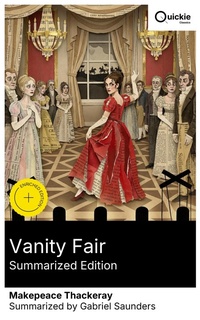
Vanity Fair (Summarized Edition)
Enriched edition. A 19th-century satire of ambition and upper-class hypocrisy amid the Napoleonic Wars, charting female rivalry and Victorian social norms.
Published on 10. January 2026
257 pages
8596547880332 (EAN)
Description

Vanity Fair, subtitled "A Novel without a Hero," surveys Regency society from London drawing rooms to Waterloo through the entwined careers of Becky Sharp and Amelia Sedley. Thackeray's panoramic yet needle-pointed prose blends realistic detail with theatrical framing-an intrusive, sardonic narrator, inset illustrations, and puppet-show metaphors-to expose the economies of marriage, credit, and reputation. Serialized structure and deft cliffhangers sustain a satiric anatomy of class pretension, imperial commerce, and the moral vacuity of fashionable life. William Makepeace Thackeray, Calcutta-born and trained as both journalist and illustrator, refined his moral irony in Punch and in studies of eighteenth-century satire from Fielding to Swift. Financial reversals and domestic sorrow sharpened his hostility to cant, later distilled in The Book of Snobs. His draughtsman's eye and serial craft shape Vanity Fair's blend of caricature and social realism, while travel and cosmopolitan upbringing attuned him to the entanglements of empire and commerce. For readers of Austen, Dickens, and Trollope, Vanity Fair offers an unsparing, witty study of ambition and self-fashioning. Ideal for courses on Victorian realism and narrative voice, it rewards patient attention with indelible characters and a bracing moral clarity.
Quickie Classics summarizes timeless works with precision, preserving the author's voice and keeping the prose clear, fast, and readable-distilled, never diluted. Enriched Edition extras: Introduction · Synopsis · Historical Context · Author Biography · Brief Analysis · 4 Reflection Q&As · Editorial Footnotes.
More details
Persons
William Makepeace Thackeray was a distinguished 19th-century British novelist and satirist, known for his keen observation of Victorian society and his incisive character portrayals. Born in Calcutta, British India, on July 18, 1811, Thackeray was sent to England after his father's death, where he was educated at Charterhouse and later at Trinity College, Cambridge. Although he left university without a degree, his literary aspirations eventually took root after numerous career experiments. Thackeray's most celebrated novel, 'Vanity Fair: A Novel without a Hero' (1847-1848), exemplifies his narrative wit and his penetrating analysis of human follies, rendered with a mix of cynicism and compassion. In this work, he coined the term 'Vanity Fair', which has since entered the lexicon to describe a frivolous, appearance-obsessed society. His literary style was marked by a directness and an ability to create intricate and realistic social settings, which allowed him to provide poignant critiques of middle-class morality and pretensions. Other significant works include 'The Luck of Barry Lyndon' (1844), a picaresque adventure later adapted into a film by Stanley Kubrick, and 'The History of Pendennis' (1848-1850) among others. Thackeray's influence reaches beyond literature; he lectured extensively and his works have continued to be adapted into various media. He died on December 24, 1863, having left an indelible mark on English literature through his sagacious observations on the human condition.
