

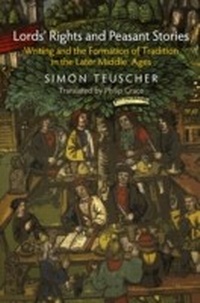
Lords' Rights and Peasant Stories
Writing and the Formation of Tradition in the Later Middle Ages
1st Edition
Published on 12. February 2013
304 pages
978-0-8122-0881-8 (ISBN)
Description

In the mid-nineteenth century, Jacob Grimm published a collection of late medieval records of local law-called WeistUEmer-that was scarcely less comprehensive than his famous collection of fairy tales. As with the fairy tales, Grimm assumed that before their transcription, people had handed these down orally from time immemorial. His interest in these customary laws arose from their seemingly folkloristic notions of custom and from their poetic narratives about ritualized encounters between lords and peasants, capturing an oral tradition from an unsophisticated time.
Grimm's readings are still used today as a basis for theories about oral societies in the premodern West and contemporary non-Western societies and the modernizing effects of writing. As Simon Teuscher contends, however, those aspects of legal texts that have been considered since Grimm to be vestiges of a traditional preliterate popular culture were eventually rooted in relatively advanced and learned techniques of writing, jurisprudence, and administration. Lords' Rights and Peasant Stories uses examples from German- and French-speaking Switzerland to investigate what legal order meant to individuals and to a society at the eve of the early modern period. Teuscher deals with legal documents not only as texts, but also as objects. The book takes the materiality of documents seriously and reconstructs cultural techniques of their production and social practices of their use.
Lords' Rights and Peasant Stories suggests the need to rethink master narratives about transitions from oral to literate societies. It explores the local dimensions of processes of state-formation and the emergence of modern notions of law in western Europe. Students of rural society and village organization will find here a discussion of local power distribution that is inspired by social anthropology, that looks beyond simple antagonisms between lords and peasants, and that insists on the role of state servants and the unconscious effects of their writing practices.
Grimm's readings are still used today as a basis for theories about oral societies in the premodern West and contemporary non-Western societies and the modernizing effects of writing. As Simon Teuscher contends, however, those aspects of legal texts that have been considered since Grimm to be vestiges of a traditional preliterate popular culture were eventually rooted in relatively advanced and learned techniques of writing, jurisprudence, and administration. Lords' Rights and Peasant Stories uses examples from German- and French-speaking Switzerland to investigate what legal order meant to individuals and to a society at the eve of the early modern period. Teuscher deals with legal documents not only as texts, but also as objects. The book takes the materiality of documents seriously and reconstructs cultural techniques of their production and social practices of their use.
Lords' Rights and Peasant Stories suggests the need to rethink master narratives about transitions from oral to literate societies. It explores the local dimensions of processes of state-formation and the emergence of modern notions of law in western Europe. Students of rural society and village organization will find here a discussion of local power distribution that is inspired by social anthropology, that looks beyond simple antagonisms between lords and peasants, and that insists on the role of state servants and the unconscious effects of their writing practices.
Reviews / Votes
"An illuminating study. . . . Teuscher offers both a valuable case study of later medieval legal development, as well as a more general reflection on the processes in the development of legal traditions and, in also making his work more widely available to an Anglophone readership, through this clear translation of a work first published in German in 2007, has produced a welcome and significant contribution to this area of research." (Phillipp Schofield, Law and History Review)All prices
More details
Series
Language
English
Place of publication
Pennsylvania
United States
Target group
College/higher education
Illustrations
5 illus.
5 illus.
File size
5,05 MB
ISBN-13
978-0-8122-0881-8 (9780812208818)
Copyright in bibliographic data and cover images is held by Nielsen Book Services Limited or by the publishers or by their respective licensors: all rights reserved.
Schweitzer Classification
Other editions
Additional editions
Simon Teuscher
Lords' Rights and Peasant Stories
Writing and the Formation of Tradition in the Later Middle Ages
Book
02/2012
University of Pennsylvania Press
€89.13
Article not available at the moment
Persons
Content
Introduction
Chapter 1. Two Inquiry Procedures
Chapter 2. Dealing with Lordship Rights
Chapter 3. Deposition Records: Techniques of Transcription and Narration
Chapter 4. WeistUEmer: Microcosms of Law
Chapter 5. Styles of Document Usage
Conclusion
Notes
Bibliography
Index
Acknowledgments
Chapter 1. Two Inquiry Procedures
Chapter 2. Dealing with Lordship Rights
Chapter 3. Deposition Records: Techniques of Transcription and Narration
Chapter 4. WeistUEmer: Microcosms of Law
Chapter 5. Styles of Document Usage
Conclusion
Notes
Bibliography
Index
Acknowledgments

