

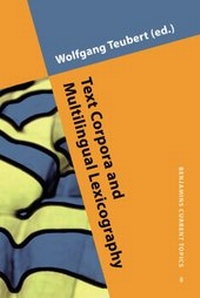
Text Corpora and Multilingual Lexicography
1st Edition
Published on 27. June 2007
X, 162 pages
978-90-272-9237-7 (ISBN)
Description

The contributions in this volume (first published as a Special Issue of International Journal of Corpus Linguistics 6 (2001)) evolved from the EU-funded project Trans-European Language Resources Infrastructure (TELRI) and deal with various aspects of multilingual corpus linguistics. The topics reach from building parallel corpora over annotation issues and questions concerning terminology extraction to bilingual and multilingual lexicography; the statistical properties of parallel corpora and the practice of translators; and the role of corpus linguistics for multilingual language technology.
More details
Other editions
Additional editions
Wolfgang Teubert
Text Corpora and Multilingual Lexicography
Book
06/2007
John Benjamins Publishing Co
€84.80
Shipment within 10-15 days
Person
Content
- Text Corpora and Multilingual Lexicography
- Editorial page
- Title page
- LCC data
- Table of contents
- Preface
- Automatic extraction of terminological translation lexicon from Czech-English parallel texts
- Introduction
- English-Czech parallel corpora
- Statistical alignment of paragraphs and sentences in English-Czech parallel corpora
- Noun phrases identification
- Noun phrase grammar
- Examples of selected noun phrases
- Translation dictionary training
- Significance filtering and the evaluation of results
- Conclusion
- References
- Words from Bononia Legal Corpus
- 1. Introduction
- 2. Corpus design and formatting
- 3. Corpus access tools
- 3.1. Corpus data retrieval
- 3.2. Source document extraction
- 4. The terms ``contratto'' and ``contract'': Translation equivalences
- 5. Translation equivalents of the terms ``tax'' and ``duty''
- 5.1. The term ``tax'': What the English subcorpus shows
- 5.2. The term ``duty''
- 5.3. A cross-linguistic comparison
- 6. Conclusion
- References
- Hybrid approaches for automatic segmentation and annotation of a Chinese text corpus
- Appendix
- References
- Distance between languages as measured by the minimal-entropy model
- 1. Introduction
- 2. Minimal-entropy language model
- 2.1. Dictionary
- 2.2. Algorithm
- 2.3. Training corpus
- 3. Plato's Republic
- 4. Distance between Slovenian and other languages
- 5. Conclusion
- References
- The importance of the syntagmatic dimension in the multilingual lexical database
- 1. Introduction
- 2. Muldi (Multi Lingual Database Interface)
- 2.1. Monolingual corpora
- 2.2. Monolingual lexicons
- 2.3. Terminological records
- 2.4. Parallel corpora
- 2.5. Translation equivalents
- 3. Concluding remarks
- References
- Compiling parallel text corpora
- General
- The project
- Structure of the corpus
- The principles of text collecting
- Maintenance of the corpus
- Parallel concordancing
- The system will work as follows:
- Experiments
- Applications of the parallel text corpus
- References
- Data-derived multilingual lexicons
- 1. The Bridge Dictionary Project
- 2. Analysing parallel corpora: TELRI and Bonomia
- 3. Analysing comparable corpora: The Council of Europe Project
- 4. Co-ordination of the approaches
- 5. Conclusion
- References
- Bridge dictionaries as bridges between languages
- Introduction
- Format of the input
- Extraction of the translations for printed dictionary
- SGML/XML format
- Electronic version of the dictionary
- Conclusion
- References
- Procedures in building the Croatian-English parallel corpus
- 1. Introduction
- 2. Corpus
- 3. Making the corpus
- 3.1. Platform
- 3.2. Text formats
- 3.3. Conversion
- 3.4. Sentence delimiting
- 4. Aligning
- 4.1. Aligning with DéjàVu
- 4.2. Aligning with Vanilla aligner
- 4.3. Encoding problems
- 5. Conclusions
- 6. Acknowledgements
- References
- Corpus linguistics and lexicography*
- Corpus linguistics - More than a Slogan?
- Corpus linguistics - A programme
- Cognitive linguistics, logical semantics and corpus linguistics
- Collocation and meaning
- Case study 1: hart as collocator
- Discourse and meaning
- Case study 2: Globalisierung
- Linguistic knowledge and encyclopaedic knowledge
- Multilingual corpus linguistics
- Multilingual corpus linguistics in practice
- Case study 3: The translation into German of sorrow and grief
- Future prospects
- References
- Analysing the fluency of translators
- 1. Introduction
- 2. Fluency and accuracy
- 3. The methodology
- 3.1. The aims
- 3.2. Problem areas
- 3.3. Annotation
- 3.4. Evaluation on the basis of comparisons
- 3.5. The practical application of the corpus - the results
- References
- Equivalence and non-equivalence in parallel corpora*
- 1. Introduction
- 2. The problem with bilingual dictionaries
- 3. The rationale for the present work
- 4. Methodological issues
- 4.1. Data and encoding scheme
- 4.2. The analysis
- 4.3. Limitations of the approach
- 5. Findings
- 5.1. Prototypical vs. other equivalents
- 5.2. A close up profile
- 6. Conclusions
- References
- Index
- The series Benjamins Current Topics (BCT)
