

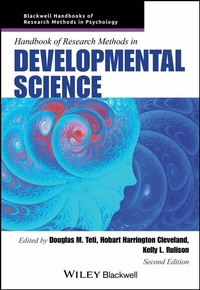
Handbook of Research Methods in Developmental Science
Description

Presents cutting-edge research methods in developmental science
The Handbook of Research Methods in Developmental Science delivers a fully revised and expanded exploration of the latest methodologies in human development research. Twenty-four entirely new chapters by renowned experts introduce innovative approaches that reflect the dynamic evolution of developmental science methodologies. Part of the Blackwell Handbooks of Research Methods in Psychology series, this authoritative resource is indispensable for those seeking to apply state-of-the-art methods to the study of human development.
The second edition of the Handbook builds upon the strengths of its predecessor while incorporating significant updates to address emerging research challenges. It offers a comprehensive review of traditional and contemporary developmental research designs, including cross-sectional, longitudinal, and quasi-experimental methods, as well as advanced topics such as the Multiphasic Optimization Strategy (MOST) framework, time-varying effect modeling, and integrative data analysis. Additionally, the authors present fresh insights into causal inference, observational methods, and intervention research, providing a more nuanced understanding of how developmental scientists can study change over time.
Capturing the latest theoretical and technological advancements in the discipline, the Handbook of Research Methods in Developmental Science:
- Features a multidisciplinary approach, integrating perspectives from psychology, human development, and family science
- Addresses challenges in developmental intervention research, including implementation science and adaptive intervention design
- Offers practical guidance on participant recruitment, panel maintenance, and best practices for obtaining reliable developmental data
- Includes real-world examples and case studies demonstrating the application of various research methods
The Handbook of Research Methods in Developmental Science, Second Edition, is an essential resource for graduate students, researchers, and professionals in developmental science, psychology, and human development. It is particularly relevant for courses in research methods, developmental psychology, and intervention science within psychology, education, and social sciences degree programs.
More details
Other editions
Additional editions
Persons
Douglas M. Teti, PhD, is a Distinguished Professor in the Department of Human Development and Family Science at The Pennsylvania State University. A leading expert in developmental science, his research focuses on family processes, parenting, and infant development.
Hobart Harrington Cleveland III, JD, PhD, is a Professor in the Department of Human Development and Family Science at The Pennsylvania State University. His research explores adolescent development, peer relationships, and substance use prevention.
Kelly L. Rulison, PhD, is a Senior Research Scientist at Prevention Strategies. A former Associate Professor at The Pennsylvania State University, Dr. Rulison's work focuses on designing and evaluating developmental interventions to improve social and behavioral outcomes.
Content
Author Bios viii
Preface xxiv
Part I Developmental Designs, Sampling, and Causal Inference 1
1 Cross- Sectional, Longitudinal, and Retrospective Designs: General Utility and Threats to Validity 3
Ekjyot K. Saini and Douglas M. Teti
2 Experimental Design in Developmental Science 31
Robert Hepach
3 Strengthening Causal Inference Using Sibling Designs 57
Gabriel L. Schlomer, Olivia C. Robertson, and Kristine Marceau Copyrighted Material
4 Quasi- Experimental Designs for Causal Inference About Intervention Effects: Addressing Threats to Validity from a Graphical Models Perspective 79
Patrick Sheehan, Muwon Kwon, and Peter M. Steiner
5 Measurement Burst Designs in Developmental Science 110
Daisy V. Zavala, Giselle A. Ferguson, Giancarlo Pasquini, and Stacey B. Scott
6 Obtaining and Keeping Your Sample: Participant Recruitment and Panel Maintenance 129
Carina Cornesse and Bella Struminskaya
7 On Sampling and Measurement: A Case Study of the Association Between Loneliness and Cognitive Function in the Survey of Health Aging and Retirement in Europe 146
Ashton M. Verdery and Mara Getz Sheftel
Part II Construct Measurement in Developmental and Family Science 181
8 Conceptualizing and Measuring the Family Context 183
Gregory M. Fosco and Devin Malloy McCauley
9 Direct and Indirect Observational Methods in Developmental and Family Science 200
Rena L. Repetti
10 Assessing Parenting in Context: Naturalistic Assessment, Domain Specificity, and Early Development 220
Douglas M. Teti
11 Maximizing Cultural Validity in the Study of Child Development 250
Suzanne Gaskins
12 Introduction to Qualitative Methods in Developmental Science 276
Debbie Kim and Rachel Carly Feldman
Part III Advances in Developmental Intervention 301
13 The Multiphase Optimization Strategy (MOST): A Framework to Develop More Effective, Affordable, Scalable, and Efficient Interventions 303
Kelly L. Rulison
14 The Sequential Multiple Assignment Randomized Trial (SMART) Design 329
Xiaoxi Yan, Yifan Cui, and Bibhas Chakraborty
Contents vii
15 Adaptive Intervention Designs for Studies of Human Development 349
Timothy R. Brick
16 Economic Evaluation of Developmental Interventions: Issues and Best Practices 370
Lawrie Green Daniel (Max) Crowley
17 Bringing Interventions to Scale: Research Methods for Dissemination and Implementation Science 389
Gitanjali Shrestha and Brittany Cooper
Part IV Data Analysis and Methods in Developmental Science 411
18 It's All Regression: Fundamentals of Developmental Data Analysis 413
Michael J. Rovine, Emily M. Weiss, and Paul A. McDermott
19 Modern Causal Mediation and Longitudinal Models for Developmental Data 453
Matthew J. Valente, Judith J. M. Rijnhart, and David P. MacKinnon
20 A Rosetta Stone for Modeling Change: Connections among Multilevel Models, Structural Equation Models, and Multilevel Structural Equation Models 483
Lesa Hoffman
21 Integrative Data Analysis in Developmental Science: A Primer 516
Veronica T. Cole, Conor H. Lacey, and Lydia F. Bierce
22 Propensity Score Methods in Quasi- Experimental Research 544
Donna L. Coffman
23 Applications of Social Network Analysis in Developmental Science 560
Andrea Vest Ettekal and Jimi Adams
24 Time- Varying Effect Modeling to Address Novel Questions in Developmental Research 583
Stephanie T. Lanza and Anna K. Hochgraf
Author Index 612
Subject Index 643
Author Bios
Andrea Vest Ettekal
Andrea Vest Ettekal is an Associate Professor in the Department of Educational Psychology at Texas A&M University. She serves as the Program Lead and Coordinator for Human Development and Family Science. Her research focuses on positive youth development through out-of-school time programs. She applies social network analysis to understand the role of out-of-school time programs to develop and maintain youth relationships.
Anna K. Hochgraf
Anna K. Hochgraf is a National Research Service Award postdoctoral fellow in the School of Public Health at the University of Minnesota. She earned her MS (2017) and PhD (2022) in Human Development and Family Studies from Pennsylvania State University, with concentrations in Family Studies and Prevention and Intervention. As a graduate student, she was awarded a Ruth L. Kirschstein National Research Service Award, a Prevention and Methodology training fellowship, and a Summer Translational Science Fellowship. Dr. Hochgraf's research centers on the development and prevention of psychological and behavioral health problems among youth, with attention to the family contexts in which youth develop. She leverages advanced and innovative research and statistical methods to address novel research questions that have implications for youth and family well-being.
Ashton M. Verdery
Ashton M. Verdery is a Professor of Sociology, Demography, and Social Data Analytics in the Department of Sociology and Criminology and a co-funded faculty member of the Institute for Computational and Data Sciences at The Pennsylvania State University. Dr. Verdery researches and teaches about cross-national demographic and family changes linked to individual and population health, emphasizing theoretical perspectives from social network analysis and novel computational and mathematical methods to sample hard-to-survey groups and model kinship networks. He is currently working with Dr. Sheftel on a project about family structure, loneliness, and cognitive health.
Bella Struminskaya
Bella Struminskaya is an Associate Professor at the Department of Methodology and Statistics at Utrecht University, The Netherlands, and a Researcher at Statistics Netherlands. Her research focuses on innovations in data collection such as using apps, wearables, and sensors in surveys and official statistics, data donation of digital trace data, and data integration. She is a management board member and country team lead of SHARE - Survey of Health, Ageing and Retirement in Europe, board member of the German Society for Online Research, and member of the Methods Advisory Board of the European Social Survey and Scientific Advisory Board of Statistics, Sweden.
Bibhas Chakraborty
Bibhas Chakraborty is an Associate Professor and Interim Director of the Center for Quantitative Medicine at the Duke-National University of Singapore Medical School (Duke-NUS), with joint appointments at NUS and Duke University. Previously (2009-2013), he was an Assistant Professor of Biostatistics at Columbia University. He holds a Ph.D. in Statistics from the University of Michigan, Ann Arbor. He is a recipient of the Young Statistical Scientist Award from the International Indian Statistical Association (2017) and an Elected Member of the International Statistical Institute (2022). His core areas of research include dynamic treatment regimens, adaptive clinical trial designs, causal inference, reinforcement learning, interpretable machine learning for analysis of electronic health records, and mobile health. He authored the first textbook on dynamic treatment regimens and Sequential Multiple Assignment Randomized Trial (SMART) design.
Muwon Kwon
Muwon Kwon is a fifth-year Ph.D. student in the Quantitative Methodology: Measurement and Statistics (QMMS) program in the Department of Human Development and Quantitative Methodology (HDQM) at the University of Maryland. He earned his bachelor's and master's degrees in Education from Yonsei University in South Korea. Under the mentorship of Dr. Peter Steiner, his research focuses on causal inference, including quasi-experimental designs with latent variables, causal graphs, and doubly robust estimation. He is also interested in the application of double/debiased machine learning methods for causal inference.
Brittany Cooper
Dr. Brittany Cooper is Professor of Human Development, Youth and Family Extension Specialist and Graduate Faculty in the Prevention Science PhD program at Washington State University. Dr. Cooper coleads the improving prevention through action research (IMPACT) lab, which aims to close the gap between the science and real-world practice of substance misuse prevention by better understanding what it takes to get effective, culturally relevant prevention programs and policies widely disseminated, implemented with high quality, and sustained. Her research, teaching, and outreach center around the translation of prevention science for public health impact. For over a decade, she has collaborated with federal, state, and other community leaders to improve the field's understanding of how best to support evidence-based prevention programs in diverse community settings. Dr. Cooper received her PhD in Human Development and Family Studies from Pennsylvania State University in 2009.
Carina Cornesse
Carina Cornesse is the Acting Head of the Survey Design and Methodology department at GESIS - Leibniz Institute for the Social Sciences in Mannheim, Germany. She is also a guest research fellow at the German Institute for Economic Research (DIW Berlin) and an affiliated researcher at the Research Institute for Social Cohesion in Bremen. Her research centers on data quality and innovation in large-scale survey infrastructures, including the integration of novel methods such as video interviewing and respondent-driven sampling. She serves on several advisory and academic boards, including those of the European Survey Research Association (ESRA) and the German Association for Online Research (DGOF).
Conor H. Lacey
Conor H. Lacey, M.A., is a Ph.D. student in Quantitative Psychology at the University of North Carolina at Chapel Hill. He earned his Master's degree in Psychology from Wake Forest University, where his thesis focused on quantifying the practical impact of measurement non-invariance. His research centers on the proper estimation of Structural Equation Models (SEMs), Exploratory and Dynamic Factor Models, and Measurement Invariance Analysis. In addition to his research, he assists in teaching undergraduate and graduate courses on psychological data analysis methods.
Daisy V. Zavala
Daisy V. Zavala, Ph.D., is a postdoctoral scientist in the Department of Behavioral Sciences and Social Medicine at the Florida State College of Medicine. She earned her Ph.D. in the Social and Health Psychology program from Stony Brook University in 2024 and her B.A. in Psychological Science from California State University (CSU), San Marcos, in 2019. Her research program takes a life-span developmental approach to examine how social and biological factors shape health and well-being. Dr. Zavala is a former recipient of the A.W. Burghadt Turner Graduate Fellowship through the Center for Inclusive Education at Stony Brook University and was part of the NIH-funded Maximizing Access to Research Careers (MARC) program at CSU, San Marcos. She is committed to expanding access to research opportunities by engaging individuals from historically underrepresented backgrounds - both as participants and as future investigators.
David P. MacKinnon
David P. MacKinnon is a Foundation and Regents Professor of Quantitative Methodology in the Department of Psychology at Arizona State University. He earned a BA from Harvard University in 1979 and a Ph.D. in Measurement and Psychometrics from UCLA in 1986. He has substantive publications in human memory, applied psychology, public health, and prevention. He has wide-ranging interests in statistics and methodology, but his primary interest is in the area of statistical methods to assess how prevention and treatment programs achieve their effects. His mediation analysis research is funded by an NIH MERIT award. He is a Thomson-Reuters and Clarivate Highly Cited Researcher. He has served as president of the American Psychological Association's Division on Quantitative and Qualitative Methods and the Society for Multivariate Experimental Psychology. He received the President's lifetime achievement award from the Society for Prevention Research.
Debbie Kim
Debbie Kim is a social science researcher in the School of Education and Social Policy at Northwestern University. She has 20 years of educational research experience and has designed and led research projects from the federal to the school levels. Debbie's work is deeply informed by institutional and organizational theory lenses. She is broadly interested in the ways that macro-level processes take form at the micro-level, and vice versa. Her research interests include policymaking and implementation, organizational change, decision-making, and access. Throughout her work, she focuses on social inequities and the ways educational policies can support or hinder more equitable outcomes for youth. Debbie has led a range of studies...
