

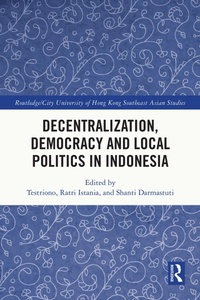
Decentralization, Democracy and Local Politics in Indonesia
Will be published approx. on 6. July 2026
296 pages
978-1-040-82163-3 (ISBN)
Description

This multidisciplinary volume provides new insights into decentralization reform in Indonesia, and examines how it has reshaped the structure of local governance and democratic practices in the country, as well as exploring the challenges and dynamics that have surfaced in Indonesia's decentralized governance landscape.
Decentralization has been in place in Indonesia for a quarter of a century, resulting in various structural changes, including the territorial autonomy (TA) and regional proliferation (or "pemekaran"). This book examines the effectiveness of long-term decentralization measures as a legacy of centralist politics by offering new data on local democracy and administration, complemented by in-depth qualitative case studies that reflect the state of contemporary, local politics in Indonesia. The book examines the evolving challenges and emerging dynamics that have surfaced in Indonesia's decentralized governance landscape, including how new-province and district claims increase and how competition among diverse elites in regions pursuing a new province or district often precipitates conflict within the region.
Engaging wider academic networks looking to understand the mechanisms of decentralization inside post-centralistic authoritarian regimes, this book will be of interest to academics studying Indonesian politics and Southeast Asian politics, as well as identity and ethnic politics. Specialists focused on decentralization will also find the volume of use.
Decentralization has been in place in Indonesia for a quarter of a century, resulting in various structural changes, including the territorial autonomy (TA) and regional proliferation (or "pemekaran"). This book examines the effectiveness of long-term decentralization measures as a legacy of centralist politics by offering new data on local democracy and administration, complemented by in-depth qualitative case studies that reflect the state of contemporary, local politics in Indonesia. The book examines the evolving challenges and emerging dynamics that have surfaced in Indonesia's decentralized governance landscape, including how new-province and district claims increase and how competition among diverse elites in regions pursuing a new province or district often precipitates conflict within the region.
Engaging wider academic networks looking to understand the mechanisms of decentralization inside post-centralistic authoritarian regimes, this book will be of interest to academics studying Indonesian politics and Southeast Asian politics, as well as identity and ethnic politics. Specialists focused on decentralization will also find the volume of use.
More details
Series
Language
English
Place of publication
London
United Kingdom
Publishing group
Taylor & Francis Ltd
Target group
Professional and scholarly
Product notice
Reflowable
Illustrations
8 Tables, black and white; 5 Line drawings, black and white; 10 Halftones, black and white; 15 Illustrations, black and white
File size
4,43 MB
ISBN-13
978-1-040-82163-3 (9781040821633)
Copyright in bibliographic data and cover images is held by Nielsen Book Services Limited or by the publishers or by their respective licensors: all rights reserved.
Schweitzer Classification
Other editions
Additional editions
Testriono | Ratri Istania | Shanti Darmastuti
Decentralization, Democracy and Local Politics in Indonesia
Book
approx. 07/2026
1st Edition
Routledge
€191.50
Not yet published
Persons
Testriono is Assistant Professor at the Faculty of Social Sciences, Universitas Islam Internasional Indonesia (UIII), Depok, Indonesia. He earned his PhD in Political Science from Northern Illinois University. His research lies at the intersection of comparative politics and public policy, with a focus on democracy and subnational politics. A 2017 Hybl Fellow at the International Foundation for Electoral Systems (IFES), Virginia, he serves as a Senior Researcher at the Center for the Study of Islam and Society (Pusat Pengkajian Islam dan Masyarakat or PPIM) UIN Jakarta and a Senior Researcher at Populi Center. He is also an Inaugural Lentera Studi Fellow at the Center for Southeast Asian Studies (CSEAS), Kyoto University, in 2026. His writings have been published in, among others, Governance and Contemporary Southeast Asia.
Ratri Istania is Associate Professor and Secretary of the Department of Public Administration of National Institute of Public Administration School of Administration (NIPA) Jakarta, Indonesia (Politeknik STIA LAN). She is also the Inaugural Indonesia Fellow at Cornell University's Jeb E. Brooks School of Public Policy, a Senior Fellow at IFAR/IPP UNIKA Atma Jaya, and a Senior Researcher at Populi Center. She earned her master's degree in political science from Ohio University in 2006 and her doctorate in Political Science from Loyola University Chicago in 2019. She focuses on decentralization, local politics, and governance practices in Indonesia and other developing democracies, while also studying territorial autonomy, power sharing, and conflict.
Shanti Darmastuti is Assistant Professor at the International Relations Study Program, Faculty of Social and Political Sciences, Universitas Pembangunan Nasional Veteran Jakarta. She completed her doctorate in International Relations at Universitas Padjadjaran in 2021. Her research interests include international political economy studies and development studies.
Ratri Istania is Associate Professor and Secretary of the Department of Public Administration of National Institute of Public Administration School of Administration (NIPA) Jakarta, Indonesia (Politeknik STIA LAN). She is also the Inaugural Indonesia Fellow at Cornell University's Jeb E. Brooks School of Public Policy, a Senior Fellow at IFAR/IPP UNIKA Atma Jaya, and a Senior Researcher at Populi Center. She earned her master's degree in political science from Ohio University in 2006 and her doctorate in Political Science from Loyola University Chicago in 2019. She focuses on decentralization, local politics, and governance practices in Indonesia and other developing democracies, while also studying territorial autonomy, power sharing, and conflict.
Shanti Darmastuti is Assistant Professor at the International Relations Study Program, Faculty of Social and Political Sciences, Universitas Pembangunan Nasional Veteran Jakarta. She completed her doctorate in International Relations at Universitas Padjadjaran in 2021. Her research interests include international political economy studies and development studies.
Content
Foreword
The Architecture of the Indonesian State: Diversity in Unity
Section I: Introduction
1 Indonesia's Decentralization Reform: Policy Contexts, Political Dynamics, and Public Perception
2 Understanding Decentralization in Indonesia: Conceptual and Theoretical Framework
3 Ex Nihilo, Ex Materia: A History of Indonesian Decentralization from the Colonial to the Contemporary
Section II: Bureaucracy and Democratic Local Governance System
4 Decentralization and the Rise of Bureaucratic Clientelism in Indonesia
5 The Competitiveness of Direct Local Elections and Losing Dynastic Candidates
6 Mitigating Conflict: The Role of Power Sharing in Indonesia's Province Proliferation
7 Bureaucratic Reform and Decentralization: Insights from Indonesia's Subnational Government
8 After the Re-vision of Special Autonomy in 2021: Development, Recognition, and Democracy in Papua
A Sudiana Sasmita and Ridwan
Section III: Strategic Issues in Post-Reform Era Decentralization
9 Planning Culture and The After-Effects of Continuous Urban Expansion- A Glimpse of Karawang
10 Decentralization and the Rise of Sister City Partnerships in Indonesia
11 Decentralization and Carbon Emissions in Southeast Asia: Regional Patterns and the Politics of Blame-Shifting in Indonesia
12 Decentralization and the Role of Women's Leadership in Achieving Inclusive Policies
13 Feminine Style in Indonesia's Decentralization and Local Politics: A Case Study of Airin Rachmy Diany
Epilogue
Evolution, Devolution, and Involution?
The Architecture of the Indonesian State: Diversity in Unity
Section I: Introduction
1 Indonesia's Decentralization Reform: Policy Contexts, Political Dynamics, and Public Perception
2 Understanding Decentralization in Indonesia: Conceptual and Theoretical Framework
3 Ex Nihilo, Ex Materia: A History of Indonesian Decentralization from the Colonial to the Contemporary
Section II: Bureaucracy and Democratic Local Governance System
4 Decentralization and the Rise of Bureaucratic Clientelism in Indonesia
5 The Competitiveness of Direct Local Elections and Losing Dynastic Candidates
6 Mitigating Conflict: The Role of Power Sharing in Indonesia's Province Proliferation
7 Bureaucratic Reform and Decentralization: Insights from Indonesia's Subnational Government
8 After the Re-vision of Special Autonomy in 2021: Development, Recognition, and Democracy in Papua
A Sudiana Sasmita and Ridwan
Section III: Strategic Issues in Post-Reform Era Decentralization
9 Planning Culture and The After-Effects of Continuous Urban Expansion- A Glimpse of Karawang
10 Decentralization and the Rise of Sister City Partnerships in Indonesia
11 Decentralization and Carbon Emissions in Southeast Asia: Regional Patterns and the Politics of Blame-Shifting in Indonesia
12 Decentralization and the Role of Women's Leadership in Achieving Inclusive Policies
13 Feminine Style in Indonesia's Decentralization and Local Politics: A Case Study of Airin Rachmy Diany
Epilogue
Evolution, Devolution, and Involution?
