

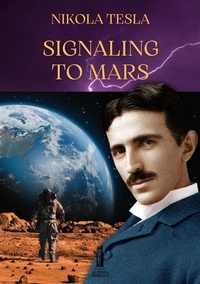
Signaling to Mars
Published on 30. July 2023
979-12-5504-378-2 (ISBN)
Description

Nikola Tesla (1856-1943) was a Serbian-American inventor, electrical and mechanical engineer, and futurist best known for his contributions to the modern alternating current electricity supply system.
Born and raised in the Austrian Empire, Tesla studied engineering and physics in the 1870s, gaining practical experience working in telephony and at Continental Edison in the new electric power industry. In 1884 he emigrated to the United States, where he became a naturalized citizen.
In 1943, at the age of 86, Tesla died alone in Room 3327 of the Hotel New Yorker, in the neighborhood of Manhattan in New York City. Two days later the F.B.I. ordered the property custodian to seize Tesla's belongings.
We can say that Nikola Tesla was an extraordinary scientific genius, a modern Leonardo Da Vinci. Many argue that a large part of his inventions have been classified by the US Government for understandable economic and military reasons.
Nikola Tesla, in his studies and research, has also dealt with the extraterrestrial issue and life on other planets. He was also very fascinated by the idea that the planet Mars could be inhabited by a civilization capable of communicating with us or receiving our communications. For this he studied and hypothesized potential systems to communicate with the Red Planet. We re-proposed to modern readers two articles on this topic, which Nikola Tesla published in 1907 in the Harvard Illustrated Magazine and in 1909 in the New York Times.
Born and raised in the Austrian Empire, Tesla studied engineering and physics in the 1870s, gaining practical experience working in telephony and at Continental Edison in the new electric power industry. In 1884 he emigrated to the United States, where he became a naturalized citizen.
In 1943, at the age of 86, Tesla died alone in Room 3327 of the Hotel New Yorker, in the neighborhood of Manhattan in New York City. Two days later the F.B.I. ordered the property custodian to seize Tesla's belongings.
We can say that Nikola Tesla was an extraordinary scientific genius, a modern Leonardo Da Vinci. Many argue that a large part of his inventions have been classified by the US Government for understandable economic and military reasons.
Nikola Tesla, in his studies and research, has also dealt with the extraterrestrial issue and life on other planets. He was also very fascinated by the idea that the planet Mars could be inhabited by a civilization capable of communicating with us or receiving our communications. For this he studied and hypothesized potential systems to communicate with the Red Planet. We re-proposed to modern readers two articles on this topic, which Nikola Tesla published in 1907 in the Harvard Illustrated Magazine and in 1909 in the New York Times.
