

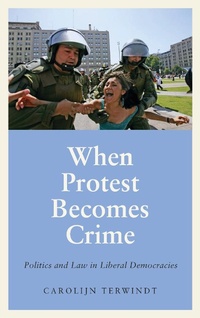
When Protest Becomes Crime
Politics and Law in Liberal Democracies
1st Edition
Published on 20. December 2019
304 pages
978-1-78680-608-6 (ISBN)
Description

How does protest become criminalised? Applying an anthropological perspective to political and legal conflicts, Carolijn Terwindt urges us to critically question the underlying interests and logic of prosecuting protesters.
The book draws upon ethnographic research in Chile, Spain, and the United States to trace prosecutorial narratives in three protracted contentious episodes in liberal democracies. Terwindt examines the conflict between Chilean landowners and the indigenous Mapuche people, the Spanish state and the Basque independence movement, and the United States' criminalisation of 'eco-terrorists.' Exploring how patterns and mechanisms of prosecutorial narrative emerge through distinct political, social and democratic contexts, Terwindt shines a light on how prosecutorial narratives in each episode changed significantly over time.
Challenging the law and justice system and warning against relying on criminal law to deal with socio-political conflicts, Terwindt's observations have implications for a wide range of actors and constituencies, including social movement activists, scholars, and prosecutors.
The book draws upon ethnographic research in Chile, Spain, and the United States to trace prosecutorial narratives in three protracted contentious episodes in liberal democracies. Terwindt examines the conflict between Chilean landowners and the indigenous Mapuche people, the Spanish state and the Basque independence movement, and the United States' criminalisation of 'eco-terrorists.' Exploring how patterns and mechanisms of prosecutorial narrative emerge through distinct political, social and democratic contexts, Terwindt shines a light on how prosecutorial narratives in each episode changed significantly over time.
Challenging the law and justice system and warning against relying on criminal law to deal with socio-political conflicts, Terwindt's observations have implications for a wide range of actors and constituencies, including social movement activists, scholars, and prosecutors.
Reviews / Votes
'Protesters often end up in criminal courts. Even so, and despite sporadic efforts, social science has long neglected the criminalization of protest. In this welcome comparative study, Carolijn Terwindt skilfully examines the complex interplay between law and protest, making an important contribution to an overlooked topic' -- Steven Barkan, author of 'Protesters on Trial: Criminal Justice in the Southern Civil Rights and Vietnam Antiwar Movements' 'Carolijn Terwindt reveals how courtroom narratives often attribute criminality to ideologies or associations going so far as to apply 'terrorism' sentencing enhancements to American environmental activists rather than to actions. This timely and meticulous analysis helps inform how the politics of law impact citizen efforts to draw attention to, and rectify, unjust practices by those in power' -- Heidi Boghosian, Executive Director of the A.J. Muste Memorial Institute 'Drawing on three well-chosen and meticulously developed case studies, Carolijn Terwindt's lucid analysis demonstrates how, far from being neutral applications of the law, prosecutorial narratives become sites of contention that can exacerbate long standing socio political conflicts' -- Patricia Richards, Meigs Professor of Sociology and Women's Studies, University of GeorgiaMore details
Series
Edition
1. Auflage
Language
English
Place of publication
London
United Kingdom
Target group
Professional and scholarly
Illustrations
2 b&w photographs
File size
1,03 MB
ISBN-13
978-1-78680-608-6 (9781786806086)
Copyright in bibliographic data and cover images is held by Nielsen Book Services Limited or by the publishers or by their respective licensors: all rights reserved.
Schweitzer Classification
Other editions
Additional editions
Book
12/2019
Pluto Press
€57.19
Shipment within 10-20 days
Person
Carolijn Terwindt is Senior Legal Advisor on Business and Human Rights at the European Center for Constitutional and Human Rights in Berlin. She has contributed articles to numerous journals and is the co-author with Chris van der Borgh of NGOs under Pressure in Partial Democracies (Palgrave Macmillan, 2014).
Content
Series Preface
Preface
Acknowledgments
Abbreviations
1. Introduction
PART I: LAW, POLITICS AND LEGITIMACY IN LIBERAL DEMOCRACIES
2. When Groups Take Justice into Their Own Hands
3. The Prosecutorial Narrative and the Double Bind of Liberal Legalism
4. Mobilizing the Power of Victimhood
5. Challenging the State's Crime Definition
PART II: WHEN PROSECUTORS RESPOND: NARRATIVES IN ACTION
ETA cases in Spain
6. Casting the Net Wider by Calling the Armed Group a Network 112
7. Narrating Praise for ETA Prisoners as Humiliation of Victims
"Mapuche conflict" cases in Chile
8. Vacillating between Criminalization and Negotiation
9. Responding to Allegations of Racism and Repression against the Mapuche People
"Eco-terrorism" cases in the United States
10. Shifting from Reactive to Proactive Prosecutions
11. Drawing a Boundary between Raising Awareness and Intimidation
12. Conclusion: The Prosecutor's Contested Claim to Criminal Justice
References
Interviews
Trial Transcripts
Index
Preface
Acknowledgments
Abbreviations
1. Introduction
PART I: LAW, POLITICS AND LEGITIMACY IN LIBERAL DEMOCRACIES
2. When Groups Take Justice into Their Own Hands
3. The Prosecutorial Narrative and the Double Bind of Liberal Legalism
4. Mobilizing the Power of Victimhood
5. Challenging the State's Crime Definition
PART II: WHEN PROSECUTORS RESPOND: NARRATIVES IN ACTION
ETA cases in Spain
6. Casting the Net Wider by Calling the Armed Group a Network 112
7. Narrating Praise for ETA Prisoners as Humiliation of Victims
"Mapuche conflict" cases in Chile
8. Vacillating between Criminalization and Negotiation
9. Responding to Allegations of Racism and Repression against the Mapuche People
"Eco-terrorism" cases in the United States
10. Shifting from Reactive to Proactive Prosecutions
11. Drawing a Boundary between Raising Awareness and Intimidation
12. Conclusion: The Prosecutor's Contested Claim to Criminal Justice
References
Interviews
Trial Transcripts
Index
