

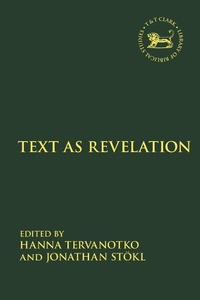
Text as Revelation
1st Edition
Published on 28. December 2023
168 pages
978-0-567-68973-3 (ISBN)
Description

Text as Revelation analyses the shift of revelatory experiences from oral to written that is described in ancient Jewish literature, including rabbinic texts. The individual essays seek to understand how, why, and for whom texts became the locus of revelation.
While the majority of the contributors analyze ancient Jewish literature for depictions of oral and written revelation, such as the Hebrew Bible and the literature of the Second Temple era, a number of articles also investigate textualization of revelation in cognate cultures, analyzing Egyptian, Mesopotamian and Greek sources. With subjects ranging from Ancient Egyptian and Sibylline oracles to Hellenistic writings and the books of Isaiah, Deuteronomy and Jeremiah, the studies in this volume bring together established and new voices reflecting on the issues raised by the interplay between writing and (divinatory) revelation.
While the majority of the contributors analyze ancient Jewish literature for depictions of oral and written revelation, such as the Hebrew Bible and the literature of the Second Temple era, a number of articles also investigate textualization of revelation in cognate cultures, analyzing Egyptian, Mesopotamian and Greek sources. With subjects ranging from Ancient Egyptian and Sibylline oracles to Hellenistic writings and the books of Isaiah, Deuteronomy and Jeremiah, the studies in this volume bring together established and new voices reflecting on the issues raised by the interplay between writing and (divinatory) revelation.
More details
Series
Edition
1. Auflage
Language
English
Place of publication
London
United Kingdom
Publishing group
Bloomsbury Publishing PLC
Target group
Professional and scholarly
ISBN-13
978-0-567-68973-3 (9780567689733)
Copyright in bibliographic data and cover images is held by Nielsen Book Services Limited or by the publishers or by their respective licensors: all rights reserved.
Schweitzer Classification
Other editions
Additional editions
Hanna Tervanotko | Jonathan Stoekl
Text as Revelation
Book
09/2025
T.& T.Clark Ltd
€43.40
Shipment within 3-4 weeks
Hanna Tervanotko | Jonathan Stoekl
Text as Revelation
Book
01/2024
T.& T.Clark Ltd
€126.28
Shipment within 3-4 weeks
Persons
Jonathan Stökl is an assistant professor at the Institute for Area Studies, University of Leiden, The Netherlands.
Hanna Tervanotko is Assistant Professor of Religious Studies at McMaster University, Canada, and Docent in Old Testament Exegesis, University of Helsinki, Finland.
Hanna Tervanotko is Assistant Professor of Religious Studies at McMaster University, Canada, and Docent in Old Testament Exegesis, University of Helsinki, Finland.
Content
Preface
List of Contributors
Revelation as Text and the Textualization of Revelation. Mesopotamia in the First Millenium BCE: Omens and Commentaries, Uri Gabay
Riddles and Revelation: The Re-Use of Isaianic Prophecies within and outside the Book of Isaiah, Reinhard G. Kratz
Combining Prophecies as Means to Access the Divine Will: Exploring and updating Jeremiah in the Hellenistic Period, Konrad Schmid
Writing and Divination in Ancient Greece, Lisa Maurizio
Divine Revelation and Inheritance of Prophecy in the Aramaic Literature from Qumran, Daniel Machiela
Sages as Mediators of Knowledge in Jewish Antiquity, Elisa Uusimäki
Writing with Prophets in Late Second Temple Judaism: Josephus and the Teacher of Righteousness, Pieter B. Hartog
Finding Jesus in the Sibylline Oracles: Textual Revelation and the Limitless Fountain of Meaning, Francis Borchardt
Index
List of Contributors
Revelation as Text and the Textualization of Revelation. Mesopotamia in the First Millenium BCE: Omens and Commentaries, Uri Gabay
Riddles and Revelation: The Re-Use of Isaianic Prophecies within and outside the Book of Isaiah, Reinhard G. Kratz
Combining Prophecies as Means to Access the Divine Will: Exploring and updating Jeremiah in the Hellenistic Period, Konrad Schmid
Writing and Divination in Ancient Greece, Lisa Maurizio
Divine Revelation and Inheritance of Prophecy in the Aramaic Literature from Qumran, Daniel Machiela
Sages as Mediators of Knowledge in Jewish Antiquity, Elisa Uusimäki
Writing with Prophets in Late Second Temple Judaism: Josephus and the Teacher of Righteousness, Pieter B. Hartog
Finding Jesus in the Sibylline Oracles: Textual Revelation and the Limitless Fountain of Meaning, Francis Borchardt
Index
