

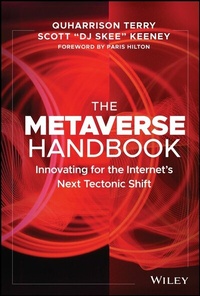
The Metaverse Handbook
Description

The metaverse is here. Are you ready?
In¿The Metaverse Handbook: Innovating for the Internet's Next Tectonic Shift, a duo of experienced tech and culture experts delivers a can't-miss guide to participating in the most promising new technology since the advent of the web. Through dozens of metaverse creator case studies and concise, actionable insights, you'll walk away from this book understanding how to explore and implement the latest metaverse tech emerging from blockchain, XR, and web3.
In The Metaverse Handbook, you'll discover:
- What the metaverse is, why you should care about it, and how to build your metaverse strategy
- The history of the metaverse and primers on critical technologies driving the metaverse, including non-fungible tokens, XR, the blockchain, and web3
- How to unearth unique metaverse opportunities in digital communities, commerce, and immersive experiences
As the metaverse has rapidly become the technology platform and marketing buzzword of the future, this new reality for companies, creators, and consumers is not easily understood at the surface level. Those who aim to be at the forefront of this exciting new arena must first understand the foundations and central technologies of the metaverse.
An essential resource for digital professionals, creators, and business leaders in the vanguard of the coming technology revolution,¿The Metaverse Handbook¿provides the go-to roadmap for your journey into the metaverse.
More details
Other editions
Additional editions
Persons
QUHARRISON TERRYis the bestselling author of The NFT Handbook, a detailed guide on how to create, sell, and buy non-fungible tokens without the need for a technical background. He is also a notable entrepreneur and growth marketer who has advised Mark Cuban and his portfolio of 200+ venture companies. In addition, QuHarrison is a 4x recipient of LinkedIn's Top Voices in Technology award.
SCOTT "DJ SKEE" KEENEY is an award-winning creator,producer, entrepreneur,media personality,investor, philanthropist, and futurist. As a driving force behind some of the most influential brands and artists over the past two decades, he is a pioneer in the metaverse operating multiple experiences as the founder of DXSH.mv Studios and also serves as the Chief Metaverse Officer at TSX Entertainment. Visit djskee.com for more information.
Content
About the Authors vi
Acknowledgments ix
Foreword xvii
Introduction xxi
Chapter 1 A Vision for the Metaverse in 2032 1
Extended Reality Emerges 3
Your Own Personalized Metaverse 4
The Rise of Bots and Digital Humans 6
The Ubiquitous Metaverse 9
Chapter 2 What Is the Metaverse? 11
From Snow Crash to Meta 13
Defining the Metaverse 19
The Metaverse Represents the Next Digital Shifts 21
Changes to Digital Identity 23
Changes to Digital Value 28
Digital Respect and Signaling Identity 30
Access to Exclusive Internet Experiences 31
Crowdfunding 2.0 33
Changes to Internet Immersion 36
It Starts with Web3 Communities 39
What's the Metaverse's Interface? 40
Preparing for the Metaverse 41
Chapter 3 Why You Should Care About the Metaverse Now 45
The Well-Timed Interest Geek 47
Interest Geeks of the Metaverse 50
Interest Geeks Over Power Brokers 53
Chapter 4 History of the Metaverse 57
La Réalité Virtuelle 58
The Early Internet 60
Early Virtual Worlds 62
Blockchain and Digital Assets 65
The Modern Metaverse 68
Chapter 5 The Metaverse Building Blocks 75
The Main Metaverse Tools 78
The Secondary Metaverse Tools 82
Building Your First Metaverse Asset 85
Chapter 6 Enter the Metaverse 87
Sandbox Metaverses 92
Decentraland 93
The Sandbox 103
Cryptovoxels 105
Somnium Space 105
Honorable Mentions 106
Gaming Metaverses 108
Miscellaneous Metaverses 114
Digital Presence 114
Phygital Commerce 115
Readymade Metaverse Environments 116
Social VR Worlds 117
The Mass Migration to the Metaverse 118
Chapter 7 Metaverse Assets 121
What We Will Own in the Metaverse 125
Avatars 126
Accessories 129
Objects 132
Real Estate 134
Metaverse Asset Management 136
Chapter 8 Challenges of the Metaverse 139
Interoperable Economies 140
Interoperable Graphics and Hardware 145
The Negative Narratives of the Metaverse 147
Chapter 9 Your Metaverse Plan 151
Designing Your Metaverse Plan 152
For Brands and Corporations with IP 153
For Entertainers 156
For Metaverse Interest Geeks 157
Further Reading at MetaverseQT.com 158
Index 161
CHAPTER 2
What Is the Metaverse?
Given enough time, technology imagined in science fiction will eventually become science fact. We've witnessed it time and time again. These phenomena are a mix of incredible visionaries and storytellers literally imagining the future, but also of creators and technologists being inspired by the science-fiction entertainment of their youth.
Jules Verne's 1865 novel From the Earth to the Moon mentions a light-propelled spacecraft nearly four decades before flight was achieved and just shy of a century before the first spacecraft left our atmosphere. In 2010, Japan's IKAROS spacecraft was the first to successfully demonstrate a propulsion method called solar sails that use radiation pressure exerted by sunlight on large mirrors to propel the spacecraft.
Throughout the early 1900s, Edward Stratemeyer dazzled young readers with the tales of Tom Swift-a teenage inventor who routinely had to stave off evildoers from stealing his inventions. One such story published in 1911 was Tom Swift and His Electric Rifle, which featured a stun-gun-like invention Swift wielded throughout the story. When former NASA engineer Jack Cover invented the first stun gun in 1970, he aptly named it TSER after the "Tom Swift Electric Rifle." The A was later added to help the invention roll off the tongue. After all, "taser" does sound better than "tser."
Following the 1964 World's Fair, Isaac Asimov wrote an article for The New York Times predicting what inventions would be on display in 50 years. One of his prescient takes was the idea of "robot-brain cars," which would be capable of self-driving. Today, Tesla is worth nearly a trillion dollars by market cap, largely building its brand and cult following with its innovations in self-driving car technology.
In 2002, the precrime unit imagined in the film adaptation of Philip K. Dick's Minority Report showed us a future when predictive analytics might allow our police force to stop crimes before they happened. Today, Palantir's Gotham software is an AI-powered operating system for making sense of large swaths of data, helping (mostly) government agencies make better decisions. Although Palantir was named from a different story, namely, the "seeing stone" in The Lord of the Rings, Palantir is far and above the leader in predictive analytics and the only company we'd currently bet on to bring the idea of a precrime unit to life.
And then there's Star Trek, a show featuring countless technologies that they envisioned ahead of their time, giving brainiacs and science-fiction nerds enough mental fodder to invent for decades, possibly centuries, to come. There's the Replicator, which could materialize almost any object out of thin air. Today, 3D printers can create everything from jewelry to food to houses. The PADD, or Personal Access Display Device, featured in the 1980s iteration of Star Trek utilized a smooth, touch-screen interface that bears a strong resemblance to the tablet computers of today. There's Star Trek's medical tricorder, which inspired a $10 million USD competition called the Qualcomm Tricorder XPRIZE to push this Star Trek device into existence. We cannot forget about the Communicator, which not only showcased a mobile communication device but also looked like the flip phones we eventually would all carry around in our pockets for a period of time. While the cell phone's inventor, Martin Cooper, publicly credits Dick Tracy's wrist radio as the inspiration, it's widely shared that it was actually Captain James T. Kirk's use of the Communicator that inspired the Motorola cell phone unit to create the device.
What most of these science-fiction predictions all had in common was that the futuristic technology was a byline in the story. These visionary devices enabled the characters to act in uncanny ways, but the characters didn't gawk at how impressive the technology was. No different than how we take smartphones and Amazon's overnight delivery for granted, the devices were an afterthought, an assumption, for the characters. Ultimately, the devices didn't change the characters. They still acted in familiar human ways. However, the technology always changed the environment in which these characters operated.
That brings us to the Metaverse.
From Snow Crash to Meta
Like the aforementioned technologies, the Metaverse also traces its roots back to a novelist. Neal Stephenson, in his book Snow Crash, envisions a number of technologies ahead of their time including mobile computing, virtual reality, wireless Internet, digital currency, smartphones, and augmented-reality headsets. But it's the book's setting, the Metaverse, that takes the cake as his most prescient vision.
The Metaverse in Snow Crash offers society an escape from a dystopian world overrun by corporate mafias and extreme class inequalities. Users access the Metaverse through personal virtual reality goggles or public ports and present themselves as avatars. Class systems manifest around avatars, where public port users have noticeably lower-quality avatars (which is oddly familiar to the current situation with profile-picture NFTs-namely, Bored Apes and CryptoPunks, which designate a higher digital class).
Stephenson's Metaverse is a single hundred-meter-wide road called the Street, which extends for 65,536 km around the circumference of a featureless, perfectly spherical planet. Users can spend their encrypted electronic currency at shops, amusement parks, offices, and a variety of other virtual businesses. They can also purchase virtual estates from the real estate overlord, Global Multimedia Protocol Group.
The book's main character, Hiro Protagonist, leads a drab physical existence in a shipping container, but in the Metaverse, he owns high-end real estate that he purchased before the Metaverse became popular. However, Hiro doesn't concern himself with enjoying the Metaverse's economies. Rather, the plot revolves around his mission to stop a computer virus called Snow Crash that causes Metaverse users to suffer real-world brain damage.
Aside from the numerous examples of Neal Stephenson being a sort of technology Nostradamus, his work on Snow Crash can count two objective claims to fame. One, he coined the term Metaverse. Two, he popularized the Hindu concept of "avatar" for describing digital representation. But in addition to the objective wins, it's the subjective impact of his novel that continues to influence people today.
The designer of Google Earth, Avi Bar-Zeev, stated that Stephenson's ideas in Snow Crash largely inspired him to create Google's mapping technology. Two decades after his book was published, Neal Stephenson became the chief futurist at Magic Leap, one of the leading companies creating augmented reality headsets. But perhaps his largest influence will be on Meta, the company formerly known as Facebook.
For starters, Meta takes its name from the term that Stephenson created. But the influence runs much deeper. One former Facebook data scientist, Dean Eckles, wrote on his blog in 2014 that "at least for a time, product managers at Facebook were required to read Snow Crash as part of their internal training." Of course, 2014 was also the year that Facebook purchased Oculus and its proprietary virtual reality headset technology. So it's clear that "the Zuck" was preparing his employees for this company-wide shift to the Metaverse for quite some time.
Oh, and by the way, they aren't calling them employees anymore. Now, they're called Metamates.
Meta is going headfirst into this Metaverse vision. They've changed their internal values from past sayings like "Be bold" and "Focus on impact" to Metaverse-minded values like "Live in the future," "Build awesome things," and "Focus on long-term impact." Additionally, they've announced plans to hire 10,000 high-skilled workers in the EU over the next five years to help build this successor to the Internet. Lastly, in 2021 they committed more than $10B USD to their Metaverse division, Facebook Reality Labs, which they expect to continue investing $10B USD into, at the minimum, for the next several years.
But what exactly is Meta's vision for building the Metaverse?
At the core of Meta's plans are the Oculus VR headsets. While Meta shares the common vision that accessing the Metaverse won't rely on VR headsets, it's clearly a major part of their plans to own the hardware on which the Metaverse is largely experienced. Qualcomm CEO Cristiano Amon mentioned in November 2021 that Meta had already sold 10 million Oculus Quest 2 headsets. Since the devices run on Qualcomm's Snapdragon XR2 chipset, it's a figure that we believe to be true.
Still, the Oculus hardware is just one part of their plan. The real Metaverse-building will take place on Horizon Worlds. This is their social VR experience that allows users to explore public Worlds created by the community, in addition to offering tools for anyone to build their own Worlds and deploy their experiences to the public. Since Horizon Worlds was unveiled to all Quest users in the United States and Canada back in December 2021, the company reports that its monthly user base has grown by a factor of 10x to 300,000 people experiencing...
