
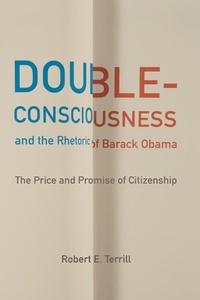
Double-Consciousness and the Rhetoric of Barack Obama
Description
Alles über E-Books | Antworten auf Fragen rund um E-Books, Kopierschutz und Dateiformate finden Sie in unserem Info- & Hilfebereich.
An examination of President Obama's oratory as a reflection of the African American experience
Robert E. Terrill argues that, to invent a robust manner of addressing one another as citizens, Americans must learn to draw on the delicate indignities of racial exclusion that have stained citizenship since its inception. In Double-Consciousness and the Rhetoric of Barack Obama, Terrill demonstrates how President Barack Obama's public address models such a discourse.
Terrill contends that Obama's most effective oratory invites his audiences to experience a form of "double-consciousness," famously described by W. E. B. Du Bois as a feeling of "two-ness" resulting from the African American experience of "always looking at one's self through the eyes of others." It is described as an effect of cruel alienation that can also bring a gift of "second-sight" in the form of perspectives on practices of citizenship not available to those in positions of privilege. When addressing fellow citizens, Obama is asking each to share in the "peculiar sensation" that Du Bois described. The racial history of U.S. citizenship is a resource for inventing contemporary ways of speaking about race.
Through close analyses of selected speeches from Obama's 2008 campaign and first presidential term, this book argues that Obama does not present double-consciousness merely as a point of view but as an idiom with which we might speak to one another. Of course, as Du Bois's work reminds us, double-consciousness results from imposition and encumbrance, so that Obama's oratory presents a mode of address that emphasizes the burdens of citizenship together with the benefits, the price as well as the promise.
All prices
More details
Other editions
Additional editions
Person
Robert E. Terrill is an associate professor in the Department of Communication and Culture at Indiana University Bloomington. He earned his Ph.D. at Northwestern University in 1996 and focuses on the rhetorical criticism of African American public address. Terrill is the author of Malcolm X: Inventing Radical Judgment and editor of The Cambridge Companion to Malcolm X.
Content
- Cover
- Contents
- Series Editor's Preface
- Preface
- Acknowledgments
- CHAPTER 1 Inventional Criticism
- CHAPTER 2 Democratic Double-Consciousness
- CHAPTER 3 A More Perfect Union
- CHAPTER 4 The Confines of Race
- CHAPTER 5 Beyond the Veil
- CHAPTER 6 Citizenship and Duality, Rhetoric and Race
- Epilogue
- Notes
- Bibliography
- Index
- A
- B
- C
- D
- E
- F
- G
- H
- I
- J
- K
- L
- M
- N
- O
- P
- R
- S
- T
- U
- V
- W
- Y
- Z

System requirements
File format: ePUB
Copy protection: Adobe-DRM (Digital Rights Management)
System requirements:
- Computer (Windows; MacOS X; Linux): Install the free reader Adobe Digital Editions prior to download (see eBook Help).
- Tablet/smartphone (Android; iOS): Install the free app Adobe Digital Editions or the app PocketBook before downloading (see eBook Help).
- E-reader: Bookeen, Kobo, Pocketbook, Sony, Tolino and many more (not Kindle).
The file format ePub works well for novels and non-fiction books – i.e., „flowing” text without complex layout. On an e-reader or smartphone, line and page breaks automatically adjust to fit the small displays.
This eBook uses Adobe-DRM, a „hard” copy protection. If the necessary requirements are not met, unfortunately you will not be able to open the eBook. You will therefore need to prepare your reading hardware before downloading.
Please note: We strongly recommend that you authorise using your personal Adobe ID after installation of any reading software.
For more information, see our ebook Help page.
File format: PDF
Copy-Protection: Adobe-DRM (Digital Rights Management)
System requirements:
- Computer (Windows; MacOS X; Linux): Install the free reader Adobe Digital Editions prior to download (see eBook Help).
- Tablet/smartphone (Android; iOS): Install the free app Adobe Digital Editions or the app PocketBook before downloading (see eBook Help).
- E-reader: Bookeen, Kobo, Pocketbook, Sony, Tolino and many more (only limited: Kindle).
The file format PDF always displays a book page identically on any hardware. This makes PDF suitable for complex layouts such as those used in textbooks and reference books (images, tables, columns, footnotes). Unfortunately, on the small screens of e-readers or smartphones, PDFs are rather annoying, requiring too much scrolling.
This eBook uses Adobe-DRM, a „hard” copy protection. If the necessary requirements are not met, unfortunately you will not be able to open the eBook. You will therefore need to prepare your reading hardware before downloading.
Please note: We strongly recommend that you authorise using your personal Adobe ID after installation of any reading software.
For more information, see our eBook Help page.
File format: ePUB
Copy protection: Watermark-DRM (Digital Rights Management)
System requirements:
- Computer (Windows; MacOS X; Linux): Use a reading software that can process the file format ePUB: e.g., Adobe Digital Editions or FBReader – both free (see eBook Help).
- Tablet/Smartphone (Android; iOS): Before downloading, install the free app Adobe Digital Editions (see eBook Help).
- E-reader: Bookeen, Kobo, Pocketbook, Sony, Tolino and many more (not Kindle).
The file format ePUB works well for novels and non-fiction books – i.e., „flowing” text without complex layout. On an e-reader or smartphone, line and page breaks automatically adjust to fit the small displays.
This eBook uses Watermark-DRM, a „soft” copy protection. This means that there are no technical restrictions to prevent illegal distribution. However, there is a personalised watermark embedded in the eBook that can be used to identify the purchaser of the eBook in the event of misuse and to provide evidence for legal purposes.
For more information, see our eBook Help page.
