

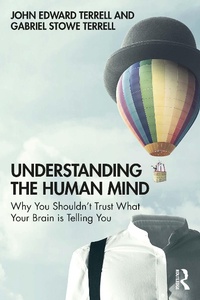
Understanding the Human Mind
Why you shouldn't trust what your brain is telling you
1st Edition
Published on 9. June 2020
166 pages
978-1-000-09356-8 (ISBN)
Description

Drawing on current research in anthropology, cognitive psychology, neuroscience, and the humanities, Understanding the Human Mind explores how and why we, as humans, find it so easy to believe we are right-even when we are outright wrong.
Humans live out their own lives effectively trapped in their own mind and, despite being exceptional survivors and a highly social species, our inner mental world is often misaligned with reality. In order to understand why, John Edward Terrell and Gabriel Stowe Terrell suggest current dual-process models of the mind overlook our mind's most decisive and unpredictable mode: creativity. Using a three-dimensional model of the mind, the authors examine the human struggle to stay in touch with reality-how we succeed, how we fail, and how winning this struggle is key to our survival in an age of mounting social problems of our own making.
Using news stories of logic-defying behavior, analogies to famous fictitious characters, and analysis of evolutionary and cognitive psychology theory, this fascinating account of how the mind works is a must-read for all interested in anthropology and cognitive psychology.
Humans live out their own lives effectively trapped in their own mind and, despite being exceptional survivors and a highly social species, our inner mental world is often misaligned with reality. In order to understand why, John Edward Terrell and Gabriel Stowe Terrell suggest current dual-process models of the mind overlook our mind's most decisive and unpredictable mode: creativity. Using a three-dimensional model of the mind, the authors examine the human struggle to stay in touch with reality-how we succeed, how we fail, and how winning this struggle is key to our survival in an age of mounting social problems of our own making.
Using news stories of logic-defying behavior, analogies to famous fictitious characters, and analysis of evolutionary and cognitive psychology theory, this fascinating account of how the mind works is a must-read for all interested in anthropology and cognitive psychology.
Reviews / Votes
"Why are humans so good at self-deception? What does that remarkable ability mean for our future on this planet? Terrell and Terrell provide a brilliantly provocative and honest assessment of the human condition and mind. Weaving insights from various scientific disciplines, from anthropology to neuroscience, they compellingly argue that evolution has bestowed humans with a handful of advantages, advantages that imperil humanity as a whole. This book is a remarkable achievement given both the breadth and complexity of ideas contained within, and their fidelity to those ideas in making them digestible and resonant with non-experts. It is a must read." - Lane Beckes, Ph.D., Associate Professor of Neuroscience and Psychology, Bradley University"Explorers Terrell & Terrell take us on a guided tour of our own minds and the marvelous advantages and hidden uncertainties of our human commitment to social life. Informed by contemporary psychology and neuroscience, the Terrells' collaboration offers original insights and perspectives on human nature and the future of our species illustrated using familiar, everyday experiences and stories. As a practicing psychologist, I think readers will benefit personally from the wellspring of meaning that flows from "knowing thyself" in this illuminating way. The compelling conclusion asks us to consider "Do I need to do something? Should I look again?"-to which I would add "Should I read this book?" Yes, yes, and again yes." - Thomas L. Clark, Ph.D., psychologist in private practice, Tallahassee FL
"Terrell and Terrell draw upon deep time, trans-oceanic cultural research, and inter-generational cooperation in this bold, vivid work on self-persuasion and delusion. Brain function, social process, and ideology come together here in evolutionary perspective as the same topic in fresh, smooth prose, recruiting familiar characters from fiction. This engaging but humbling study contends that human creative thinking-including selective perception, logical reasoning, and dreaming-is also dangerous thinking. It urges us to recheck our own accruing presumptions, showing why it's vital we do."- Parker Shipton, Ph.D., Professor, Department of Anthropology, Research Fellow, African Studies Center, Boston University "Why are humans so good at self-deception? What does that remarkable ability mean for our future on this planet? Terrell and Terrell provide a brilliantly provocative and honest assessment of the human condition and mind. Weaving insights from various scientific disciplines, from anthropology to neuroscience, they compellingly argue that evolution has bestowed humans with a handful of advantages, advantages that imperil humanity as a whole. This book is a remarkable achievement given both the breadth and complexity of ideas contained within, and their fidelity to those ideas in making them digestible and resonant with non-experts. It is a must read." - Lane Beckes, Ph.D., Associate Professor of Neuroscience and Psychology, Bradley University
"Explorers Terrell and Terrell take us on a guided tour of our own minds and the marvelous advantages and hidden uncertainties of our human commitment to social life. Informed by contemporary psychology and neuroscience, the Terrells' collaboration offers original insights and perspectives on human nature and the future of our species illustrated using familiar, everyday experiences and stories. As a practicing psychologist, I think readers will benefit personally from the wellspring of meaning that flows from "knowing thyself" in this illuminating way. The compelling conclusion asks us to consider "Do I need to do something? Should I look again?"-to which I would add "Should I read this book?" Yes, yes, and again yes." - Thomas L. Clark, Ph.D., psychologist in private practice, Tallahassee FL
"Terrell and Terrell draw upon deep time, trans-oceanic cultural research, and inter-generational cooperation in this bold, vivid work on self-persuasion and delusion. Brain function, social process, and ideology come together here in evolutionary perspective as the same topic in fresh, smooth prose, recruiting familiar characters from fiction. This engaging but humbling study contends that human creative thinking-including selective perception, logical reasoning, and dreaming-is also dangerous thinking. It urges us to recheck our own accruing presumptions, showing why it's vital we do."- Parker Shipton, Ph.D., Professor, Department of Anthropology, Research Fellow, African Studies Center, Boston University
More details
Edition
1. Auflage
Language
English
Place of publication
London
United Kingdom
Publishing group
Taylor & Francis Ltd
Target group
College/higher education
Product notice
Reflowable
Illustrations
6 Halftones, black and white; 6 Illustrations, black and white
ISBN-13
978-1-000-09356-8 (9781000093568)
Copyright in bibliographic data and cover images is held by Nielsen Book Services Limited or by the publishers or by their respective licensors: all rights reserved.
Schweitzer Classification
Other editions
Additional editions
John Terrell | Gabriel Terrell
Understanding the Human Mind
Why you shouldn't trust what your brain is telling you
Book
07/2020
1st Edition
Routledge
€205.90
Shipment within 15-20 days
John Terrell | Gabriel Terrell
Understanding the Human Mind
Why you shouldn't trust what your brain is telling you
Book
07/2020
1st Edition
Routledge
€71.90
Shipment within 15-20 days
Persons
John Edward Terrell is internationally known for his pioneering research and publications on human biological and cultural diversity, social network analysis, human biogeography, and the peopling and prehistory of the Pacific Islands.
Gabriel Stowe Terrell is studying industrial relations with an emphasis on conflict resolution techniques, organizational behavior, and labor history.
Gabriel Stowe Terrell is studying industrial relations with an emphasis on conflict resolution techniques, organizational behavior, and labor history.
Content
1. How your Mind Works: Travels in Wonderland
2. Models of the Human Mind: How do we think about thinking?
3. Human Failings in Reasoning: Why do you trust yourself?
4. The Great Human High-Five Advantage: What makes us human?
5. The Brain as a Pattern Recognition Device: How do you know that?
6. The Brain as a Pattern Learning Device: Why do we have habits?
7. The Brain as a Pattern Making Device: What makes us creative?
8. The Impact of Creativity: How did you learn that?
9. Lies, deceit, and self-deception: How gullible are you?
10. Human isolation and loneliness: Private lives and public duties
11. Pros and Cons of Being Human: The War of the Worlds
12. Making sense of our future prospects: Are we an endangered species?
2. Models of the Human Mind: How do we think about thinking?
3. Human Failings in Reasoning: Why do you trust yourself?
4. The Great Human High-Five Advantage: What makes us human?
5. The Brain as a Pattern Recognition Device: How do you know that?
6. The Brain as a Pattern Learning Device: Why do we have habits?
7. The Brain as a Pattern Making Device: What makes us creative?
8. The Impact of Creativity: How did you learn that?
9. Lies, deceit, and self-deception: How gullible are you?
10. Human isolation and loneliness: Private lives and public duties
11. Pros and Cons of Being Human: The War of the Worlds
12. Making sense of our future prospects: Are we an endangered species?
