

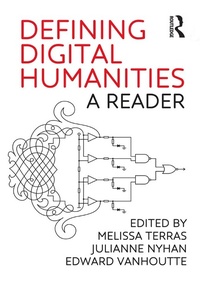
Defining Digital Humanities
A Reader
1st Edition
Published on 13. May 2016
330 pages
978-1-317-15358-0 (ISBN)
Description

Digital Humanities is becoming an increasingly popular focus of academic endeavour. There are now hundreds of Digital Humanities centres worldwide and the subject is taught at both postgraduate and undergraduate level. Yet the term 'Digital Humanities' is much debated. This reader brings together, for the first time, in one core volume the essential readings that have emerged in Digital Humanities. We provide a historical overview of how the term 'Humanities Computing' developed into the term 'Digital Humanities', and highlight core readings which explore the meaning, scope, and implementation of the field. To contextualize and frame each included reading, the editors and authors provide a commentary on the original piece. There is also an annotated bibliography of other material not included in the text to provide an essential list of reading in the discipline. This text will be required reading for scholars and students who want to discover the history of Digital Humanities through its core writings, and for those who wish to understand the many possibilities that exist when trying to define Digital Humanities.
Reviews / Votes
'This reader presents a comprehensive selection of contributions discussing the role and potential definition of Humanities Computing? or, as the more recently coined label has it, of Digital Humanities? - a change in name that is significant in that it expresses the field's progression from an application-centered practice of computing in? the Humanities to a critically reflected digital, i.e. a distinct methodological, variant of Humanities research.' Jan Christoph Meister, University of Hamburg, Germany 'Defining Digital Humanities does just that: it gathers articles published over the past 10 years that explore the digital humanities as a field. It captures current and past debates, its developing history, and divergent views of the field's porous boundaries. It is an ideal introductory reader for the classroom as well as for the curious'. Susan Schreibman, Trinity College Dublin, Ireland 'This definitive collection captures the intense activity and sheer energy in digital humanities for over more than a decade. Charting its emergence and expansion as an academic field in its own right, this work provides a map and guide to the past, the present and the future of digital humanities. An indispensable resource for teaching and research.' Paul Arthur, University of Western Sydney, Australia 'Foremost among many strengths of this collection is that it brings together a confluence of the many views and perspectives about the Digital Humanities - and the past histories as well as the present shapes and forms of Digital Humanities that point to its possible futures.' Ray Siemens, University of Victoria, Canada 'This is not only a valuable resource for digital humanities scholars and students; it also offers valuable insights on discipline formation, on vexed questions about the role of computing and on the relationships between established and emerging fields for those working in the traditional humanities.' Online Information RMore details
Series
Edition
1. Auflage
Language
English
Place of publication
London
United Kingdom
Publishing group
Taylor & Francis Ltd
Target group
College/higher education
File size
2,09 MB
ISBN-13
978-1-317-15358-0 (9781317153580)
Copyright in bibliographic data and cover images is held by Nielsen Book Services Limited or by the publishers or by their respective licensors: all rights reserved.
Schweitzer Classification
Other editions
Additional editions
Book
12/2013
1st Edition
Routledge
€72.00
Shipment within 10-20 days
Book
12/2013
1st Edition
Routledge
€233.80
Shipment within 10-20 days
Persons
Melissa Terras is Director of UCL's Centre for Digital Humanities, and Professor in Digital Humanities at University College London, Julianne Nyhan is Lecturer in Digital Information Studies in the Department of Information Studies at University College London, and Edward Vanhoutte is Director of Research and Publications in the Royal Academy of Dutch Language and Literature - KANTL, Belgium and Editor-in-Chief of LLC: The Journal of Digital Scholarship in the Humanities.
Content
Acknowledgements, Notes on Contributors, Introduction, Section I: Humanities Computing, 1. Is Humanities Computing an Academic Discipline?, 2. What is Humanities Computing and What is Not?, 3. Information Technology and the Troubled Humanities, 4. Disciplined: Using Educational Studies to Analyse 'Humanities Computing', 5. Tree, Turf, Centre, Archipelago - or Wild Acre? Metaphors and Stories for Humanities Computing, 6. The Gates of Hell: History and Definition of Digital | Humanities | Computing, Section II: Digital Humanities, 7. Humanities Computing as Digital Humanities, 8. Something Called Digital Humanities, 9. What Is Digital Humanities and What's It Doing in English Departments?, 10. The Productive Unease of 21st-century Digital Scholarship, 11. Toward a Conceptual Framework for the Digital Humanities, Section III: From the Blogosphere, 12. Digital Humanities is a Spectrum, or "We're All Digital Humanists Now", 13. Who's In and Who's Out, 14. On Building, 15. Inclusion in the Digital Humanities, 16. The Digital Humanities is not about Building, it's about Sharing, 17. I'm Chris, Where Am I Wrong?, 18. Peering Inside the Big Tent, 19. ADHO, On Love and Money, Section IV: Voices from the Community, 20. Selected Definitions from the Day of Digital Humanities: 2009-2012, 21. Digital Humanities Definitions by Type, Section V: Further Materials, 22. Selected Further Reading, 23. Questions for Discussion, Index
