

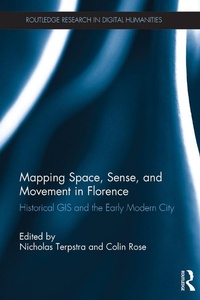
Mapping Space, Sense, and Movement in Florence
Historical GIS and the Early Modern City
Published on 5. February 2016
236 pages
978-1-317-27365-3 (ISBN)
Description

Mapping Space, Sense, and Movement in Florence explores the potential of digital mapping or Historical GIS as a research and teaching tool to enable researchers and students to uncover the spatial, kinetic and sensory dimensions of the early modern city.
The exploration focuses on new digital research and mapping projects that engage the rich social, cultural, and artistic life of Florence in particular. One is a new GIS tool known as DECIMA, (Digitally-Encoded Census Information and Mapping Archive), and the other is a smartphone app called Hidden Florence. The international collaborators who have helped build these and other projects address three questions: how such projects can be created when there are typically fewer sources than for modern cities; how they facilitate more collaborative models for historical research into social relations, senses, and emotions; and how they help us interrogate older historical interpretations and create new models of analysis and communication. Four authors examine technical issues around the software programs and manuscripts. Five then describe how GIS can be used to advance and develop existing research projects. Finally, four authors look to the future and consider how digital mapping transforms the communication of research results, and makes it possible to envision new directions in research.
This exciting new volume is illustrated throughout with maps, screenshots and diagrams to show the projects at work. It will be essential reading for students and scholars of early modern Italy, the Renaissance and digital humanities.
The exploration focuses on new digital research and mapping projects that engage the rich social, cultural, and artistic life of Florence in particular. One is a new GIS tool known as DECIMA, (Digitally-Encoded Census Information and Mapping Archive), and the other is a smartphone app called Hidden Florence. The international collaborators who have helped build these and other projects address three questions: how such projects can be created when there are typically fewer sources than for modern cities; how they facilitate more collaborative models for historical research into social relations, senses, and emotions; and how they help us interrogate older historical interpretations and create new models of analysis and communication. Four authors examine technical issues around the software programs and manuscripts. Five then describe how GIS can be used to advance and develop existing research projects. Finally, four authors look to the future and consider how digital mapping transforms the communication of research results, and makes it possible to envision new directions in research.
This exciting new volume is illustrated throughout with maps, screenshots and diagrams to show the projects at work. It will be essential reading for students and scholars of early modern Italy, the Renaissance and digital humanities.
Reviews / Votes
"This volume is one of the first to address the strengths and challenges of digital work focused on the historical data provided by one city. Nicholas Terpstra and his team have developed a model project to show how new technologies can transform and enhance our historical understanding of places and spaces, breaking down traditional divisions between disciplines and forging new capacities to communicate scholarly information."Caroline Bruzelius, Duke University, USA
"A highly innovative, fascinating study that will open up new horizons, this groundbreaking book is the first to analyse Renaissance urban history using the powerful tools of digital humanities. This is a highly recommended study, written in non-technical language, of what mapping tools can and cannot do for the study of urban history."
Kathleen Christian, The Open University, UK
More details
Series
Language
English
Place of publication
London
United Kingdom
Publishing group
Taylor & Francis Ltd
Target group
College/higher education
Product notice
Reflowable
Illustrations
13 s/w Tabellen, 57 s/w Photographien bzw. Rasterbilder
13 Tables, black and white; 57 Halftones, black and white
File size
55,23 MB
ISBN-13
978-1-317-27365-3 (9781317273653)
Copyright in bibliographic data and cover images is held by Nielsen Book Services Limited or by the publishers or by their respective licensors: all rights reserved.
Schweitzer Classification
Other editions
Additional editions
Nicholas Terpstra | Colin Rose
Mapping Space, Sense, and Movement in Florence
Historical GIS and the Early Modern City
Book
12/2019
1st Edition
Routledge
€69.30
Shipment within 15-20 days
Nicholas Terpstra | Colin Rose
Mapping Space, Sense, and Movement in Florence
Historical GIS and the Early Modern City
Book
02/2016
1st Edition
Routledge
€231.70
Shipment within 10-20 days
Persons
Nicholas Terpstra is Professor of History at the University of Toronto. His recent publications include Cultures of Charity: Women, Politics, and the Reform of Poor Relief in Renaissance Italy (2013) and Religious Refugees in the Early Modern World: An Alternative Interpretation of the Reformation (2015).
Colin Rose is a PhD Candidate in the Department of History at the University of Toronto. He has published on petitioning the court in early modern Parma and on vendetta and judicial practice in Bologna.
Colin Rose is a PhD Candidate in the Department of History at the University of Toronto. He has published on petitioning the court in early modern Parma and on vendetta and judicial practice in Bologna.
Content
Mapping Sense, Space and Movement in Florence: Historical GIS and the Early Modern City List of Figures List of Tables Abbreviations Acknowledgements List of Contributors Introduction Nicholas Terpstra Thinking and Using DECIMA: Neighbourhoods and Occupations in Renaissance Florence Colin Rose The Route of Governmentality: Surveying and Collecting Urban Space in Ducal Florence Leah Faibisoff From the Decima to the DECIMA and Back Again: the Data Behind the Data Eduardo Fabbro Shaping the Streetscape: Institutions as Landlords in Early Modern Florence Daniel Jamison Women Behind Walls: Tracking Nuns and Socio-Spatial Networks in Sixteenth-Century Florence Sharon Strocchia and Julia Rombough Locating the Sex Trade in the Early Modern City: Space, Sense, and Regulation in Sixteenth Century Florence Nicholas Terpstra Plague and the City: Methodological Considerations in Mapping Disease in Early Modern Florence John Henderson and Colin Rose Seeing Sound: Mapping the Florentine Soundscape Niall Atkinson Mapping Fear: Plague and Perception in Florence & Tuscany Nicholas A. Eckstein Locating Experience in the Renaissance City Using Mobile App Technologies: The Hidden Florence Project Fabrizio Nevola and David Rosenthal Conclusion: Towards Early Modern Spatial Humanities
