

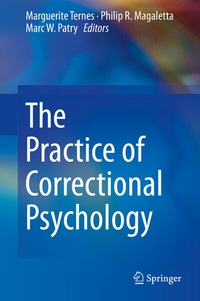
The Practice of Correctional Psychology
Description

This highly accessible volume tours the competencies and challenges relating to contemporary mental health service delivery in correctional settings. Balancing the general and specific knowledge needed for conducting effective therapy in jails and prisons, leading experts present eclectic theoretical models, current statistics, diagnostic information, and frontline wisdom. Evidence-based practices are detailed for mental health assessment, treatment, and management of inmates, including specialized populations (women, youth) and offenders with specific pathologies (sexual offenders, psychopaths). And readers are reminded that correctional psychology is in an evolutionary state, adapting to the diverse needs of populations and practitioners in the context of reducing further offending.
Included in the coverage:
· Assessing and treating offenders with mental illness.
· Substance use disorders in correctional populations.
· Assessing and treating offenders with intellectual disabilities.
· Assessing and treating those who have committed sexual offenses.
· Self-harm/suicidality in corrections.
· Correctional staff: The issue of job stress.
The Practice of Correctional Psychology
will be of major interest to psychologists, social workers, and master's level clinicians and students who work in correctional institutions and settings with offenders on parole or probation, as well as other professionals within the correctional system who work directly with offenders, such as probation officers, parole officers, program officers, and corrections officers.
More details
Other editions
Additional editions
Persons
Dr. Marguerite Ternes joined the Psychology Department at Saint Mary's University in July 2014, after working for several years for the Correctional Service of Canada's research branch. Meg completed her B.A. at St. Francis Xavier University in 2001, then went on to complete an M.A. (2003) and Ph.D. (2009) in Forensic Psychology at the University of British Columbia. Her research interests include substance use and addiction, correctional psychology,credibility assessment, eyewitness memory, and investigative interviewing.
Philip R. Magaletta, PhD, is the Chief of Clinical Education and Workforce Development for the Psychology Services Branch, Federal Bureau of Prisons. He has administered and practiced correctional psychology for nearly two decades. He served as a faculty associate at Johns Hopkins University, is now at George WashingtonUniversity, and has lectured around the United States. A graduate of University of Scranton, Magaletta earned his M.A. from Loyola College in Maryland and his Ph.D. in Clinical Psychology from St. Louis University. He has been a member of the Bureau of Prison national Institutional Review Board for twelve years, and has earned a number of awards for his federal service. Early in his career, he was selected for the Myrl E. Alexander Award, a nationalaward issued by the BOP for developing new techniques in correctional programs and implementing innovativecorrectional procedures. More recently has been selected as a fellow in the American Psychological Association's Division of Public Service Psychologists. His current interests include correctional mental health service delivery and workforce development, addictions counseling, spirituality, and telehealth.
