

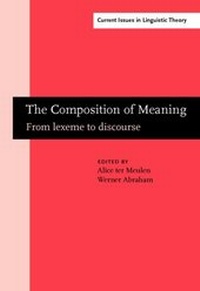
The Composition of Meaning
From lexeme to discourse
1st Edition
Published on 31. October 2004
VI, 232 pages
978-90-272-9510-1 (ISBN)
Description

In the modular design of generative theory the syntax-semantics interface has accounted all along for meanings at the level of Logical Form. The syntax-pragmatics interface, on the other hand, is the result of what one may call the 'pragmatic turn' in the linguistic theory, where content is partitioned into given and new information. In other words, the structural division of the clause has been subjected to criteria of information, or discourse structure. Both interfaces require a structurally descriptive inventory whose specific shapes can be motivated on theory-internal grounds only. The present collection of original articles develops the concept of these interfaces further. The papers in the first section focus on the syntax-semantics interface, those in the second section on the syntax-pragmatics interface.
More details
Other editions
Additional editions

Book
10/2004
John Benjamins Publishing Co
€104.94
Shipment within 10-15 days
Persons
Content
- THE COMPOSITION OF MEANING
- Editorial page
- Title page
- LCC page
- Table of contents
- The composition of meaning
- Note
- References
- Part I. Mapping syntactic structure to meaning
- Coordination in morphology and syntax
- 1. Introduction
- 2. Coordination in syntax and morphology
- 3. The compound template
- 4. Instantiation of determinative and copulative readings
- 5. Copulative `compounds' in Sanskrit
- 6. Semantic properties of copulative compounds in English
- 6.1. True copulatives
- 6.2. Copulatives as front forms
- 7. Conclusion
- Notes
- References
- Appendix
- Aspect, infinitival complements, and evidentials
- 1. Introduction
- 2. Are bare infinitives perfectives in English?
- 3. Bare infinitives: Infinitival endings and perfectivity
- 3.1. Perception verb complements (hence PVCs)
- 3.2. The use of the simple present
- 4. The reanalysis of -ing as ASP
- 4.1. ASP
- 4.2. Changes in ASP
- 5. Perception verbs in Modern English and Dutch
- 5.1. Three kinds of see
- 5.2. More evidence
- 6. Conclusion and further research
- Notes
- Abreviations used
- References
- The problem of unintelligibility
- 1. Introduction
- 2. Ineffability
- 3. Unintelligibility
- 4. Towards solving the problem
- 5. Unintelligibility in a bidirectional OT framework
- 6. Conclusion
- Notes
- References
- VP-internal subjects as `unaccusatives'
- 1. A brief intellectual history of `Burzio's Generalization'1
- 2. The (in)transitivity division
- 3. What do ergative predicates have to do with the definiteness property in existential sentences?
- 4. Toward an answer: The questions to be asked - and first answers: Aspect and Aktionsart perfectivity
- 5. Unaccusativity in German: A unified semantic-syntactic category (common denominator for eV-tests)
- 6. `There is/are' as an alleged test for ergative predicates
- 7. Theoretical aporia
- 8. `Unaccusative/ergative predicate': Simply a misnomer based on observational inadequacy?
- 9. The paradoxality of Burzio's Generalization in German
- 10. The perfect fit of the `Perfectivity Account' in terms of theta role distribution
- 11. Conclusion
- Notes
- References
- Part II. Mapping meaning to information structure
- Either, both and neither in coordinate structures
- 1. Introduction
- 2. Either
- 2.1. The distribution of either
- 2.2. The interaction of either with intonation
- 2.3. Scope ambiguities with either
- 2.4. The contribution of either to the interpretation of the sentence
- 2.5. Inclusive versus exclusive disjunction
- 3. Both
- 3.1. The distribution of both
- 3.2. The interaction of both with intonation
- 3.3. The contribution of both to the interpretation of the sentence
- 3.4. Collective versus distributive readings
- 4. Neither
- 4.1. The distribution of neither
- 4.2. The interaction of neither with intonation
- 4.3. The contribution of neither to the interpretation of the sentence
- 5. Conclusion
- Notes
- References
- Information structure meets Minimalist syntax*
- 1. Introduction
- 2. Case system of (Middle) Bavarian
- 3. Word order in (Middle) Bavarian
- 4. Scrambling and the MP
- 4.1. Object scrambling: Data
- 4.2. Object scrambling: Explanation(s)
- 4.3. CS and the information structure
- 5. The Principle of Strong Morphology
- 6. Other languages showing similar properties
- 7. Conclusion
- Notes
- References
- Focus particles, sentence meaning, and discourse structure
- 1. Introduction
- 2. The conceptual background of the information dichotomy
- 3. Semantic theories of association with focus
- 3.1. Structured Meanings
- 3.2. Alternative Semantics
- 3.3. Comparing semantic theories of information structure
- 4. Association with focus in definite NPs
- 5. Discourse structure
- 6. Foreground-Background Semantics
- 7. Summary
- Notes
- References
- On the interpretation of multiple negation in spoken and written Afrikaans
- 1. Introduction
- 2. Empirical data
- 3. Discussion: The structure of negation in Afrikaans
- 3.1. General conditions of Neg-percolation
- 3.2. Negative quantifiers in Spec-Neg
- 4. The puzzle - the spell-out of additional negation copies in the scope domain
- 5. Towards a solution - the identification of functional domains
- 6. Interpreting negation in the spoken language - negation copies as scope-shibboleths
- 6.1. Negative spread as a rhema-shibboleth
- 7. Conclusion
- Notes
- References
- Index
- CURRENT ISSUES IN LINGUISTIC THEORY
