

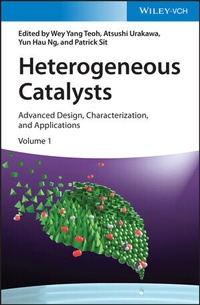
Heterogeneous Catalysts
Advanced Design, Characterization and Applications
1st Edition
Published on 23. February 2021
XXXII, 736 pages
978-3-527-81356-8 (ISBN)
Description

This book presents state-of-the-art knowledge of heterogeneous catalysts including new applications in energy and environmental fields.
More details
Other editions
Additional editions
Wey Yang Teoh | Atsushi Urakawa | Yun Hau Ng
Heterogeneous Catalysts
Advanced Design, Characterization and Applications
Book
03/2021
1st Edition
Wiley-VCH
€329.00
Shipment within 5-7 days
Wey Yang Teoh | Atsushi Urakawa | Yun Hau Ng
Heterogeneous Catalysts
Advanced Design, Characterization, and Applications
Software
02/2021
Wiley-VCH
€413.73
No shipping information available
Persons
Wey Yang Teoh obtained his BE and PhD in Chemical Engineering at The University of New South Wales (Australia). He spent an attachment at ETH Zürich (Switzerland) as part of his PhD studies. In 2010, he joined the School of Energy and Environment at the City University of Hong Kong as tenure-track Assistant Professor, and promoted to Tenured Associate Professor in 2015. He is currently Associate Professor at the Department of Chemical Engineering, University of Malaya (Malaysia), with concurrent appointment as Honorary Associate Professor at The University of New South Wales. His research team develops new strategies for rational catalysts design based on fundamental surface and materials engineering, charge transport, and photochemical conversions, with focus on energy and environmental applications.
Atsushi Urakawa was born in Japan. He obtained his BSc degree (with one year stay in the USA) in Applied Chemistry at Kyushu University (Japan) and he studied Chemical Engineering at Delft University of Technology (The Netherlands) for his MSc degree. He obtained his PhD in 2006 at ETH Zürich (Switzerland) where he worked as Senior Scientist and Lecturer until he joined ICIQ as Group Leader in Spain in 2010. In 2019, he undertook a new challenge as Professor of Catalysis Engineering at Delft University of Technology. His research team combines fundamental and applied research and focuses on the rational development of heterogeneous catalysts and processes aided by in situ and operando methodologies.
Yun Hau Ng is an Associate Professor at the School of Energy and Environment, City University of Hong Kong. He received his BSc (Industrial Chemistry) from Universiti Teknologi Malaysia in 2003 and his PhD from Osaka University in 2009. He was a lecturer (2014) and senior lecturer (2016) at the School of Chemical Engineering at the University of New South Wales (UNSW). His research is focused on the development of novel photoactive semiconductors (particles and thin film) for sunlight energy conversion. He was awarded the Honda-Fujishima Prize (2013), the Chemical Society Japan (CSJ) Distinguished Lectureship Award (2018) and the APEC Science Prize for Innovation, Research and Education (ASPIRE Prize 2019) in recognition of his work in the area of photo-driven water splitting. He is currently serving as an Editor for the Journal of Materials Science: Materials in Electronics (Springer).
Patrick Sit is an Associate Professor at the School of Energy and Environment, City University of Hong Kong. He obtained his PhD in Physics from Massachusetts Institute of Technology, USA. Prior to joining the City University of Hong Kong, he was an associate research scholar in the Department of Chemistry at Princeton University, USA and a post-doctoral associate in the Department of Chemistry at the University of Pennsylvania, USA. His research focuses on the ab initio study of the processes and materials important in energy applications.
Atsushi Urakawa was born in Japan. He obtained his BSc degree (with one year stay in the USA) in Applied Chemistry at Kyushu University (Japan) and he studied Chemical Engineering at Delft University of Technology (The Netherlands) for his MSc degree. He obtained his PhD in 2006 at ETH Zürich (Switzerland) where he worked as Senior Scientist and Lecturer until he joined ICIQ as Group Leader in Spain in 2010. In 2019, he undertook a new challenge as Professor of Catalysis Engineering at Delft University of Technology. His research team combines fundamental and applied research and focuses on the rational development of heterogeneous catalysts and processes aided by in situ and operando methodologies.
Yun Hau Ng is an Associate Professor at the School of Energy and Environment, City University of Hong Kong. He received his BSc (Industrial Chemistry) from Universiti Teknologi Malaysia in 2003 and his PhD from Osaka University in 2009. He was a lecturer (2014) and senior lecturer (2016) at the School of Chemical Engineering at the University of New South Wales (UNSW). His research is focused on the development of novel photoactive semiconductors (particles and thin film) for sunlight energy conversion. He was awarded the Honda-Fujishima Prize (2013), the Chemical Society Japan (CSJ) Distinguished Lectureship Award (2018) and the APEC Science Prize for Innovation, Research and Education (ASPIRE Prize 2019) in recognition of his work in the area of photo-driven water splitting. He is currently serving as an Editor for the Journal of Materials Science: Materials in Electronics (Springer).
Patrick Sit is an Associate Professor at the School of Energy and Environment, City University of Hong Kong. He obtained his PhD in Physics from Massachusetts Institute of Technology, USA. Prior to joining the City University of Hong Kong, he was an associate research scholar in the Department of Chemistry at Princeton University, USA and a post-doctoral associate in the Department of Chemistry at the University of Pennsylvania, USA. His research focuses on the ab initio study of the processes and materials important in energy applications.
Content
Volume 1
PART I.
Evolution of catalysts design and synthesis
Facets engineering on catalysts
Electrochemical synthesis of nanostructured catalytic thin films
Synthesis and design of carbon-supported highly dispersed metal catalysts
Metal clusters-based catalysts
Single-atom heterogeneous catalysts
Synthesis strategies for hierarchical zeolites
Design of molecular heterogeneous catalysts with metal-organic frameworks
Hierarchical and anisotropic nanostructured catalysts
Flame synthesis of simple and multielemental oxide catalysts
Band engineering of semiconductors toward visible-light-responsive photocatalysts
PART II.
Towards precise understanding of catalytic events and materials under working conditions
Pressure gaps in heterogeneous catalysis
In situ transmission electron microscopy observation of gas/solid and liquid/solid interfaces
Tomography in catalysts design
Resolving catalyst performance at nanoscale via fluorescence microscopy
In situ electron paramagnetic resonance spectroscopy in catalysis
Toward operando infrared spectroscopy of heterogeneous catalysts
Operando X-ray spectroscopies on catalysts in action
Methodologies to hunt active sites and active species
Ultrafast spectroscopic techniques in photocatalysis
Volume 2
PART III.
Quantum approaches to predicting molecular reactions on catalytic surfaces
Density functional theory in heterogeneous catalysis
Ab initio molecular dynamics in heterogeneous catalysis
First-principles simulations of electrified interfaces in electrochemistry
Time-dependent density functional theory for excited states calculations
The GW method for excited states calculations
High-throughput computational design of novel catalytic materials
PART IV.
Embracing the energy and environmental challenges of the 21st Century through heterogeneous catalysis
Electrochemical water splitting
New visible-light-responsive photocatalysts for water splitting based on mixed anions
Electrocatalysts in polymer electrolyte membrane fuel cells
Conversion of lignocellulosic biomass to biofuels
Conversion of carbohydrates to high value products
Enhancing sustainability through heterogeneous catalytic conversions at high pressure
Electro-, photo- and photoelectro-chemical reduction of CO2
Photocatalytic abatement of emerging micropollutants in water and wastewater
Catalytic abatement of NOx emissions over the zeolite catalysts
PART I.
Evolution of catalysts design and synthesis
Facets engineering on catalysts
Electrochemical synthesis of nanostructured catalytic thin films
Synthesis and design of carbon-supported highly dispersed metal catalysts
Metal clusters-based catalysts
Single-atom heterogeneous catalysts
Synthesis strategies for hierarchical zeolites
Design of molecular heterogeneous catalysts with metal-organic frameworks
Hierarchical and anisotropic nanostructured catalysts
Flame synthesis of simple and multielemental oxide catalysts
Band engineering of semiconductors toward visible-light-responsive photocatalysts
PART II.
Towards precise understanding of catalytic events and materials under working conditions
Pressure gaps in heterogeneous catalysis
In situ transmission electron microscopy observation of gas/solid and liquid/solid interfaces
Tomography in catalysts design
Resolving catalyst performance at nanoscale via fluorescence microscopy
In situ electron paramagnetic resonance spectroscopy in catalysis
Toward operando infrared spectroscopy of heterogeneous catalysts
Operando X-ray spectroscopies on catalysts in action
Methodologies to hunt active sites and active species
Ultrafast spectroscopic techniques in photocatalysis
Volume 2
PART III.
Quantum approaches to predicting molecular reactions on catalytic surfaces
Density functional theory in heterogeneous catalysis
Ab initio molecular dynamics in heterogeneous catalysis
First-principles simulations of electrified interfaces in electrochemistry
Time-dependent density functional theory for excited states calculations
The GW method for excited states calculations
High-throughput computational design of novel catalytic materials
PART IV.
Embracing the energy and environmental challenges of the 21st Century through heterogeneous catalysis
Electrochemical water splitting
New visible-light-responsive photocatalysts for water splitting based on mixed anions
Electrocatalysts in polymer electrolyte membrane fuel cells
Conversion of lignocellulosic biomass to biofuels
Conversion of carbohydrates to high value products
Enhancing sustainability through heterogeneous catalytic conversions at high pressure
Electro-, photo- and photoelectro-chemical reduction of CO2
Photocatalytic abatement of emerging micropollutants in water and wastewater
Catalytic abatement of NOx emissions over the zeolite catalysts
