

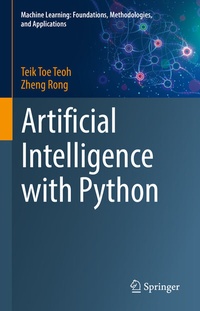
Artificial Intelligence with Python
Description

Entering the field of artificial intelligence and data science can seem daunting to beginners with little to no prior background, especially those with no programming experience. The concepts used in self-driving cars and virtual assistants like Amazon's Alexa may seem very complex and difficult to grasp. The aim of Artificial Intelligence in Python is to make AI accessible and easy to understand for people with little to no programming experience though practical exercises. Newcomers will gain the necessary knowledge on how to create such systems, which are capable of executing tasks that require some form of human-like intelligence.
This book introduces readers to various topics and examples of programming in Python, as well as key concepts in artificial intelligence. Python programming skills will be imparted as we go along. Concepts and code snippets will be covered in a step-by-step manner, to guide and instill confidence in beginners. Complex subjectsin deep learning and machine learning will be broken down into easy-to-digest content and examples. Artificial intelligence implementations will also be shared, allowing beginners to generate their own artificial intelligence algorithms for reinforcement learning, style transfer, chatbots, speech, and natural language processing.
Reviews / Votes
"The book under review follows the structure of a textbook and is decorated with examples, exercises and sample code . . The book is addressed to a wide range of audiences, from students to established researchers. Some computer science background facilitates the understanding of concepts; however, the numerous examples, and ample references recommend this book for researchers with backgrounds other than computer science." (Irina Ioana Mohorianu, zbMATH 1541.68001, 2024)
More details
Other editions
Additional editions
Persons
Dr. Teoh has been pursuing research in big data, deep learning, cybersecurity, artificial intelligence, machine learning, and software development for more than 25 years. His works have been published in more than 50 journals, conference proceedings, books, and book chapters. His qualifications include a PhD in computer engineering from the NTU, Doctor of Business Administration from the University of Newcastle, Master of Law from the NUS, LLB and LLM from the UoL, CFA, ACCA, and CIMA. He has more than 15 years' experience in data mining, quantitative analysis, data statistics, finance, accounting, and law and is passionate about the synergy between business and technology.
Zheng Rong is a software engineer with 4 years of experience. He embraces the ambiguity of data and enjoys the challenges presented by business problems. He has 3 years of teaching experience in data mining and data science, and has coauthored three journal publications on machine learning and deeplearning. He is interested in making learning programming and technology easy for all, including those from a non-technical background.
