

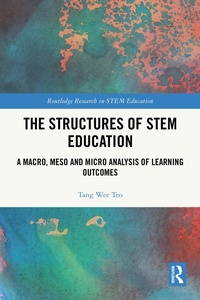
The Structures of STEM Education
A Macro, Meso and Micro Analysis of Learning Outcomes
1st Edition
Published on 18. December 2025
218 pages
978-1-040-74162-7 (ISBN)
Description

STEM education is shaped by interconnected macro, meso, and micro structures that impact curriculum design, teaching practices, and learning outcomes. This book explores three distinctive STEM programmes, offering practical insights for educators, researchers, and policymakers to design, plan, and implement effective STEM opportunities that drive meaningful, transformative education.
The first programme, Code to Sew, showcases a university-industry-school partnership that bridges the private-public spaces to foster innovative learning. The second programme, EPIC-STEM, takes an ecosystemic approach to building students' STEM capital through the affordance of multiple epistemic infrastructures-hackathons, consultative STEM inquiry, symposia, internships, and learning journeys-providing a scalable model across local school clusters. The third programme transcends national boundaries, enhancing teachers' capacities for STEM curriculum development with cognisance and sensitivities to the partnering country's digital transformation, education reforms, and local needs.
This book is an essential resource for readers from academic or scholarly policy-making backgrounds aiming to gain deeper insights into the interconnected Structures of STEM education and how they shape meaningful, transferable learning experiences for both educators and learners.
The first programme, Code to Sew, showcases a university-industry-school partnership that bridges the private-public spaces to foster innovative learning. The second programme, EPIC-STEM, takes an ecosystemic approach to building students' STEM capital through the affordance of multiple epistemic infrastructures-hackathons, consultative STEM inquiry, symposia, internships, and learning journeys-providing a scalable model across local school clusters. The third programme transcends national boundaries, enhancing teachers' capacities for STEM curriculum development with cognisance and sensitivities to the partnering country's digital transformation, education reforms, and local needs.
This book is an essential resource for readers from academic or scholarly policy-making backgrounds aiming to gain deeper insights into the interconnected Structures of STEM education and how they shape meaningful, transferable learning experiences for both educators and learners.
Reviews / Votes
"I strongly recommend this volume to researchers, teachers, and teacher educators in STEM education worldwide. This book invites readers to reflect on themselves and their practices as agents operating within the fluid, dynamic, and context-dependent STEM education ecosystem. May it inspire you to reflect, engage, and act with renewed purpose and imagination."Dr Jina Chang, Assistant Professor, National Institute of Education, Nanyang Technological University, Singapore
"This book provides rich insights into how STEM education practices with different purposes are connected at the three levels, namely narratives at macro-levels, interpretations at meso-levels, and practices or processes at micro-levels. The author provides compelling reasons to consider macro-, meso-, and micro-Structures in the design of systemic STEM programmes."
Dr Aik-Ling Tan, Associate Professor, National Institute of Education. Nanyang Technological University, Singapore
More details
Series
Edition
1. Auflage
Language
English
Place of publication
London
United Kingdom
Publishing group
Taylor & Francis Ltd
Target group
College/higher education
Professional and scholarly
Illustrations
4 Tables, black and white; 5 Line drawings, black and white; 49 Halftones, black and white; 54 Illustrations, black and white
File size
38,46 MB
ISBN-13
978-1-040-74162-7 (9781040741627)
Copyright in bibliographic data and cover images is held by Nielsen Book Services Limited or by the publishers or by their respective licensors: all rights reserved.
Schweitzer Classification
Other editions
Additional editions
Book
approx. 12/2025
1st Edition
Routledge
€211.20
Not yet published
Person
Tang Wee Teo, Ph.D., is an Associate Professor at the National Institute of Education (NIE), Nanyang Technological University, Singapore. She is the Head of the Natural Sciences and Science Education department and also the Co-Head of the Multi-centric Education, Research and Industry STEM Centre at NIE (meriSTEM@NIE). Her research focuses on equity and sociocultural issues in integrated STEM education.
Content
List of Figures
List of Tables
Foreword 1
Foreword 2
Foreword 3
Preface
Acknowledgements
Declarations
SECTION A: INTRODUCTION
1. Introduction to STEM education
2. Theoretical Framework
SECTION B: UNIVERSITY-INDUSTRY STEM PARTNERSHIP
3. University-industry partnership in STEM education
4. (Micro) vignettes: Developing understanding about materials
5. (Micro) vignettes: Digital coding and sewing
6. (Micro) vignettes: Digital embroidery and sewing
7. (Macro-meso-micro) Structures of Code to Sew
SECTION B SUMMARY
SECTION C: LOCAL ECOSYSTEMIC STEM EDUCATION
8. Building a local STEM ecosystem
9. (Meso and micro) Structures of the EPIC-STEM hackathon
10. (Meso and micro) Structures of the EPIC-STEM inquiry projects
11. (Meso and micro) Structures of the EPIC-STEM student symposium
SECTION C SUMMARY
SECTION D: REGIONAL STEM EDUCATION
12. (Macro) Structures of STEM education in Asia
13. (Meso) Structures of Indonesia's education system
14. (Micro) Structures of STEM teacher capacity building in Indonesia
SECTION D SUMMARY
SECTION E: IMPLICATIONS AND CONCLUSION
15. Implications and conclusion
Index
List of Tables
Foreword 1
Foreword 2
Foreword 3
Preface
Acknowledgements
Declarations
SECTION A: INTRODUCTION
1. Introduction to STEM education
2. Theoretical Framework
SECTION B: UNIVERSITY-INDUSTRY STEM PARTNERSHIP
3. University-industry partnership in STEM education
4. (Micro) vignettes: Developing understanding about materials
5. (Micro) vignettes: Digital coding and sewing
6. (Micro) vignettes: Digital embroidery and sewing
7. (Macro-meso-micro) Structures of Code to Sew
SECTION B SUMMARY
SECTION C: LOCAL ECOSYSTEMIC STEM EDUCATION
8. Building a local STEM ecosystem
9. (Meso and micro) Structures of the EPIC-STEM hackathon
10. (Meso and micro) Structures of the EPIC-STEM inquiry projects
11. (Meso and micro) Structures of the EPIC-STEM student symposium
SECTION C SUMMARY
SECTION D: REGIONAL STEM EDUCATION
12. (Macro) Structures of STEM education in Asia
13. (Meso) Structures of Indonesia's education system
14. (Micro) Structures of STEM teacher capacity building in Indonesia
SECTION D SUMMARY
SECTION E: IMPLICATIONS AND CONCLUSION
15. Implications and conclusion
Index
