

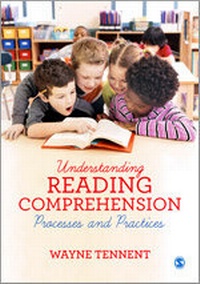
Understanding Reading Comprehension
Processes and Practices
1st Edition
Published on 29. September 2014
224 pages
978-1-4739-0956-4 (ISBN)
Description

Can baboons read? That is the thought-provoking question that opens this wonderfully accessible book for trainee and practising primary school teachers to fully understand the process of reading comprehension. Comprehension is an essential component of learning to read and a successful teacher of reading will have a portfolio of different strategies and approaches that take in to account that children learn to read in different ways. This book supports the development of student and practising teachers' subject knowledge by providing detailed guidance in to the reading comprehension process, along with practical strategies and lesson ideas for use in the classroom. Drawing from educational and psychological research, coverage includes:
School-based activities in every chapter
An in-depth focus on the inference making process
The role of vocabulary and syntax in comprehension
Cognitive and meta-cognitive processes including the use of memory
Advice on developing effective classroom talk with different groups of children
Using different text genres and selecting texts
School-based activities in every chapter
An in-depth focus on the inference making process
The role of vocabulary and syntax in comprehension
Cognitive and meta-cognitive processes including the use of memory
Advice on developing effective classroom talk with different groups of children
Using different text genres and selecting texts
Reviews / Votes
'Much attention has been placed on the decoding aspect of reading and far less on the hugely complex twin process of comprehending texts. Wayne Tennent's scholarly but accessible book helps to redress the imbalance. The author explains the key issues and offers practical guidance on how teachers can best support children to fully comprehend what they read. The book is timely and will become essential reading for all primary teachers.' -- Jeni Riley 'Comprehensive, authoritative and timely, this book is informed by thorough analysis of research in the field and provides an insightful and invaluable guide to the teaching of reading comprehension. This is an essential resource for training and practising teachers, teacher educators and researchers.' -- Mary Anne Wolpert This book addresses the teaching of reading comprehension from a pedagogically informed position. It provides a detailed and comprehensive analysis of historical, international and current research into the teaching of reading comprehension and is illuminated by the author's own extensive experience of working and researching with children. -- Mary Anne WolportMore details
Language
English
Place of publication
London
United Kingdom
Target group
College/higher education
ISBN-13
978-1-4739-0956-4 (9781473909564)
Copyright in bibliographic data and cover images is held by Nielsen Book Services Limited or by the publishers or by their respective licensors: all rights reserved.
Schweitzer Classification
Other editions
Additional editions
Book
11/2014
1st Edition
SAGE Publications Ltd
€150.05
Shipment within 15-20 days
Book
11/2014
1st Edition
SAGE Publications Ltd
€37.50
Shipment within 15-20 days
Person
Wayne Tennent is a Senior Lecturer in Education at Brunel University of London. His co-authored book Guiding Readers - Layers of Meaning was published in 2016 and won the United Kingdom Literacy Association (UKLA) academic book of the year award. He is a Brunel Global Citizen Award Winner, as nominated by the students, for his work in promoting a critical awareness of 'race' and gender in texts used for teaching.
He works with schools, both nationally and internationally, developing pedagogical practices to support teaching for reading comprehension. Previously, he taught for many years, mainly in London, but also in Greece, Brunei and New Zealand. He continues to work with children on a regular basis.
He works with schools, both nationally and internationally, developing pedagogical practices to support teaching for reading comprehension. Previously, he taught for many years, mainly in London, but also in Greece, Brunei and New Zealand. He continues to work with children on a regular basis.
Content
Locating reading
Locating comprehension
SECTION 1: PROCESSES
Knowledge: of life and language
Memory and monitoring
Inference making: Definition and difficulties
Coherence inferences
Interrogative inferences
Text comprehension: uniting the separate components
SECTION 2: PRACTICES
Selecting texts
Teaching comprehension: Pedagogical principles
Teaching comprehension: Pedagogy in practice
Conclusion
Locating comprehension
SECTION 1: PROCESSES
Knowledge: of life and language
Memory and monitoring
Inference making: Definition and difficulties
Coherence inferences
Interrogative inferences
Text comprehension: uniting the separate components
SECTION 2: PRACTICES
Selecting texts
Teaching comprehension: Pedagogical principles
Teaching comprehension: Pedagogy in practice
Conclusion
