

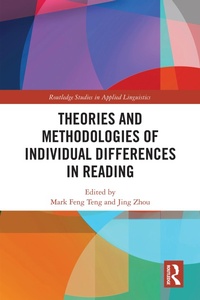
Theories and Methodologies of Individual Differences in Reading
Will be published approx. on 3. July 2026
264 pages
978-1-040-66780-4 (ISBN)
Description

This collection makes the case for exploring individual differences (IDs) in foreign language reading, arguing for a shift from a universalist view to
consider new ID-focused theories and methodologies.
The volume demonstrates the need to recognize individual variations, such as lexical knowledge and working memory capacity, and the diverse cognitive and linguistic profiles of learners in the study of reading, particularly in mixed-ability learning environments. The chapters explore variability among learners and their impact on reading dynamics, acquisition, and instructional effectiveness. Seeking to bridge theory and practice, the collection empowers stakeholders with a better understanding of the theoretical foundations of the intersection of ID research and reading practices toward effective practical implementation in the classroom.
This book will appeal to students and scholars in applied linguistics, second language learning, second language acquisition, and language education, particularly those with an interest in reading studies and research methods.
consider new ID-focused theories and methodologies.
The volume demonstrates the need to recognize individual variations, such as lexical knowledge and working memory capacity, and the diverse cognitive and linguistic profiles of learners in the study of reading, particularly in mixed-ability learning environments. The chapters explore variability among learners and their impact on reading dynamics, acquisition, and instructional effectiveness. Seeking to bridge theory and practice, the collection empowers stakeholders with a better understanding of the theoretical foundations of the intersection of ID research and reading practices toward effective practical implementation in the classroom.
This book will appeal to students and scholars in applied linguistics, second language learning, second language acquisition, and language education, particularly those with an interest in reading studies and research methods.
More details
Series
Language
English
Place of publication
London
United Kingdom
Publishing group
Taylor & Francis Ltd
Target group
College/higher education
Professional and scholarly
Product notice
Reflowable
Illustrations
9 Tables, black and white; 7 Line drawings, black and white; 1 Halftones, black and white; 8 Illustrations, black and white
File size
1,86 MB
ISBN-13
978-1-040-66780-4 (9781040667804)
Copyright in bibliographic data and cover images is held by Nielsen Book Services Limited or by the publishers or by their respective licensors: all rights reserved.
Schweitzer Classification
Other editions
Additional editions
Mark Feng Teng | Jing Zhou
Theories and Methodologies of Individual Differences in Reading
Book
approx. 07/2026
1st Edition
Routledge
€191.50
Not yet published
Persons
Mark Feng Teng is Associate Professor of Applied Linguistics at Macao Polytechnic University, Macau SAR, China. His research focuses primarily on vocabulary and reading. He serves as Editor-in-Chief of the International Journal of TESOL Studies and Digital Applied Linguistics, and as Co- Editor of Reading in a Foreign Language.
Jing Zhou is Tenure-Track Assistant Professor at the Defense Language Institute Foreign Language Center, Monterey, CA, USA. She specializes in second language reading, extensive reading, and teaching Chinese and English as foreign languages. She currently serves as Co-Editor of Reading in a Foreign Language.
Jing Zhou is Tenure-Track Assistant Professor at the Defense Language Institute Foreign Language Center, Monterey, CA, USA. She specializes in second language reading, extensive reading, and teaching Chinese and English as foreign languages. She currently serves as Co-Editor of Reading in a Foreign Language.
Content
Chapter 1. Introduction: Theories and Methodologies of Individual Differences in Reading Jing Zhou and Mark Feng Teng, Chapter 2. Gender and Socioeconomic Status in Reading Guofang Li and Fubiao Zhen, Chapter 3. Corpus-based Models of Reading Input, Individual Differences and L2 Vocabulary Learning Clarence Green and Maggie Jiayi Mai, Chapter 4. Exploring cognitive-linguistic individual differences in L2 collocation learning from reading Jookyoung Jung, Chapter 5. Applying and Evaluating the Simple View of Reading Model for L2 Reading Richard L. Sparks and Philip S. Dale, Chapter 6. Vocabulary knowledge and L2 Reading Xian Zhang, Chapter 7. Metacognition in EFL Reading Mark Feng Teng, Chapter 8. The Effect of Individual Differences in Extensive Reading Thomas N. Robb, Chapter 9. Hybrid Mixed Methods Exploration of L2 Reading Gains and Affective Shifts in Extensive Reading Research Mitsue Tabata-Sandom, Chapter 10. Conversation Analysis and L2 Reading Motivation Eunseok Ro, Chapter 11. Motivation and Extensive Reading Jing Zhou, Chapter 12. Future Directions for Theories and Methodologies of Individual Differences in Reading Mark Feng Teng and Jing Zhou, Index
