

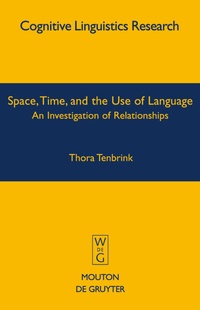
Space, Time, and the Use of Language
Description

Does temporal language depend on spatial language? This widespread view is intuitively appealing since spatial and temporal expressions are often similar or identical. Also, metaphors consistently express temporal phenomena in terms of spatial language, pointing to a close semantic and conceptual relationship. But what about the application of the two kinds of linguistic expressions in natural discourse?
The book draws together findings on terms that describe the relation of objects or events to each other (such as in front / behind , before / after , etc.), highlighting the relationship between cognition and language usage. Using the method of cognitively motivated discourse analysis, novel empirical results are presented to complement earlier findings. The detailed investigation of a selected range of terms that appear to be parallel in space and time highlights both similarities and fundamental differences in their application. As a result, a new picture emerges: The concepts of space and time are represented in language usage in various systematic ways, reflecting how we understand the world - and at the same time reflecting how our concepts of space and time differ fundamentally.
The volume contributes to a debate that has been of interest for cognitive linguists for several decades, concerning the understanding of transfer processes between two conceptually intertwined domains. The specific contribution of this work consists of addressing the novel question of how such processes come into play in the actual application of relevant expressions in natural discourse. By adopting established approaches from Discourse Analysis for issues that are deeply rooted in interdisciplinary research in Cognitive Science, insights are drawn together from two hitherto largely unrelated fields of research to approach the topic from an original perspective, leading to a deeper understanding of the relationship between the domains of space and time and their expression in language.
More details
Other editions
Additional editions
Person
Content
2 - Table of contents [Seite 7]
3 - Chapter 1. Introduction [Seite 9]
4 - Chapter 2. Time and space [Seite 20]
5 - Chapter 3. Temporal dimensions: Linguistic repertory and issues of application [Seite 46]
6 - Chapter 4. Temporal dimensions: Empirical analysis [Seite 74]
7 - Chapter 5. Spatial dimensions: Linguistic repertory and issues of application [Seite 126]
8 - Chapter 6. Spatial dimensions: Empirical analysis [Seite 208]
9 - Chapter 7. Conclusion: Comparing the applicability conditions [Seite 275]
10 - Backmatter [Seite 296]
