

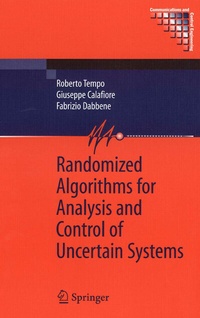
Randomized Algorithms for Analysis and Control of Uncertain Systems
Description

Reviews / Votes
From the reviews:
In summary, this book provides an excellent survey of how randomization techniques are successfully applicable for advanced robust control... The style of writing renders it very well accessible for final year Master's students with a solid background in robust control, and for the whole control community it constitutes an excellent up-to-date foundation for entering research on probabilistic techniques.
Automatica 41 (2005) 2001 - 2017 (Reviewer: Carsten Scherer)
I believe that this book is a very good tool for introducing both control practioners and graduate students to the area of probabilistic robustness. An overview of basis results in both control and probability is provided. Moreover, it describes many of the recent results in the area of probabilistic robustness.
Summarizing, in this book, the area of probabilistic robustness is for the first time introduced in a sympathetic way and it is, in my opinion, a very useful reference for anyone who wants to get acquainted with this area.
International Journal of Robust and Nonlinear Control 16 (2006) 728 - 729 (Reviewer: Constantino M. Lagoa)
The central theme of the present work is the application of randomized algorithms to various problems in control system analysis and synthesis.. This well-written book can be recommended to readers in control systems analysis and synthesis, especially in robustness analysis and robust controller synthesis.
Zentralblatt MATH 1079 (2006) (Reviewer: Kurt Marti)
More details
Other editions
New editions
Additional editions
Persons
Roberto Tempo is one of the next generation of "top brass" in the control research community. He is currently the director of research at the National Research Council of Italy. Like any leading academic, he has the usual "long-as-your-arm" string of publications, both in refereed journals and at conferences. This is his second book, the first being an edited volume Robustness in Identification and Control. He is a regular member of program committees for several IFAC, IEEE, IEE and EUCA (European Union Control Association) conferences including Conference on Decision and Control (of which he will be program chair when the conference joins with ECC in Seville 2005) and is a fellow of the IEEE. He has been Associate Editor of IEEE Transaction on Automatic Control and is at present the Deputy Editor-in-Chief of Automatica the most widely read and respected journal in the field of theoretical control.
Giuseppe Calafiore is an up-and coming academic who has established a reputation on both sides of the Atlantic with frequent periods as a visiting scholar at both Stanford University and UC Berkeley.
