

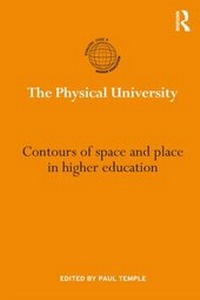
The Physical University
Contours of space and place in higher education
1st Edition
Published on 21. March 2014
278 pages
978-1-317-80252-5 (ISBN)
Description

The great universities of the world are to a large extent defined in the public imagination by their physical form: when people think of a university, they usually think of a distinctive place, rather than about say the teaching or the research that might go on there. This is understandable, both because universities usually stay rooted to the same spot over the centuries; and because their physical forms may send powerful messages about the kind of places they are.
The physical form of the university, and how the spaces within it become transformed by their users into places which hold meanings for them, has become of increased interest recently from both academic and institutional management perspectives, when trying to understand more about how universities work, and how they may be made more effective. Yet, despite its seemingly obvious importance, the available literature on space and place in higher education internationally is scant when compared to that dealing with, say, teaching and learning methods, or with evaluating quality, or many other topics.
This book brings together a range of academic and professional perspectives on university spaces and places, and show how technical matters of building design, maintenance and use interact with academic considerations on the goals of the university. Space issues are located at an intellectual crossroads, where widely differing conceptual and professional perspectives meet, and need to be integrated and this important book brings together perspectives from around the world to show design and use issues are changing Higher Education..
Globally, higher education is being required to do more things - to teach more students, to be better at research, to engage more with business and communities; and many other things. These pressures are leading universities to reconsider their management processes, as well as their academic structures: an often-quoted saying is that "we make our buildings, and afterwards they make us". At a time when universities and colleges are seeking competitive advantages, ideas and analysis about space design and use is much needed and will be well-received.
The physical form of the university, and how the spaces within it become transformed by their users into places which hold meanings for them, has become of increased interest recently from both academic and institutional management perspectives, when trying to understand more about how universities work, and how they may be made more effective. Yet, despite its seemingly obvious importance, the available literature on space and place in higher education internationally is scant when compared to that dealing with, say, teaching and learning methods, or with evaluating quality, or many other topics.
This book brings together a range of academic and professional perspectives on university spaces and places, and show how technical matters of building design, maintenance and use interact with academic considerations on the goals of the university. Space issues are located at an intellectual crossroads, where widely differing conceptual and professional perspectives meet, and need to be integrated and this important book brings together perspectives from around the world to show design and use issues are changing Higher Education..
Globally, higher education is being required to do more things - to teach more students, to be better at research, to engage more with business and communities; and many other things. These pressures are leading universities to reconsider their management processes, as well as their academic structures: an often-quoted saying is that "we make our buildings, and afterwards they make us". At a time when universities and colleges are seeking competitive advantages, ideas and analysis about space design and use is much needed and will be well-received.
Reviews / Votes
"The eclectic nature of this collection is a considerable strength, for it includes, as implied, a wide variety of intellectual approaches. Here, the old categories of hard /soft and pure/applied come to mind...This is a tremendous book. For anyone interested in the university as a physical space there is surely something here." - Ronald Barnett, Institute of Education, London Review of EducationMore details
Series
Language
English
Place of publication
London
United Kingdom
Publishing group
Taylor & Francis Ltd
Target group
College/higher education
Professional and scholarly
Illustrations
13 s/w Abbildungen, 3 s/w Tabellen, 13 s/w Photographien bzw. Rasterbilder
3 Tables, black and white; 13 Halftones, black and white; 13 Illustrations, black and white
File size
2,80 MB
ISBN-13
978-1-317-80252-5 (9781317802525)
Copyright in bibliographic data and cover images is held by Nielsen Book Services Limited or by the publishers or by their respective licensors: all rights reserved.
Schweitzer Classification
Other editions
Additional editions
Book
02/2017
1st Edition
Routledge
€82.80
Shipment within 10-20 days
Book
03/2014
1st Edition
Routledge
€231.10
Shipment within 15-20 days
Person
Paul Temple is Reader in Higher Education Management at the Institute of Education, University of London, and Co-Director of its Centre for Higher Education Studies.
Content
Part I: Space at Work
1. Space, Place and University Effectiveness Paul Temple
2. Performing University Spaces: Multiplicity, relationality, affect Christoph Michels and Timon Beyes
3. Examining New Processes for Learning Space Design Brett Bligh
4. Managing the Campus: facility management, the student experience and university effectiveness Alexi Marmot
5. Reading Campus Landscapes Phillip Waite
6. Sustainable Development: Impacts on space and place in higher education Marcella Ucci
7. Place-making and Other Purposes: Public art on campus Lorna Hards, Sian Vaughan and James Williams
Part II: Space and Place in Context
8. The Idea of a University and its Concrete Form Anthony Ossa-Richardson
9. Science-driven University Development in the United States Eugene P Trani
10. "Let's go for the chicken-drum": the everyday production of social space in a Chinese university Zhongyuan Zhang
11. The University and the City: Social Science Centre, Lincoln - forming the urban revolution Mike Neary
12. Decoding University Ideals by Reading Campuses Paul Benneworth
1. Space, Place and University Effectiveness Paul Temple
2. Performing University Spaces: Multiplicity, relationality, affect Christoph Michels and Timon Beyes
3. Examining New Processes for Learning Space Design Brett Bligh
4. Managing the Campus: facility management, the student experience and university effectiveness Alexi Marmot
5. Reading Campus Landscapes Phillip Waite
6. Sustainable Development: Impacts on space and place in higher education Marcella Ucci
7. Place-making and Other Purposes: Public art on campus Lorna Hards, Sian Vaughan and James Williams
Part II: Space and Place in Context
8. The Idea of a University and its Concrete Form Anthony Ossa-Richardson
9. Science-driven University Development in the United States Eugene P Trani
10. "Let's go for the chicken-drum": the everyday production of social space in a Chinese university Zhongyuan Zhang
11. The University and the City: Social Science Centre, Lincoln - forming the urban revolution Mike Neary
12. Decoding University Ideals by Reading Campuses Paul Benneworth
