

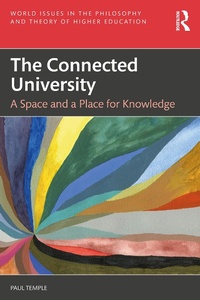
The Connected University
A Space and a Place for Knowledge
1st Edition
Published on 7. November 2024
172 pages
978-1-040-15025-2 (ISBN)
Description

Universities are primarily social institutions, but they are also physical, material structures. This book bridges this divide by examining the links between the two and explores how good connectivity can result in a more effective university.
Through an original study of connectivity in university design, Paul Temple explores what it is, why it's important, and how it works. Using case studies and practical examples to examine the nature of social and material interactions, this book reviews what is known about connectivity and how it can be used to enhance academic effectiveness.
This book will be of interest to academics, students, and researchers interested in higher education theory and practice, the philosophy of higher education, and those working at the interface between higher education studies and architecture and design.
Through an original study of connectivity in university design, Paul Temple explores what it is, why it's important, and how it works. Using case studies and practical examples to examine the nature of social and material interactions, this book reviews what is known about connectivity and how it can be used to enhance academic effectiveness.
This book will be of interest to academics, students, and researchers interested in higher education theory and practice, the philosophy of higher education, and those working at the interface between higher education studies and architecture and design.
More details
Series
Edition
1. Auflage
Language
English
Place of publication
London
United Kingdom
Publishing group
Taylor & Francis Ltd
Target group
College/higher education
Professional and scholarly
Illustrations
1 Tables, black and white; 3 Line drawings, black and white; 1 Halftones, black and white; 4 Illustrations, black and white
ISBN-13
978-1-040-15025-2 (9781040150252)
Copyright in bibliographic data and cover images is held by Nielsen Book Services Limited or by the publishers or by their respective licensors: all rights reserved.
Schweitzer Classification
Other editions
Additional editions
Book
11/2024
1st Edition
Routledge
€200.56
Shipment within 10-20 days
Book
11/2024
1st Edition
Routledge
€50.50
Shipment within 10-20 days
Person
Paul Temple is Honorary Associate Professor, University College London Institute of Education, London, UK where he was previously Co-Director of the Centre for Higher Education Studies.
Content
Introduction
Part I Physicality, space, and place
Chapter 1 The physical university in the twenty-first century
Chapter 2 Why space? Why connectivity?
Chapter 3 University space types
Chapter 4 Creating space and place
Chapter 5 The campus
Chapter 6 The university and the city
Part II The University at Work
Chapter 7 Space and learning
Chapter 8 Space for research and scholarship
Chapter 9 The University of York: a study of place-making
Chapter 10 Conclusions: connectivity and place-making
Part I Physicality, space, and place
Chapter 1 The physical university in the twenty-first century
Chapter 2 Why space? Why connectivity?
Chapter 3 University space types
Chapter 4 Creating space and place
Chapter 5 The campus
Chapter 6 The university and the city
Part II The University at Work
Chapter 7 Space and learning
Chapter 8 Space for research and scholarship
Chapter 9 The University of York: a study of place-making
Chapter 10 Conclusions: connectivity and place-making
