

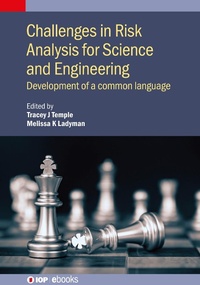
Challenges in Risk Analysis for Science and Engineering
Description

Risk analysis involves the quantification of risk and is essential to all areas of science and engineering. Analysing risk ensures that the hazards or detrimental impacts of research and other activities are identified, mitigated and managed.
The interpretation and implementation of risk assessment has evolved independently within disciplines, which means that small errors in communication have in some cases led to large scale consequences. The aim of this reference text is to provide a common language and consistent approach to risk assessment across disciplines through the collation of detailed, real examples and scenarios.
Examples are drawn from industries including defence, explosive manufacturing, mine action, nuclear, science education and engineering, and focus on key risk topics such as tolerability, data collection, hazard identification and hazard interpretation. The approaches communicate common challenges and are compared and contrasted, with a particular focus on the terminology used.
The book is essential reading for scientists and engineers that undertake risk assessment, including industry practitioners, researchers in academia and those with a general interest in improving risk assessment processes. It is also a valuable reference for science and engineering students that regularly undertake risk assessments or study courses on risk assessment.
Key Features:
- Proposes a common language and consistent approach to risk assessment across science and engineering disciplines
- Creates a bridge between industrial and academic approaches to risk analysis and encourages cross-disciplinary collaboration
- Collates detailed practical examples of risk assessment
- Explores the diverse undertaking of risk assessment in a wide range of disciplines
- Analyses the approaches taken, with a particular focus on the terminology used
More details
Other editions
Additional editions

Persons
Dr Tracey Temple is a senior lecturer in environmental science and the Course Director for the Explosives Ordnance and Engineering MSc at Cranfield University. Prior to Cranfield, Dr Temple was an environmental consultant primarily for UK Defence, working in the UK and Cyprus.
Dr Melissa Ladyman is a lecturer in environmental science at Cranfield University, a position she has held since 2014. In the same year Dr Ladyman gained a PhD in organic and medicinal chemistry focussing on the development of fluorescent assays for biological analysis from The University of Edinburgh.
Content
- Intro
- Introduction to challenges in Risk Analysis for science and engineering: development of a common language
- Outline placeholder
- 0.1 Introduction
- Chapter 1: An introduction to Risk Analysis for scientists and engineers
- Chapter 2: On the tolerability of risk, public and private
- Chapter 3: Storage of military ammunition and explosives- risk evaluation and hazard management
- Chapter 4: The application of Systems Thinking to Risk Assessment: left shifting safety
- Chapter 5: Influence of automation on human factor integration in Risk Assessment systems
- Chapter 6: Minimising the risks to decision-making by selecting representative experimental methods for environmental science research
- Chapter 7: The Importance of the conceptual site model in the assessment of land contamination
- Chapter 8: Land release: A Risk Management approach for mine action
- Chapter 9: Risk Assessment and management at a heritage site
- Chapter 10: Amazonian non-timber forest products and ways forward to ensure their sustainability at low risk: Acai case-study
- Chapter 11: Development of a risk matrix for low-cost engineering solutions: a systematic approach
- Chapter 12: Assessing the academic and experiential risk to students from the transition to hybrid and online delivery
- Chapter 13: Practical application of a decision framework to mitigate environmental risks posed by the treatment of explosive contaminated wastewater
- Chapter 14: Risk recognition and continuous risk management
- Conclusion: Challenges in Risk Analysis
- References
- Acknowledgement
- Editor biographies
- Tracey Temple
- Melissa Ladyman
- List of contributors
- Message from the editors
- Abbreviations
- Chapter 1 An introduction to risk analysis for scientists and engineers
- 1.1 Risk Analysis: definition and uncertainties
- 1.2 Types of Risk Analysis for science and engineering
- 1.3 Communication in Risk Analysis: a standardised terminology
- 1.4 Benefits of performing a Risk Analysis
- 1.5 Conclusion
- References
- Chapter 2 On the tolerability of risk, public and private
- 2.1 Introduction
- 2.2 Risk, hazard and peril
- 2.3 Political tolerability of risk
- 2.3.1 Road and rail traffic as exemplars of this approach
- 2.4 Public mortality
- 2.5 Mortality and fiscal cost
- 2.6 Public perception of risk
- 2.7 Peril and the information super highway
- 2.8 Peril versus lack of benefit as an arbiter of tolerability
- 2.9 How rare is rare: how to describe unlikely events
- 2.10 Conclusion
- References
- Chapter 3 Storage of military ammunition and explosives-risk evaluation and hazard management
- 3.1 Introduction
- 3.1.1 Scope
- 3.1.2 Risk Assessment
- 3.2 Ammunition and explosives hazards
- 3.2.1 Qualifying tests
- 3.2.2 Hazards to ammunition and explosives
- 3.2.3 Hazards from ammunition and explosives
- 3.3 Risk reduction and hazard mitigation
- 3.3.1 Determining risk
- 3.3.2 Consequence analysis
- 3.3.3 Case studies
- 3.4 Opportunities for harmonisation and standardisation
- 3.5 Conclusion
- Appendix A United Nations hazard division tests (UN 2019a)
- Appendix B Explosives trials
- References
- Chapter 4 The application of systems thinking to Risk Assessment: left shifting safety
- 4.1 Introduction
- 4.2 Application of functional-failure modes and effect analysis (F-FMEA)
- 4.3 The F-FMEA toolkit
- 4.3.1 Functionality
- 4.3.2 Functional MAP illustration
- 4.4 Example 1: small scale woodworking
- 4.4.1 Example 1 summary
- 4.5 Example 2: ignition composition for tracer bullet
- 4.5.1 Individual process-premix 1
- 4.5.2 Individual process-premix 2
- 4.5.3 Individual processes-final mix, blending premix 1 and premix 2
- 4.6 Conclusions
- References
- Chapter 5 Influence of automation on human factor integration in Risk Assessment systems
- 5.1 Introduction
- 5.2 Risk Assessment
- 5.2.1 Qualitative Risk Assessment
- 5.3 Human factor integration
- 5.3.1 Brief history of HFI
- 5.3.2 HFI in RA systems
- 5.3.3 Human reliability assessment
- 5.3.4 Automation
- 5.3.5 Machine learning
- 5.3.6 Human robot collaboration
- 5.4 Scope
- 5.5 Case studies and the development of Risk Assessment systems
- 5.5.1 Mile Island
- 5.5.2 Human factor considerations in the 3 Mile Island accident
- 5.5.3 Influence of Risk Assessment and automation on process safety
- 5.6 Chernobyl
- 5.6.1 Human factor considerations in the Chernobyl accident
- 5.6.2 Influence of Risk Assessment and automation on process safety
- 5.7 Fukushima
- 5.7.1 Human factor considerations in the Fukushima accident
- 5.7.2 Influence of Risk Assessment and automation on process safety
- 5.8 Human factors and Risk Assessment: the way forward
- 5.9 Conclusion
- References
- Chapter 6 Minimising the risks to decision-making by selecting representative experimental methods for environmental science research
- 6.1 Introduction
- 6.2 Incorporating representativeness into experimental methods
- 6.3 The use of indoor facilities: data representativeness uncontrolled versus controlled conditions
- 6.4 Computational modelling and the art of assessing representativeness
- 6.5 The consequences of choice: the final step in decision-making overall
- 6.6 Conclusions and recommendations
- References
- Chapter 7 The importance of the conceptual site model in the assessment of land contamination
- 7.1 Introduction
- 7.2 Contaminated land legal/regulatory background
- 7.2.1 A brief history
- 7.2.2 Current contaminated land legislation and guidance
- 7.2.3 Planning and construction policies and guidelines
- 7.2.4 Other consideration and further guidance
- 7.3 Developing the conceptual site model (CSM)
- 7.3.1 Source identification
- 7.3.2 Receptors
- 7.3.3 Pathways
- 7.4 Assessing the risk
- 7.4.1 Phase two LQA-the site investigation
- 7.4.2 Site investigation methods
- 7.4.3 Revised CSM
- 7.5 Case study: Caesar's Camp, Area B6, Aldershot [12]
- 7.5.1 Site history
- 7.5.2 Environmental setting
- 7.5.3 Preliminary conceptual site model
- 7.5.4 Summary of site investigations
- 7.5.5 Assessment of soil and controlled waters
- 7.5.6 Summary of findings
- 7.5.7 Revised conceptual site model and environmental Risk Assessment
- 7.5.8 Conclusion
- References
- Chapter 8 Land Release: a Risk Management approach for mine action
- 8.1 Introduction
- 8.2 The basis of mine action
- 8.3 What is Land Release?
- 8.4 The importance of operational data
- 8.5 The problem of low-density contamination
- 8.6 The problem of routes
- 8.7 The problem of criteria
- 8.8 The issue of explosive remnants of war
- 8.9 The influence of ISO
- 8.10 Land release success stories
- 8.11 Future developments of land release
- 8.12 Conclusion
- References
- Chapter 9 Risk assessment and management at a heritage site
- 9.1 Introduction
- 9.2 Risk Management
- 9.2.1 Scheduled monument management plan
- 9.2.2 Wildlife management plan
- 9.2.3 Woodland management plan
- 9.3 People safety
- 9.4 Conclusion
- References
- Chapter 10 Amazonian non-timber forest products and ways forward to ensure their sustainability at low risk: Acai case study
- 10.1 Introduction
- 10.2 Background
- 10.3 Method
- 10.4 Results
- 10.4.1 Metadata analysis
- 10.4.2 Analysis of Acai industry as an entry point of Risk Assessments
- 10.4.3 Analysis of Acai industry at Solimões river
- 10.5 Discussion
- 10.5.1 Considerations for integrated Risk Assessment
- 10.5.2 Further enhancing sustainability of the industry
- 10.6 Conclusion
- Acknowledgements
- References
- Chapter 11 Development of a risk matrix for low-cost engineering solutions: a systematic approach
- 11.1 Introduction
- 11.1.1 The risk to be assessed
- 11.1.2 How current PPE responds to blast and fragmenting incidents
- 11.1.3 PPE review
- 11.2 Literature review of non-destructive tests to assess residual stress/damage to the visor
- 11.2.1 Test 1-direct illumination test: author designed method adapted from Horn et al (2017)
- 11.2.2 Test 2-low-level illumination test: background and discussion
- 11.2.3 Test 3-birefringence test: background and discussion
- 11.2.4 Test 4-yellowing test: background and discussion
- 11.3 Subjectivity of scientific testing
- 11.4 Discussion of tests that can inform the Risk Assessment
- 11.4.1 Test 1-direct illumination test: evaluation and discussion
- 11.4.2 Test 2-low-level illumination test: evaluation and discussion
- 11.4.3 Test 3-birefringence test evaluation and discussion
- 11.4.4 Test 4-yellowing test: evaluation and discussion
- 11.5 Conclusions
- Abbreviations
- References
- Chapter 12 Assessing the academic and experiential risk to students from the transition to hybrid and online delivery
- 12.1 Introduction
- 12.2 Method development
- 12.2.1 Risk Assessment development
- 12.2.2 Risk Assessment methodology
- 12.3 Results
- 12.4 Discussion
- 12.4.1 Highest risks to standards, quality and student experience
- 12.4.2 Moderate risks to standards, quality and student experience
- 12.5 Risks to the provider
- 12.6 Conclusion
- References
- Chapter 13 Practical application of a decision framework to mitigate environmental risks posed by the treatment of explosive contaminated wastewater
- 13.1 Introduction
- 13.2 Site description
- 13.3 Decision framework
- 13.4 Results and discussion
- 13.4.1 Decision framework 1-discharge of IHE-X contaminated wastewater
- 13.4.2 Decision framework 2-contracted disposal of explosive wastewater off-site
- 13.4.3 Decision framework 3-on-site treatment of explosive wastewater using an adsorptive system
- 13.5 Conclusions
- References
- Chapter 14 Risk recognition and continuous Risk Management
- 14.1 Introduction
- 14.2 Discussion
- 14.3 Conclusion
- References
- Chapter 15 Conclusion: challenges in Risk Analysis
- 15.1 Introduction
- 15.1.1 Challenge: a holistic approach
- 15.1.2 Challenge: subjectivity of language
- 15.1.3 Challenge: uncertainty in risk
- 15.2 Future considerations
- References
